Categories
GeekWire

Last man on the moon leaves a dying wish

Gene Cernan
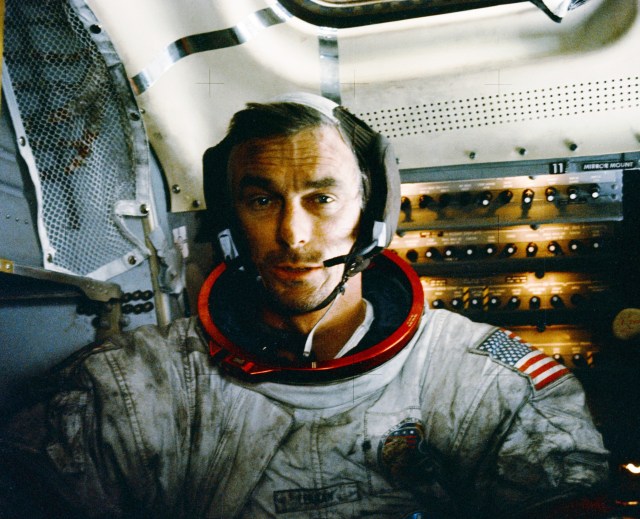
Apollo 17 commander Gene Cernan wears a spacesuit smeared with lunar dirt in 1972. (NASA Photo)

Apollo 17 commander Gene Cernan, the last human to leave footprints on the moon, passed away today – but his family says his dying wish remains to be fulfilled.

“Even at the age of 82, Gene was passionate about sharing his desire to see the continued human exploration of space, and encouraged our nation’s leaders and young people to not let him remain the last man to walk on the moon,” the family said in a statement released by NASA.

The family statement said Cernan had been suffering from ongoing health issues. He died at a Houston hospital, surrounded by relatives.

Get the full story on GeekWire.

Categories
GeekWire

Get a video tour of Apollo moon rocket artifacts

It’s been almost a year since Amazon billionaire Jeff Bezos unveiled pieces of the Saturn V rocket engines that propelled Apollo’s astronauts to the moon – and now you can watch a video guide to the goodies, courtesy of Seattle’s Museum of Flight (and GeekWire).

Next spring, the decades-old artifacts will be among the highlights of a remodeled exhibit focusing on the golden age of spaceflight, which reached its climax with the Apollo moon missions.

But for now, they’re sitting in one of the museum’s secure storage areas, ready to be installed once the exhibit space is ready.

After each Saturn V launch, the rocket’s first stage – including its 19-foot-tall F-1 engines – fell into the Atlantic Ocean while the rest of the spacecraft powered onward. If anyone had been there to see the first stage’s plunge, it wouldn’t have been a pretty sight.

“When hot engines hit cold seawater, often the engines just exploded,” said Geoff Nunn, the Museum of Flight’s adjunct curator for space history (and your guide for the video tour).

Get the full story on GeekWire.

Categories
GeekWire

Apollo 11 spaceship slated to stop by Seattle

Apollo 11 command module
The Apollo 11 command module, shown here at the Smithsonian’s National Air and Space Museum in Washington, D.C., is due to go on a road trip in 2019. (Credit: Smithsonian Institution / NASM)

The Smithsonian’s National Air and Space Museum is laying the groundwork for a 50th-anniversary traveling exhibit featuring Apollo 11 space hardware, including the moon mission’s command module – and Seattle’s Museum of Flight could be a prime stop.

The 2019 road show is the Smithsonian’s preferred solution to an awkward problem: what to do with artifacts from the historic 1969 moon landing while a section of the museum in Washington, D.C., is being renovated.

Get the full story on GeekWire.

Categories
GeekWire

How an astronaut got tangled up in WikiLeaks

Edgar Mitchell and Alan Shepard
NASA astronauts Edgar Mitchell (foreground) and Alan Shepard (background) work on the lunar surface during the Apollo 14 mission in 1971. (Credit: NASA)

WikiLeaks’ purloined emails cover a wide range of issues that were handled by Hillary Clinton’s campaign chairman, John Podesta, but the farthest-out issues may well have to do with E.T., alien energy sources and Apollo 14 astronaut Edgar Mitchell.

While GOP presidential candidate Donald Trump focused his fire on what the WikiLeaks file had to say about Clinton’s Wall Street speeches, UFO fans dwelled on what Mitchell was telling Podesta as he made the transition from the Obama White House to the Clinton campaign in 2015.

Get the full story on GeekWire.

Categories
GeekWire

Are moonshots hazardous to heart health?

Image: Apollo 15
NASA astronaut James Irwin salutes the American flag during the Apollo 15 mission in 1971. Irwin experienced irregular heart rhythms while on the lunar surface, and suffered at least two serious heart attacks after returning to Earth. He died in 1991. (Credit: NASA)

Is deep-space radiation hazardous to your cardiovascular system? A newly published study focusing on the Apollo astronauts suggests that it is, but the sample size is too small to firm up the connection.

The suggestion of a link comes out of a study published today in Scientific Reports, an open-access journal affiliated with Nature.

A research team led by Florida State University’s Michael Delp looked at the medical histories of seven Apollo astronauts who took part in lunar missions and have since died. They compared those histories with similar mortality statistics for astronauts who stayed in low Earth orbit, as well as astronauts who never got into orbit.

The aim was to find out whether the increased exposure to radiation that astronauts get when they travel beyond Earth’s protective magnetic field might have added health impacts.

“We know very little about the effects of deep space radiation on human health, particularly on the cardiovascular system,” Delp explained in a news release. “This gives us the first glimpse into its adverse effects on humans.”

Get the full story on GeekWire.

Categories
GeekWire

Apollo 11 anniversary adds to space appetite

Buzz Aldrin picture on moon
A photograph of Buzz Aldrin on the moon during the Apollo 11 mission, signed by the astronaut himself, is among the hundreds of items offered at a space-themed auction this week. The print is expected to sell for $2,500 to $3,500. (Credit: NASA via Bonhams)

Forty-seven years ago this week, NASA’s Apollo 11 mission put humans on the moon for the first time – and although we don’t currently have the hardware to do that again, the anniversary offers opportunities to own a piece of past achievements in space.

For example, Bonhams auction house in New York is selling hundreds of artifacts from the U.S. and Russian space programs on Wednesday, the anniversary of the Apollo 11 landing. The big-ticket items include an Apollo 11 navigational chart that moonwalker Buzz Aldrin used during the mission, expected to go for as much as $35,000.

There’s also a Gemini training console, which duplicates the panels that were arrayed in NASA’s Gemini capsules and were used to train astronauts in the early 1960s. That’s expected to sell for $60,000 to $90,000. A Russian-style spacesuit that NASA astronaut Don Pettit wore when he rode a Soyuz craft down to Earth in 2003 has a pre-sale estimate of $25,000 to $30,000.

The live auction takes place in New York on Wednesday, but bids can also be placed online.

Get the full story on GeekWire.

Categories
GeekWire

Apollo 10’s moon music mystery revisited

Image: Apollo 10 crew
Apollo 10’s Gene Cernan, Tom Stafford and John Young sit for their official portrait. (Credit: NASA)

Where did the weird, outer-spacey music that Apollo 10’s astronauts heard on the far side of the moon come from? The case was solved decades ago. Or was it???

“NASA’s Unexplained Files,” airing on the Science Channel, leaves the mystery hanging in a show that’s due to air this season. The program also makes it sound as if the case was hushed up until 2008, for fear that its disclosure would unsettle the public.

“Shall we tell them about it?” astronaut John Young is heard saying on an audio recording. Crewmate Gene Cernan replies, “I don’t know. We ought to think about it some.”

The show’s narrator says the mystery continues to this day. “I suspect there’s a very, very clear cause of what they heard on Apollo 10, which maybe we haven’t uncovered yet, ” Apollo 15 astronaut Al Worden says in an interview.

But the way NASA and other Apollo astronauts tell it, the mystery was solved soon after Apollo 10’s crew returned from their 1969 round-the-moon trip.

Get the full story on GeekWire.

Categories
GeekWire

Apollo 14 moonwalker Edgar Mitchell dies at 85

Image: Edgar Mitchell
Apollo 14 astronaut Edgar Mitchell sits for his official portrait in 1970. Mitchell’s crewmates on the mission in 1971 were Alan Shepard and Stuart Roosa. (Credit: NASA)

Apollo 14 astronaut Edgar Mitchell has died at the age of 85 after a months-long illness, according to reports that emerged on the 45th anniversary of his first moonwalk.

Members of Mitchell’s family spread the word on Feb. 5 in obituaries published by news outlets in Palm Beach, Fla., where the former astronaut lived. The Palm Beach Post quoted his daughter, Kimberly Mitchell, as saying he died at a local hospice at about 10 p.m. ET the previous night.

“As a member of the Apollo 14 crew, Edgar is one of only 12 men to walk on the moon, and he helped to change how we view our place in the universe,” NASA Administrator Charles Bolden said in a statement.

Edgar Mitchell took part in the first lunar mission to follow 1970’s nearly disastrous flight of Apollo 13, and became the sixth human to set foot on the moon.

Get the full story on GeekWire.

Categories
GeekWire

Jeff Bezos helps unwrap Apollo engine artifacts

Unwrapping the injector plate
Billionare Jeff Bezos beams as Allison Loveland, a collection specialist at Seattle’s Museum of Flight, unwraps an Apollo F1 rocket engine injection plate. Geoff Nunn, the museum’s adjunct curator for space history, stands by to the left. (GeekWire photo by Alan Boyle)

Even Amazon billionaire Jeff Bezos got misty-eyed at Seattle’s Museum of Flight during Thursday’s unveiling of rocket engine parts from the Apollo moonshots.

“I always do,” he told GeekWire afterward.

It’s not just the fact that Bezos has been a space fan since the age of 5. He funded the Bezos Expeditions voyage that recovered hundreds of parts from the bottom of the Atlantic Ocean, 14,000 feet down – and he was aboard the ship when the mangled 40-year-old parts were brought up from the deep in 2013.

It was Bezos who asked NASA to let some of the artifacts go on exhibit in his hometown museum. This summer, the space agency gave its OK. So Bezos was all smiles when he showed off some of the shrink-wrapped remains from the Saturn V rockets that sent Apollo 12 and Apollo 16 to the moon.

Get the story, and the pictures, on GeekWire.