Categories
GeekWire

‘Alien megastructure’ star’s mystery deepens

Image: KIC 8462852
This illustration shows a star behind a shattered comet. Astronomers say it’s possible that such a phenomenon could explain some aspects of the dimming pattern for a mysterious star called KIC 8462852, but not all aspects. (Credit: NASA / JPL-Caltech)

It’s been almost a year since astronomers first speculated that a strangely dimming star called KIC 8462852 might harbor an alien megastructure, and newly reported observations are making the case even stranger.

KIC 8462852 is also known as Tabby’s Star, because Yale astronomer Tabetha Boyajian first brought the case to light, based on observations that were collected by NASA’s Kepler space telescope and analyzed by the Planet Hunters project. The somewhat sunlike star lies about 1,500 light-years from Earth in the constellation Cygnus.

Kepler’s data revealed an erratic pattern in the intensity of KIC 8462852’s starlight, including periods when the light dimmed as much as 20 percent. Penn State astronomer Jason Wright noted that the dimming could theoretically be caused by shifts in an alien megastructure surrounding the star – something like a giant energy-generating Dyson sphere.

Thus was an Internet phenomenon born.

Get the full story on GeekWire.

Categories
GeekWire

Hubble hails the 4th with galactic fireworks

Image: Kiso 5639
The tadpole galaxy Kiso 5639, also known as LEDA 36252, sparkles in this Hubble image. (Credit: D. Elmegreen et al. / Vassar / NASA / ESA)

Kiso 5639 is just a tadpole when it comes to galaxies, but it’s a real firecracker in a picture unveiled by the Hubble Space Telescope’s science team just in time for the Fourth of July.

Today’s image emphasizes the galaxy’s blazing head and its long, star-studded tail in shades of red, purple and blue that’d be well-suited for a fireworks display. The colors represent the different wavelengths that were picked up by Hubble’s Wide Field Camera 3 and UVIS imager during viewing opportunities in February and July of 2015. (A version of the picture released by the European Space Agency’s Hubble team isn’t quite as colorful.)

KIso 5639, which lies 82 million light-years away in the northern constellation Ursa Major, is an elongated type of galaxy known as a tadpole. The tadpole’s bright head marks a frenzy of starbirth, thought to be sparked by intergalactic gas that’s raining down on one end of the galaxy as it drifts through space. About 10 percent of all galaxies in the early universe are tadpoles, but few such galaxies have been seen nearby.

“I think Kiso 5639 is a beautiful, up-close example of what must have been common long ago,” Vassar College astronomer Debra Elmegreen said in today’s news release. “The current thinking is that galaxies in the early universe grow from accreting gas from the surrounding neighborhood. It’s a stage that galaxies, including our Milky Way, must go through as they are growing up.”

Get the full story on GeekWire.

Categories
GeekWire

Atlas shows where you’ll miss the Milky Way

Image: Night sky atlas
A Google Earth visualization shows the effect of light pollution on night-sky viewing in North America. Darker colors indicate lower light pollution, while warmer colors indicate higher levels. (Credit: Falchi et al., Science Advances; Jakob Grothe / NPS; Matthew Price / CU-Boulder)

Eighty percent of Americans can’t see the Milky Way from where they live, according to a new analysis of light pollution’s effect on the night sky. The global dark sky atlas, produced by an international team of researchers, suggests there’s only one spot in Washington state that’s untouched by the effect of artificial light.

“I hope that this atlas will finally open the eyes of people to light pollution,” Fabio Falchi of Italy’s Light Pollution Science and Technology Institute said in a news release. Falchi is the lead author of the analysis, published today by Science Advances.

The atlas is based on readings from the Suomi NPP satellite, which was launched in 2011 and is managed by NASA and the National Oceanic and Atmospheric Administration. Suomi’s main purpose is to provide weather data, but it’s equipped with imagers that can pick up low-light readings at night.

Get the full story on GeekWire.

Categories
GeekWire

Make the most of a super-sized Mars

This image of Mars was captured on May 12 by the Hubble Space Telescope’s Wide Field Camera 3 and UVIS. Click on the image for an annotated view. (Credit: NASA, / ESA / STScI / AURA / J. Bell / ASU / M. Wolff / STScI)
This image of Mars was captured on May 12 by the Hubble Space Telescope’s Wide Field Camera 3 and UVIS. (Credit: NASA, / ESA / STScI / AURA / J. Bell / ASU / M. Wolff / STScI)

For the next couple of weeks, Mars will look bigger than it’s looked in a decade! And no, this is not a hoax.

Every August, the Internet goes a little crazy over claims that the Red Planet is about to look twice as big as the moon in the night sky. That viral hoax got started in 2003, when some folks scrambled up reports about Mars’ historic close approach during that summer.

Mars isn’t coming quite as close as it did back then, and it certainly won’t be anywhere near as big as the moon. But by May 30, the distance between Earth and Mars will shrink to 46.8 million miles, which is closer than any other approach since 2005.

That closeness is due to the position of Earth and Mars in their elliptical orbits as they line up with each other and with the sun. On May 22, Mars will be directly opposite the sun, looming right in the center of the night sky at astronomical midnight. The occasion is known as opposition.

Because Mars’ full disk is illuminated, as seen from Earth, opposition is an especially good time to check out the Red Planet with your naked eye, with binoculars … or with the Hubble Space Telescope.

Get the full story on GeekWire.

Categories
GeekWire

How to watch the transit of Mercury

Image: Transit of Mercury
A multiple-exposure photo shows Mercury as a speck making its way across the sun. (Credit: NASA)

For the first time in a decade, we Earthlings can watch the planet Mercury’s black speck pass across the sun on Monday – even in Seattle, where seeing the sun can be an iffy proposition. Just make sure you see it safely.

“This is one of the very rare opportunities to see the parts of the solar system in motion,” said Stephanie Anderson, president of the Seattle Astronomical Society. “It doesn’t happen very often, so when you get an opportunity, take it.”

The event begins at 4:12 a.m. PT, when the edge of our solar system’s closest-in planet appears to touch the sun’s disk. That’s before dawn for West Coasters, so Seattleites will have to wait until sunrise at 5:40 a.m., when the transit is in progress.

Anderson and other skywatchers plan to be ready at Snoqualmie Point Park, just off Interstate 90 at Exit 27, for a viewing party sponsored by the astronomical society. Members will set up telescopes with solar-safe filter for a look-see. Some of the telescopes will be equipped with hydrogen-alpha filters that highlight solar prominences.

The forecast for Monday morning calls for partly cloudy skies over Seattle, but if the weather is favorable, the party could go on until Mercury completes its transit at 11:42 a.m. PT. Keep an eye on the Seattle Astronomical Society’s website for updates.

Get the full story on GeekWire.

Categories
GeekWire

Solar eclipse spotted from air and space

Image: Solar eclipse
The moon’s shadow can be seen as a dark spot at upper right in this picture of Earth’s full disk, as captured Tuesday by Japan’s Himawari 8 satellite. (Credit: NICT)

A total solar eclipse is a rare and thrilling sight, but seeing it from a height makes it even more exotic.

Check out the view from Japan’s Himawari 8 weather satellite, stationed more than 22,000 miles above the Pacific Ocean in geostationary orbit. The satellite was perfectly placed to track the moon’s shadow as it sped from west of Indonesia to east of Hawaii on March 8. (Or was that March 9?)

Get the full story on GeekWire.

Categories
GeekWire

Watch an eclipse online – and get set for 2017

Image: 2012 eclipse
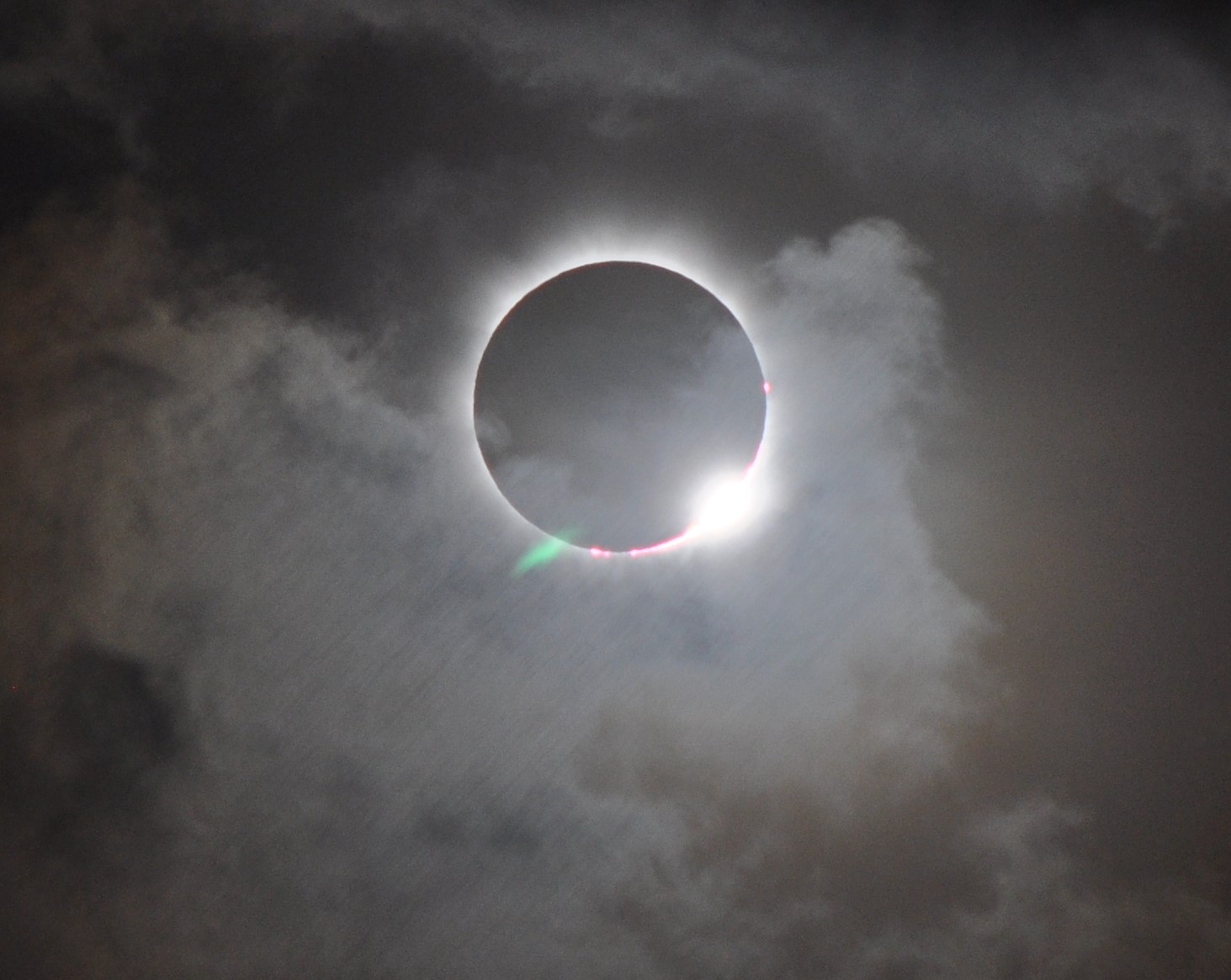
The sun’s corona gleams during a total solar eclipse seen from the northern tip of Australia in November 2012. (Credit: Romeo Durscher via NASA)

This week’s total solar eclipse is a bad-news, good-news, even-better-news situation for skywatchers in the United States.

Solar eclipses are must-see astronomical events that occur when the moon is positioned just right to block the sun’s disk, as seen from Earth. The eclipse that unfolds on Tuesday is the only time during 2016 that anyone can see the sun totally blotted out.

The bad news is that the total eclipse is visible only in the Asia-Pacific region. The moon’s shadow rolls eastward across the Indian and Pacific oceans, beginning at sunrise just west of Indonesia and ending at sunset just east of Hawaii. If you’re in the United States, you’ll totally miss seeing totality in person.

The good news is that in this age of the Internet, you can still get a peek online.

Get the full story on GeekWire.

Categories
GeekWire

NASA finishes huge mirror for Webb Telescope

Image: Webb Telescope mirror
The James Webb Space Telescope’s 18 mirrors are fully installed. (Credit: Chris Gunn / NASA)

NASA has put the 18th and final piece of the puzzle into place for the $8.8 billionJames Webb Space Telescope’s primary mirror – marking a major milestone on the way to the observatory’s launch in 2018.

The 21.3-foot-wide mirror is so big it couldn’t be fabricated in one piece. Instead, it’s made up of 18 hexagonal segments, each spanning a little more than 4 feet and weighing about 88 pounds. The last segment was carefully laid into place using a clawlike robotic arm at NASA’s Goddard Space Flight Center in Maryland on Feb. 3.

“With the mirrors finally complete, we are one step closer to the audacious observations that will unravel the mysteries of the universe,” John Grunsfeld, NASA’s associate administrator for science, said in a news release.

Get the full story on GeekWire.

Categories
GeekWire

The case for Planet Nine (a.k.a. Planet X)

Image: Planet Nine
An artist’s conception shows a “super-Earth” far from the sun. (Credit: R. Hurt / IPAC / Caltech)

For decades, astronomers have gone back and forth over whether a “Planet X” exists on the edge of our solar system – and now two researchers have laid out new evidence supporting the claim, including a rough idea of where it could be found.

One of the most notable things about the claim has to do with one of the people who’s making it: Mike Brown, the Caltech astronomer who says he “killed” Pluto when it was the ninth planet.

“This would be a real ninth planet,” Brown said in a news release. “There have only been two true planets discovered since ancient times, and this would be the third.”

Brown’s “two true planets” refer to Uranus and Neptune, not Pluto. To emphasize the point, Brown and his collaborator at Caltech, Konstantin Batygin, have nicknamed the object “Planet Nine.” (Other nicknames are said to include George, Planet of the Apes, Jehoshaphat and Phattie.)

There’s one big gap in the argument: No such object has yet been detected.

Get the full story on GeekWire.

Categories
GeekWire

Hubble salutes ‘Star Wars’ with lightsaber

An image from the Hubble Space Telescope focuses on jets of hot gas blazing forth from a protostar in the middle of a dusty cloud known as Herbig-Haro 24. (Credit: NASA / ESA)

Leave it to the scientists behind the Hubble Space Telescope to capitalize on the craziness over “Star Wars: The Force Awakens.” Their latest cosmic snapshot shows what looks like a double-bladed lightsaber worthy of Darth Maul.

The lightsaber is actually a pair of jets of superheated gas, emanating a newborn star that’s hidden in a cloak of dust as thick as a Jedi Knight’s cloak. This scene isn’t set in a galaxy far, far away. Instead, it’s 1,350 light-years away in our own galaxy, in a celestial cradle called the Orion B molecular cloud complex.

Get the full story on GeekWire.