Tech billionaires Elon Musk and Mark Zuckerberg are feuding over AI. (SpaceX / Facebook Photos)
Techies, grab some popcorn: Facebook CEO Mark Zuckerberg and SpaceX/Tesla CEO Elon Musk are throwing shade at each other over what Musk considers the scariest issue facing humanity: the rapid rise of artificial intelligence.
It all started last week at the National Governors Association’s summer meeting in Rhode Island, where Musk complained that policymakers and tech leaders weren’t sufficiently worried about AI.
“I keep sounding the alarm bell, but until people see robots going down the street, killing people, they don’t know how to react because it seems so ethereal,” he said.
Over the weekend, Zuckerberg basically said Musk was being reckless.
A humanoid Furo robot guides Sea-Tac travelers through the intricacies of the security screening process in multiple languages. (Port of Seattle via YouTube)
I, for one, welcome our cute new robot overlords at Seattle-Tacoma International Airport – as long as they don’t boss me around.
Two types of humanoid robots are getting tryouts this week at Sea-Tac: One is SoftBank’s Pepper robot, which is programmed to help travelers find food and drink establishments at the airport. The other is a Furo robot, which provides tips to get through the security lines faster.
Robot 2, built by Electroimpact, places fasteners into precisely drilled holes in the fuselage for a 777 jet at Boeing’s Everett plant. In this case, a human worker inside the fuselage hooks up the other part of the fastener. (GeekWire Photo / Alan Boyle)
EVERETT, Wash. – Some manufacturing workers may worry that robots will be stealing their jobs, but not Boeing’s Jordan Northrup.
He’s glad to work with Robot 1 and Robot 2, the industrial-strength machines that drill holes and hook up fasteners in the metal panels of a Boeing 777 jet’s fuselage.
“Instead of blowing my shoulder out, shooting 300 fasteners a day or countersinking 300 holes a day, I get to learn a new skill. … I get to run a robot,” said Northrup, structures team lead for midbody at the Fuselage Automated Upright Build facility in Boeing’s Everett plant.
The facility, known as the FAUB, is just one of the places where Boeing is upping the ante for automation in the airplane industry. Boeing showed off the FAUB and other robotic hot spots at its Everett plant as a preview for this month’s Paris Air Show.
As Boeing gears up to start building 777X airplanes, the company is building on its experience with robot-assisted assembly for the widebody 787 Dreamliner and single-aisle 737 MAX.
A two-diagram sequence shows how an Amazon cleanup robot could open its robotic arms and pull a box into its storage pod. (Amazon Illustration via USPTO)
How does Amazon plan to keep automated warehouses free of debris? With automated cleanup robots, of course.
At least that’s a scenario laid out in a patent granted to the Seattle-based online retailer today. There’s no guarantee the cleanup robots will become a reality. But it makes a weird sort of sense to have robots pick up after messy robots.
A researcher gives the next-generation Atlas robot a good, hard push. (Credit: Boston Dynamics)
Newly published research runs counter to the hope that the rise of automation should create as many jobs for human workers as it destroys. Computer modeling suggests a downward trend, and real-world statistics from the 1990-2007 time period confirm the effect, MIT’s Daron Acemoglu and Boston University’s Pascual Restrepo say. A report on the research in The New York Times says blue-collar men without college degrees are hit especially hard, which helps explain the angst behind last November’s Rust Belt support for Donald Trump’s presidential run.
President Donald Trump shakes hands with Treasury Secretary Steven Mnuchin during his White House swearing-in ceremony in February. (White House via YouTube)
Mnuchin made his comments during a “News Shapers” sitdown with Axios’ Mike Allen. His observations are pointed enough, and brief enough, that they’re worth an extended quote:
Mnuchin: “In terms of artificial intelligence taking over American jobs, I think we’re like so far away from that, not even on my radar screen.”
Allen: “How far away?”
Mnuchin: “Far enough that it’s …”
Allen: “Seven more years?”
Mnuchin: “Seven more years? I think it’s 50 or 100 more years.”
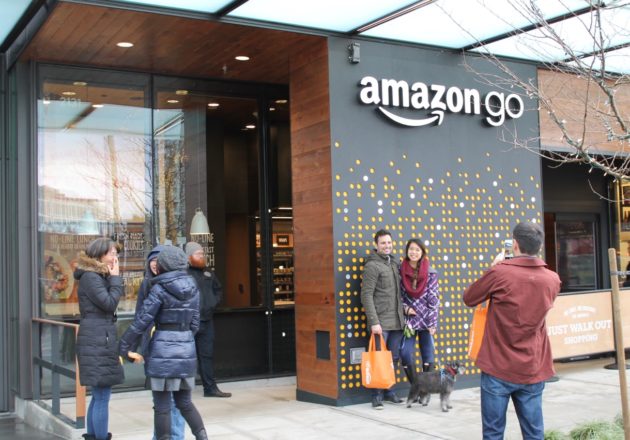
Outside Amazon’s first “Amazon Go” retail store in the Denny Triangle neighborhood of Seattle. (GeekWire Photo / Nat Levy)
Amazon Go, the online retailer’s “Just Walk Out” convenience store in downtown Seattle, is still in private beta mode three and a half months after its unveiling – and some reports suggest the concept is facing tougher sledding than anticipated.
The checkout-free store is just one of several brick-and-mortar experiments under way at Amazon. A different drive-up concept, AmazonFresh Pickup, seems nearly ready for its debut in Seattle’s Ballard neighborhood and SoDo district.
Unlike AmazonFresh Pickup, Amazon Go envisions a system where customers can walk in off the street, pick up anything they want, and “just walk out.” Their purchases would be tracked using high-tech object recognition and inventory management systems, matched up with the customers’ mobile app and automatically charged to their Amazon account.
Since December, Amazon has been testing the system at an 1,800-square-foot store on Seventh Avenue. Only employees are allowed to enter the store, but when the store was unveiled, Amazon promised that it’d be open to the public in early 2017.
Amazon has issued no updates since December, and this week, Bloomberg News reported that Amazon’s “Just Walk Out” just isn’t ready for prime time yet.
Microsoft CEO Satya Nadella talks about the “upscaling” effect of AI at the DLD tech conference in Munich. (DLD via YouTube)
Experts on employment trends have long raised concerns about how job markets are being disrupted so quickly by artificial intelligence and automation are disrupting the job market, and now it sounds as if Microsoft CEO Satya Nadella shares those concerns.
President Barack Obama sits for a 3-D portrait being produced by the Smithsonian Institution. (White House Photo / Pete Souza)
Dealing with the coming revolution in artificial intelligence is likely to require modernizing America’s social safety net, White House experts said today, in what may well be the Obama administration’s last official word on the subject.
Today’s report focuses on the potential economic impacts of AI, and draws upon analyses from the Council of Economic Advisers, the Domestic Policy Council, the National Economic Council, the Office of Management and Budget, and the Office of Science and Technology Policy.
The opportunities offered by AI are likely to be a key driver for future productivity and wage growth, said Jason Furman, chairman of the Council of Economic Advisers.
“As we look at AI, our biggest economic concern is that we won’t have enough of it,” he told reporters during a teleconference.
Universe makes it possible for an AI agent to play Flash games like Dusk Drive. (OpenAI Graphic)
If you were weirded out by HBO’s “Westworld,” hold onto your cowboy hats: OpenAI, the artificial intelligence lab backed by Elon Musk and other tech gurus, has released a software platform called Universe that lets AI agents use computers the way humans do.
Universe’s first mission? Master thousands of video games and real-world browser tasks.
The idea is to train AI agents to hone their general-intelligence skills by exposing them to a huge number of computer-based environments, over and over again.
“Our goal is to develop a single AI agent that can flexibly apply its past experience on Universe environments to quickly master unfamiliar, difficult environments, which would be a major step towards general intelligence,” OpenAI says in a blog post announcing Universe’s release.