An artist’s impression shows the Jupiter-sized exoplanet Kepler-1625b transiting its parent star with the Neptune-sized candidate exomoon in tow. (Dan Durda Illustration)
With a lot of help from the Hubble Space Telescope, astronomers now feel confident enough to publish their evidence for the first moon detected in orbit around a planet beyond our solar system.
But they’re still not completely confident.
“At this point, it’s up to us to report what we’re seeing, hand it over to the community and let the community probe it,” said Columbia University astronomer Alex Teachey, one of the authors of a study about the find published in the open-access journal Science Advances. “If they see what we see, I expect some people will be convinced and other people will be skeptical. And that’s all part of the process.”
Observations made by the Hubble Space Telescope and ground-based observatories indicate that the cigar-shaped interstellar object known as ‘Oumuamua got an unexpected boost in speed and a shift in its trajectory as it passed through the inner solar system last year. Scientists surmise that the source of the boost was an outflow of gas and dust from ‘Oumuamua, which suggests that the object is more like an active comet than a passive asteroid.
This multiple-exposure photo shows 22 minutes’ worth of Phobos’ orbit around Mars. (NASA / ESA / STScI Photo / Z. Levay)
Leave it to tiny Phobos to horn in on Mars’ glory in an image captured by the Hubble Space Telescope.
The view of the Red Planet and the larger of its two moons, released today, is actually a testament to the orbiting observatory’s sharper vision.
Phobos is an irregular hunk of rock and ice, measuring no more than 16.5 miles in diameter. It’s small enough to sit comfortably inside the Beltway in Washington, D.C. (although residents of the nation’s capital would be none too comfortable).
Despite its status as one of the solar system’s smallest moons, Hubble’s Wide Field Camera 3 could pick out Phobos easily against the black background of space in a series of images acquired over the course of 22 minutes on May 12, 2016.
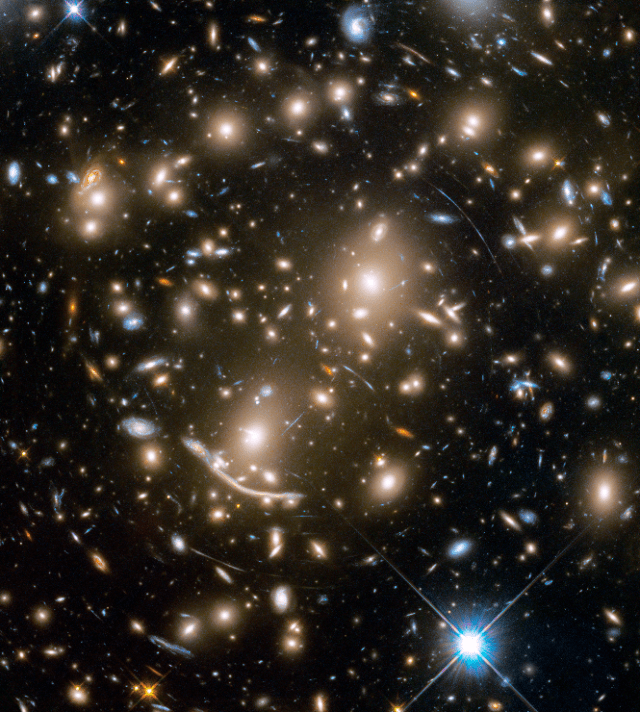
This composite view from Hubble’s Wide Field Camera 3 and the Advanced Camera for Surveys shows hundreds of galaxies in the cluster, which is 6 billion light-years away in the constellation Cetus.
The view is remarkable not only because the galaxies are so dense, but also because their mass serves as a gravitational lens, focusing the light from even more distant galaxies into luminous arcs of blue light.
This Hubble image, marking the 27th anniversary of the space telescope’s launch, features the edge-on spiral galaxy NGC 4302 and the tilted galaxy NGC 4298. (STScI / NASA / ESA Photo / M. Mutchler)
It’s traditional for the team behind the Hubble Space Telescope to release a jaw-dropping picture to celebrate the anniversary of the observatory’s launch in April 1990, and this year’s image might well rate a double jaw drop.
The science team’s greeting card for Hubble’s 27th birthday features side-by-side views of two spiral galaxies much like our own Milky Way galaxy, seen from two angles.
The edge-on galaxy at left, NGC 4302, is about 60 percent of the Milky Way’s size and contains about 10 percent of our home galaxy’s mass, the Hubble team says in today’s image advisory.
The galaxy at right, NGC 4298, is tilted about 70 degrees as seen from Earth, and measures about a third as wide as the Milky Way. It weighs in at 17 billion solar masses, which is less than 2 percent of the Milky Way’s 1 trillion solar masses.
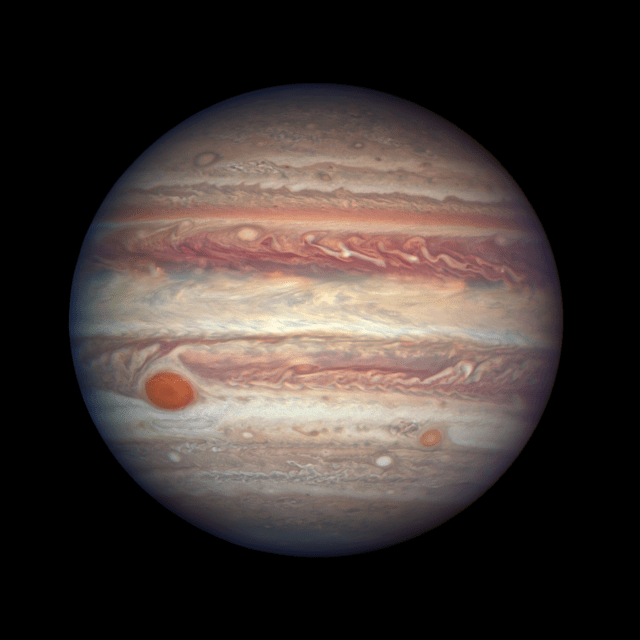
As Jupiter made its nearest approach to Earth in a year, the Hubble Space Telescope viewed the solar system’s largest planet in all of its up-close glory. This picture was taken on April 3 from a distance of 415 million miles. (STScI / ESA / NASA / GSFC Photo / A. Simon)
Astronomer Amy Simon of NASA’s Goddard Space Flight Center arranged to have Hubble trained on the hemisphere that includes Jupiter’s Great Red Spot and another whirling storm to the south, dubbed “Red Spot Jr.” You can also see white spots speckling the planet’s cloud tops.
The interplay of orbits for Jupiter and Earth brought our two planets just 415 million miles apart, which means Hubble’s Wide Field Camera 3 could pick up features as small as 80 miles across.
A deep-field image from the Great Observatories Origins Deep Survey, or GOODS, shows a scattering of distant galaxies. (Credit: NASA / ESA / GOODS Team / M. Giavialisco / UMass-Amherst)
It looks as if astronomers have been way, way off on their galaxy counts: A new analysis of data from the Hubble Space Telescope suggests that the observable universe holds at least 2 trillion galaxies, which is 10 times the previous estimate.
How could scientists be so far off? The key is that the early universe appears to have had lots of relatively small, faint galaxies. As they merged to form larger galaxies, the population density dwindled.
It took Hubble’s deep-field surveys to register the smaller galaxies that existed far back in time, and it took painstaking analysis to count up a sampling of those galaxies.
This composite image shows suspected plumes of water vapor erupting at the 7 o’clock position off the limb of Jupiter’s moon Europa. The Hubble data were taken on Jan. 26, 2014. The image of Europa, superimposed on the Hubble data, is assembled from data from the Galileo and Voyager missions. (Credit: W. Sparks / STScI / NASA / ESA / USGS Astrogeology Science Center)
It’s not aliens. And it’s not exactly surprising, despite NASA’s advance billing. But new evidence of water plumes emanating from Europa, an ice-covered moon of Jupiter, have added to the excitement over a proposed mission that could sample the water for signs of life.
The evidence comes in the form of splotchy ultraviolet images captured by the Hubble Space Telescope, operating at the limits of its sensitivity. Scientists say the images appear to show intermittent emissions of water vapor near Europa’s south pole.
“If plumes exist, this is an exciting finding,” William Sparks, an astronomer at the Space Telescope Science Institute in Baltimore, told reporters today during a teleconference.
An image from NASA’s Galileo orbiter shows Europa’s icy surface, crisscrossed by reddish-brown streaks of radiation-darkened salt. (Credit: NASA / JPL / Ted Stryk)
NASA is gearing up to unveil “surprising evidence” of activity that may be related to the presence of a watery ocean beneath the icy surface of Europa, one of Jupiter’s moons.
In a media advisory sent out today, the space agency said the evidence comes from the Hubble Space Telescope, in the form of images taken during a “unique Europa observing campaign.”
The tadpole galaxy Kiso 5639, also known as LEDA 36252, sparkles in this Hubble image. (Credit: D. Elmegreen et al. / Vassar / NASA / ESA)
Kiso 5639 is just a tadpole when it comes to galaxies, but it’s a real firecracker in a picture unveiled by the Hubble Space Telescope’s science team just in time for the Fourth of July.
Today’s image emphasizes the galaxy’s blazing head and its long, star-studded tail in shades of red, purple and blue that’d be well-suited for a fireworks display. The colors represent the different wavelengths that were picked up by Hubble’s Wide Field Camera 3 and UVIS imager during viewing opportunities in February and July of 2015. (A version of the picture released by the European Space Agency’s Hubble team isn’t quite as colorful.)
KIso 5639, which lies 82 million light-years away in the northern constellation Ursa Major, is an elongated type of galaxy known as a tadpole. The tadpole’s bright head marks a frenzy of starbirth, thought to be sparked by intergalactic gas that’s raining down on one end of the galaxy as it drifts through space. About 10 percent of all galaxies in the early universe are tadpoles, but few such galaxies have been seen nearby.
“I think Kiso 5639 is a beautiful, up-close example of what must have been common long ago,” Vassar College astronomer Debra Elmegreen said in today’s news release. “The current thinking is that galaxies in the early universe grow from accreting gas from the surrounding neighborhood. It’s a stage that galaxies, including our Milky Way, must go through as they are growing up.”