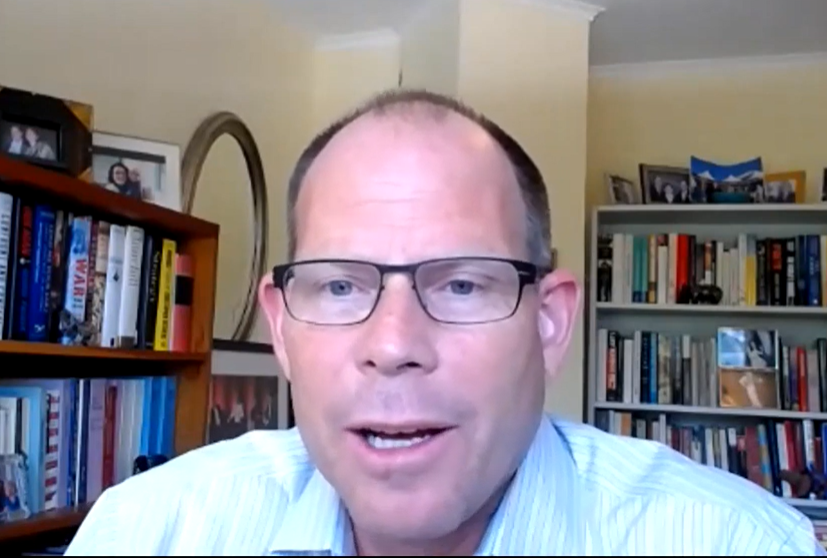
Thomas Lynch, the president and director of the Fred Hutchinson Cancer Research Center, discusses the impact of the coronavirus outbreak during a GeekWire forum. (GeekWire Photo via Zoom / YouTube)
Seattle’s Fred Hutchinson Cancer Research Center already has dozens of scientists working on infectious diseases, including COVID-19 — but the center’s president and director, Thomas Lynch, says the research community is going to have to kick things up a notch to head off future pandemics.
His prescription? Create institutions like Fred Hutch that are devoted to virology.
“I feel strongly about this,” Lynch, a veteran medical doctor and researcher who took on the Hutch’s top post less than four months ago, said today during an online conversation presented via Zoom for GeekWire members. “I think virology needs a ‘cancer centers’ program, OK?”
President Donald Trump said today that he’s taking hydroxychloroquine, an antimalarial drug that’s being tested as a COVID-19 treatment at the University of Washington and dozens of other sites across the country.
The search for COVID-19 therapies has turned to an antibody that was first identified back in 2003, in a blood sample from a patient who recovered from a similar coronavirus-based disease.
Massachusetts-based Moderna’s share price — and the stock market as a whole — were lifted today by the company’s encouraging report about a coronavirus vaccine trial that got its start at Seattle’s Kaiser Permanente Washington Health Research Institute.
Hydrochloroquine and azithromycin will be the focus of a clinical trial enrolling 2,000 participants. (UW Medicine Photo)
One of the treatments that’s been talked up by President Donald Trump for COVID-19 — a combination of the antimalarial drug hydroxychloroquine and azithromycin, an antibiotic — is the subject of a nationwide study with UW Medicine playing a role.
“We know from a number of different other kinds of infections that if antiviral treatment is going to be effective, it tends to be most effective if it’s given very early on,” Ann Collier, a professor at the University of Washington’s School of Medicine, said in a video about the study.
A nurse takes samples during a drive-through coronavirus test. (UW Medicine Photo)
Washington state public health officials have broadened their guidance to say that anyone who has COVID-19 symptoms, or has been in close contact with a person who has the disease, should get tested as soon as possible.
Moderna is pioneering a new class of medicines, including vaccines, that make use of messenger RNA. (Moderna via YouTube)
The coronavirus vaccine trial that started out in Seattle is progressing well enough to get onto Food and Drug Administration’s fast track for development, with planning well underway for the next two phases of testing.
Seattle’s Kaiser Permanente Washington Health Research Institute kicked off the Phase I clinical trial, which focuses on ensuring that the vaccine is safe for humans.
The first participants got their shots in mid-March, and last month, the trial was expanded to Emory University in Atlanta and the National Institute of Allergy and Infectious Diseases’ Vaccine Research Clinic in Bethesda, Md. NIAID is funding the trial, and the vaccine was developed by Moderna Therapeutics.
Seattle Cancer Care Alliance and the Fred Hutchinson Cancer Research Center are headquartered in Seattle’s South Lake Union neighborhood. (Fred Hutch Photo)
Multiple COVID-19 vaccines are in development. (Johnson & Johnson via YouTube)
Unprecedented collaborations involving the biotech industry and government agencies are urgently needed to develop and produce the billions of doses of vaccine that will be needed to stop the coronavirus pandemic, four public-health pioneers declare.
The experts behind the call to action, published today by the journal Science, include Larry Corey, a past president and director of Seattle’s Fred Hutchinson Cancer Research Center and a professor in its vaccine and infectious disease division.
Corey’s co-authors are Anthony Fauci, director of the National Institute of Allergy and Infectious Diseases; John Mascola, director of NIAID’s Vaccine Research Center; and Francis Collins, director of the National Institutes of Health.
“We’re experiencing a series of unprecedented events with a disease that has spread globally and infected more people in a shorter time than any other infection in modern times,” Corey said in a news release. “In order to overcome the challenges in front of us, we each need to bring nothing short of our absolute best.”
Gates Foundation CEO Mark Suzman discusses the coronavirus pandemic from his home study during a virtual event for GeekWire members. (GeekWire via Zoom)
The CEO of the Bill & Melinda Gates Foundation is disappointed that the United States isn’t on the same page with other nations when it comes to fighting the coronavirus pandemic, but he says it’s still possible to present a united front in dealing with what he calls “the ultimate global crisis.”
Mark Suzman, who stepped into the foundation’s top executive role in February just as the pandemic was ramping up, points to a high-profile conference held this week as an example. Leaders and luminaries from Europe, Canada, Japan, Saudi Arabia and other parts of the world pledged $8 billion to help the World Health Organization fight COVID-19.
“Unfortunately, the United States did not participate in that event,” Suzman said today during a live virtual event for GeekWire members. “But the United States is putting a lot of resources, obviously, into the COVID vaccine. Our hope is, at a minimum, can we make these investments complementary to each other, so you don’t have any duplicative races that are wasting resources.”