An extreme ultraviolet image of the sun, captured by NASA’s Solar Dynamics Observatory, shows an X9.3 flare erupting at lower right. (NASA / Goddard / SDO Photo)
The sun has been acting up this week, and normally that would produce auroral displays bright enough to see in Washington state.
But this isn’t a normal week: Western skies have been obscured by wildfire smoke, and although westerly winds are expected to push out a lot of that smoke overnight in the Seattle area, it’s debatable whether northern lights will be visible.
This image shows field lines of a solar coronal magnetic model based on measurements from the National Solar Observatory Integrated Synoptic Program, one solar rotation before the Aug. 21 total solar eclipse. (NSO / NSF Graphic)
Skywatchers will see a rare celestial sight during the Aug. 21 total solar eclipse: the sun’s shimmering outer atmosphere, known as the corona. What will it look like? Astronomers worked their magic to give us a glimpse.
The corona is more than just a fuzzy halo: The superheated gas that makes up the sun’s outermost layer tends to follow the patterns of magnetic force that arc around the sun.
To come up with their preview of the corona, researchers at the National Solar Observatory in Arizona modeled the sun’s magnetic field as of July 25, which was 27 days in advance of the solar eclipse. That’s important, because it takes the sun 27.2753 days to make a complete rotation.
A multiple-exposure photo shows Mercury as a speck making its way across the sun. (Credit: NASA)
For the first time in a decade, we Earthlings can watch the planet Mercury’s black speck pass across the sun on Monday – even in Seattle, where seeing the sun can be an iffy proposition. Just make sure you see it safely.
“This is one of the very rare opportunities to see the parts of the solar system in motion,” said Stephanie Anderson, president of the Seattle Astronomical Society. “It doesn’t happen very often, so when you get an opportunity, take it.”
The event begins at 4:12 a.m. PT, when the edge of our solar system’s closest-in planet appears to touch the sun’s disk. That’s before dawn for West Coasters, so Seattleites will have to wait until sunrise at 5:40 a.m., when the transit is in progress.
Anderson and other skywatchers plan to be ready at Snoqualmie Point Park, just off Interstate 90 at Exit 27, for a viewing party sponsored by the astronomical society. Members will set up telescopes with solar-safe filter for a look-see. Some of the telescopes will be equipped with hydrogen-alpha filters that highlight solar prominences.
The forecast for Monday morning calls for partly cloudy skies over Seattle, but if the weather is favorable, the party could go on until Mercury completes its transit at 11:42 a.m. PT. Keep an eye on the Seattle Astronomical Society’s website for updates.
The moon’s shadow can be seen as a dark spot at upper right in this picture of Earth’s full disk, as captured Tuesday by Japan’s Himawari 8 satellite. (Credit: NICT)
A total solar eclipse is a rare and thrilling sight, but seeing it from a height makes it even more exotic.
Check out the view from Japan’s Himawari 8 weather satellite, stationed more than 22,000 miles above the Pacific Ocean in geostationary orbit. The satellite was perfectly placed to track the moon’s shadow as it sped from west of Indonesia to east of Hawaii on March 8. (Or was that March 9?)
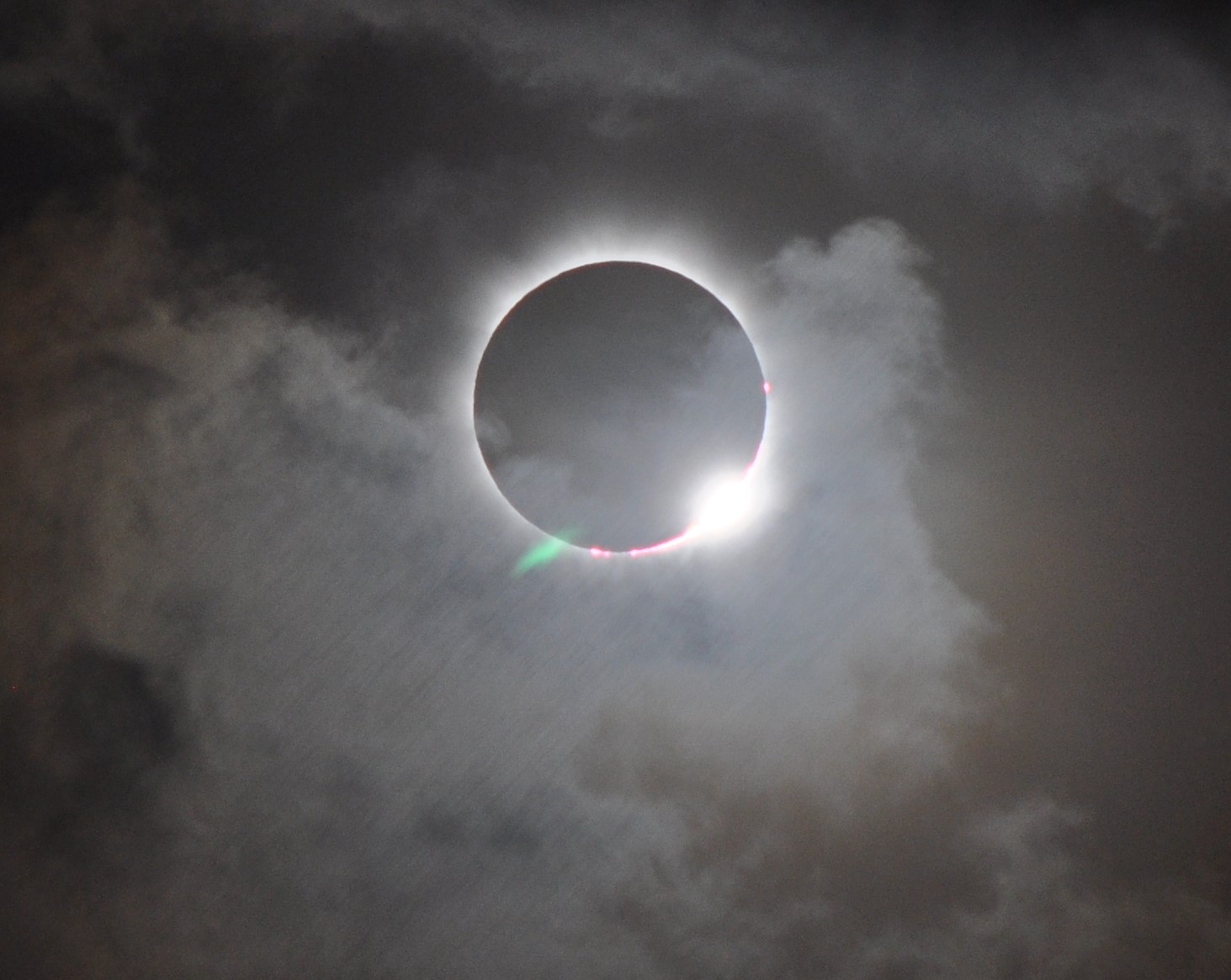
The sun’s corona gleams during a total solar eclipse seen from the northern tip of Australia in November 2012. (Credit: Romeo Durscher via NASA)
This week’s total solar eclipse is a bad-news, good-news, even-better-news situation for skywatchers in the United States.
Solar eclipses are must-see astronomical events that occur when the moon is positioned just right to block the sun’s disk, as seen from Earth. The eclipse that unfolds on Tuesday is the only time during 2016 that anyone can see the sun totally blotted out.
The bad news is that the total eclipse is visible only in the Asia-Pacific region. The moon’s shadow rolls eastward across the Indian and Pacific oceans, beginning at sunrise just west of Indonesia and ending at sunset just east of Hawaii. If you’re in the United States, you’ll totally miss seeing totality in person.
The good news is that in this age of the Internet, you can still get a peek online.