Categories
GeekWire

Next-gen weather satellite goes into orbit

JPSS-1 launch
A United Launch Alliance Delta 2 rocket sends the JPSS-1 satellite into space from Vandenberg Air Force Base in California. (ULA Photo)

The first in a series of four next-generation weather satellites, known as the Joint Polar Satellite System-1 or JPSS-1, is in orbit after a twice-delayed liftoff from Vandenberg Air Force Base in California.

Four small research satellites and an Australian nanosatellite piggybacked on today’s United Launch Alliance Delta 2 launch and were successfully deployed as well.

Two launch attempts had to be scrubbed earlier in the week due to a variety of snags, including boats that strayed into the restricted zone for the launch, a technical glitch and weather concerns. But today’s countdown went smoothly, leading to liftoff at 1:47 a.m. PT today.
Get the full story on GeekWire.

Categories
GeekWire

Wildfires and ash wow the weather gurus

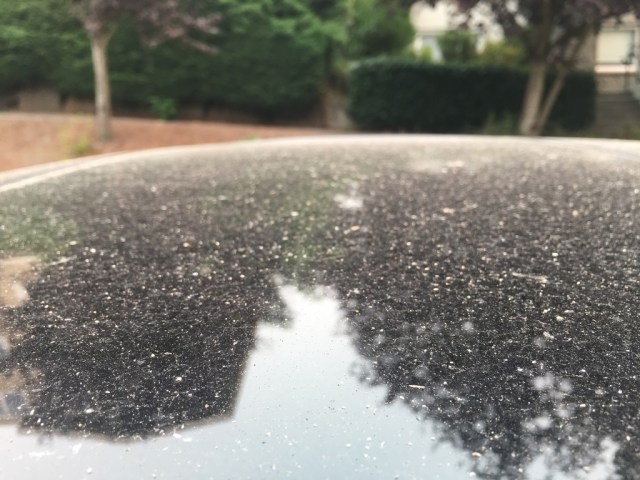
Ash on roof
Car roofs are being peppered with ash from Washington’s wildfires. (GeekWire Photo / Todd Bishop)

Texas has its floods, Florida has a potentially catastrophic hurricane coming its way, but the Pacific Northwest has its own sign of the apocalypse: wildfires that are turning the sun into a smoke-obscured blood orange and peppering the streets with ash.

“I have been forecasting around here for a long time and have never seen a situation like this,” Cliff Mass, a University of Washington professor of atmospheric sciences, wrote on his blog this morning.

KCPQ meteorologist Rebecca Stevenson suggested that Seattleites should sweep up the ash and put it in baggies “to save and mark the incredibly hot/dry summer of 2017.”

Weather conditions have been conducive to wildfires all summer long, even in the stereotypically rainy Northwest. Western Washington suffered through smoky skies last month, due primarily to fires in British Columbia, but this week is shaping up as even worse.

Get the full story on GeekWire.

Categories
GeekWire

It’s alive! Lightning zaps the Space Needle

Lightning at Space Needle
Lightning lights up Seattle’s Space Needle. (Space Needle via Twitter)

Heavy snow and lightning at the end of February? In Seattle? Something’s happening here, and weather guru Cliff Mass makes it clear.

“As predicted, a strong convergence zone has formed over Puget Sound, producing heavy precipitation and lightning,” the University of Washington professor wrote in a blog entry about Seattle’s surprise snowstorm.

“The heavy precipitation is driving the freezing/snow levels towards the surface, and there is mixed rain/snow here at the UW,” Mass said. “Did you notice how the snow was associated with the heaviest precipitation?”

Heavy, wet, fluffy snow happens when part of the atmosphere is near or just above freezing, causing snowflakes to melt partially and stick together as they fall. The result? Snowfall in Seattle that looks like a scene on a Christmas card.

Get the full story on GeekWire.

Categories
GeekWire

Weather satellite sends planetary postcard

GOES-16 view of Earth
This composite color full-disk image from GOES-16, focusing on North and South America, was acquired at 10:07 a.m. PT on Jan. 15. (NOAA / NASA Photo)

Two months after its launch, the National Oceanic and Atmospheric Administration’s GOES-16 weather satellite is sending back its first images – and they’re spectacular.

GOES-16 is watching the Western Hemisphere from a geosynchronous orbit 22,300 miles above Earth, with a camera known as the Advanced Baseline Imager that provides four times the resolution of previously launched GOES satellites.

In a news release accompanying the first pictures, NOAA says the higher resolution should allow forecasters to pinpoint the location of severe weather with greater accuracy.

The imager scans Earth’s disk five times faster than the earlier generation of GOES cameras. That allows it to produce pictures of the continental U.S. every five minutes, and full-disk views every 15 minutes.

Get the full story on GeekWire.

Categories
GeekWire

Hurricane-watching microsatellites go in orbit

Rocket deployment
A photo taken from a NASA F-18 chase plane shows Orbital ATK’s L-1011 Stargazer jet deploying a Pegasus XL rocket to launch eight CYGNSS satellites. (NASA Photo / Lori Losey)

After several days of delays, a squadron of eight microsatellites was sent into orbit by a rocket launched from a high-flying airplane. Their mission? To study the winds that power the heart of a hurricane.

The launch was originally scheduled for Dec. 12, and then for Dec. 14. Each time, technical glitches forced a postponement. But today, it was all systems go as Orbital ATK’s Lockheed L-1011 Stargazer jet took off from Cape Canaveral Air Force Station in Fliroda.

An hour after takeoff, the airplane released a three-stage Pegasus rocket from an altitude of 39,000 feet. The Pegasus fired up its rocket engines and deployed the eight suitcase-sized satellites into low Earth orbit.

“The deployments looked great,” said Southwest Research Institute’s John Scherrer, a project manager for the Cyclone Global Navigation Satellite System, or CYGNSS. “Right on time.”

Get the full story on GeekWire.

Categories
GeekWire

Space station crew arrives; satellite lifts off

GOES-R launch
An Atlas 5 rocket lifts off from Cape Canaveral Air Force Station in Florida, sending the GOES-R weather satellite into space. (United Launch Alliance Photo)

NASA and its space partners juggled an arrival and a departure today: First, three new crew members docked with the International Space Station to begin a months-long stay in orbit. Then the next-generation GOES-R went into space for a 20-year weather-monitoring mission.

One operation went by the book. The other almost didn’t happen.

The crew’s arrival aboard a Russian Soyuz craft brings the space station’s staffing back to its full strength of six spacefliers. The new arrivals include NASA astronaut Peggy Whitson, who already has served two tours of duty aboard the station and is due to break the U.S. record for cumulative time in space during her current flight.

At the age of 56, Whitson is the oldest woman to fly in space.

Get the full story on GeekWire.

Categories
GeekWire

How to fix future superstorm forecasts

Weather tracks
This chart shows three of the forecast tracks that the National Weather Service’s meteorologists were looking at on Saturday morning (in black, blue and purple), as well as the actual track that the storm took (in red). Credit: NWS / Google Maps

Meteorologists have gotten the message: They messed up.

Before Saturday’s storm, forecasters warned that Puget Sound could be lashed by winds reaching tropical storm levels. After the storm – which wasn’t anywhere near that windy – the mea culpas were falling like a soft Seattle rain.

“Yes, our forecast did not turn out as predicted,” the National Weather Service’s Seattle office said in a Facebook post. “We are not pleased about it either.”

Get the full story on GeekWire.

Categories
GeekWire

Northwest storm is strong but no wind-pocalypse

Weather graphic
A color-coded graphic shows the low-pressure center of the storm off the coast of Washington and Oregon at 1 p.m. PT. (Credit: National Weather Service)

The rains and the winds that were spawned by Typhoon Songda swept through Western Washington tonight, leaving downed trees and power outages in its wake. But Seattle was spared the brunt of the storm.

“We’re glad the storm passed without significant damage, given the potential outcomes,” the National Weather Service’s Seattle office said in a tweet.

Days earlier, computer models suggested there was a chance that Seattleites could get hit by winds gusting beyond 60 mph. But the storm’s track passed farther west and north than predicted, and winds in the Seattle area weren’t that strong.

That left some wondering what all the fuss was all about.

Get the full story on GeekWire.

Categories
GeekWire

Storm’s one-two punch starts hitting Northwest

Bothell roadblock
Bothell police reported that State Route 527 was closed in both directions due to a tree that fell into power lines. (Credit: Bothell Police via Twitter)

The first of two big storm fronts swept through the Pacific Northwest today, leaving tens of thousands without power in Western Washington and stirring up a tornado on the Oregon Coast. And that’s just the start.

The second storm, representing the remnants of Pacific Typhoon Songda, is expected to hit with greater force on Oct. 15, said Art Gaebel, a meteorologist at the National Weather Service in Seattle.

“It’s going to get pretty blustery,” he told GeekWire.

Get the full story on GeekWire.

Categories
GeekWire

How to cope with a Northwest superstorm

Power substation maintenance
Seattle City Light employees work at a substation. (Credit: Seattle.gov)

There’s a storm coming. A big one. So big that Seattle weather guru Cliff Mass says it could match the “most powerful storm in NW history” – the Big Blow, which hit exactly 54 years ago today.

“My head is spinning with the action that may be occurring around here,” the University of Washington professor of atmospheric sciences wrote in a blog post on Oct. 11.

This morning, he followed up by calling attention to an “amazing plume of moisture” spreading across the Pacific and leading to Typhoon Songda. “Never saw anything like this,” he said.

The action is expected to start on Oct. 13, when a strong Pacific cyclone approaches the coast. That could whip up winds that gust up to 57 mph along the coast and over portions of Seattle.

“Expect a lot of power failures,” Mass said. “Be prepared.”

Get the full story on GeekWire.