Categories
GeekWire

RBC Signals turns to India for space networking

Indian antenna
Vikram Sarabhai Space Center’s 18-meter antenna, located near Bangalore, India, can be used for deep-space communications. (VSSC Photo)

Seattle-based RBC Signals has forged an agreement with Antrix, the commercial arm of the Indian Space Research Organization, to widen its spectrum of communication services for spacecraft operators.

The partnership adds C-band, Ku-band and Ka-band communication capabilities to RBC Signals’ existing resources in the VHF, UHF, S, C and X radio bands. It also extends the company’s potential reach beyond Earth orbit to the moon and deep space.

The pact marks another first for the three-year-old startup. “It represents our first partnership with a national program,” RBC Signals co-founder and CEO Christopher Richins told GeekWire.

Get the full story on GeekWire.

Categories
GeekWire

Kymeta unveils portable satellite terminal

KyWay Go terminal
The KyWay Go satellite terminal system is designed to be set up within four minutes. (Kymeta Photo)

Redmond, Wash.-based Kymeta Corp., the communications company backed by Microsoft co-founder Bill Gates, says it’s starting to roll out a ruggedized portable terminal that’s designed to be set up for satellite links within four minutes.

“Commercial and government customers have shown great interest in a portable KyWay satellite terminal for use in defense, oil and gas, and first responder applications,” Nathan Kundtz, Kymeta’s founder, president and CEO, said in a news release issued March 13 at the Satellite 2018 conference in Washington, D.C.

Kundtz said Kymeta has deployed a larger version of its KyWay flat-panel, electronically steered terminal system to more than 20 customers in 10 countries. The portable rig, called KyWay Go, is expected to widen the system’s appeal for mobile applications.

Get the full story on GeekWire.

Categories
GeekWire

Connected car comes home after 7,000-mile trek

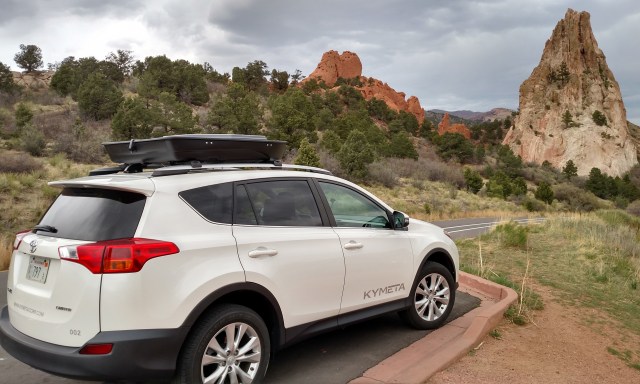
Kymeta connected car
Kymeta employees check out the stop-sign-shaped antenna on the roof of a Toyota RAV4 car that made a coast-to-coast connected drive. (GeekWire Photo / Alan Boyle)

REDMOND, Wash. — Kymeta Corp.’s Toyota RAV4 sport utility vehicle and the flat-panel satellite antenna on its roof are back at the company’s headquarters after a 7,000-mile test drive across America, and few people are more relieved than Benjamin Ash.

“I’ve never seen anything coming back from being out in the field that long,” Ash, who is Kymeta’s director of manufacturing engineering, said after examining the stop-sign-sized panel. “I thought it was going to be much worse.”

Ash and about a dozen of his fellow Kymeta employees gathered in Kymeta’s parking lot today to celebrate the car’s return to its Redmond headquarters after a two-week, coast-to-coast odyssey.

The trek served as Kymeta’s beta test for a new mobile satellite internet service called Kalo, provided in partnership with the Intelsat satellite network. Kalo is the centerpiece service offering from Kymeta, which was spun out from Intellectual Ventures in 2012 with backing from Microsoft co-founder Bill Gates and other high-profile investors.

Get the full story on GeekWire.

Categories
GeekWire

Kymeta’s pizza-box antennas pass tests at sea

Antenna replacement
An artist’s concept shows the bridge of the White Rose of Drachs before and after installation of Kymeta’s antennas. The antenna visible in the right image replaces the antenna domes visible in the left image. (Kymeta / e3 Illustration)

Kymeta Corp. — a company based in Redmond, Wash. and backed by Microsoft co-founder Bill Gates — says it’s conducted successful sea trials of its streamlined antenna system for broadband communications.

The trials were performed over the past several months in the Mediterranean Sea on a super-yacht known as the White Rose of Drachs, in cooperation with Kymeta’s Spain-based distribution partner, e3 Systems.

Word of the trials emerged today during the buildup to the Monaco Yacht Show, scheduled Sept. 27-30.

Get the full story on GeekWire.

Categories
GeekWire

Kymeta wins FCC’s OK for pizza-box antennas

Kymeta RAV4 SUV
During an 8,000-mile test drive known as “Kytrek 2,” Kymeta demonstrated how its KyWay terminal could provide coast-to-coast satellite connectivity for a Toyota RAV4 SUV. (Kymeta Photo)

Kymeta Corp., the flat-panel antenna startup backed by Microsoft co-founder Bill Gates, has won key approvals from the Federal Communications Commission and its British counterpart for thousands of satellite antennas and the terminals to go with them.

Until now, the company has been providing its mTenna antennas and KyWay data terminals under the terms of special, temporary or experimental licenses, said Carl Novello, vice president of solutions for the Redmond, Wash.-based company.

“This is the big one that says, ‘Yup, you’re well on your way to commercialization,’” he told GeekWire today.

The FCC issued the blanket license on Aug. 24, authorizing 5,000 terminals for land mobile applications, 1,000 for maritime applications and 5,000 for fixed satellite service.

Get the full story on GeekWire.

Categories
GeekWire

Pivotal Commware raises $17M for antennas

Pivotal Commware beam-forming
An artist’s conception illustrates different applications for Pivotal Commware’s software-defined antenna system. (Pivotal Commware Illustration)

BELLEVUE, Wash. – Chalk up another score for metamaterials technology: Bellevue-based Pivotal Commware says it’s raised $17 million in Series A funding from Microsoft co-founder Bill Gates, Globalstar’s parent company and other heavy-hitters.

The investment will give a boost to Pivotal’s “holographic beam forming” technology, which takes advantage of the beam-bending properties of metamaterials. The company’s software-defined antenna system facilitates easier communication with moving targets ranging from ships and planes to trains and connected cars.

One unusual angle to Pivotal’s play is that the company is already making a profit, said CEO Brian Deutsch. “The fact that we’ve had early commercial success is unique. … We’re not only post-revenue, we’re post-profit,” he told GeekWire.

Get the full story on GeekWire.

Categories
GeekWire

NASA backs mini-antennas and 3-D printer

Cubesats
Nanosatellites tumble through space after their deployment from the International Space Station. Kymeta is working on flat-panel communication antennas that could be placed on such satellites. (NASA Photo)

Flat-panel antennas that are tiny enough to fit on a nanosatellite and a 3-D printer that can recycle space station trash are among the Seattle-area projects that have won seed money in NASA’s latest round of grant-making.

They’re just a couple of the 133 proposals selected for contracts of up to $750,000 under NASA’s Small Business Innovation Research program, or SBIR. But what’s notable about Kymeta’s mini-antennas and Tethers Unlimited Inc.’s ERASMUS plastics recycler and 3-D printer is that they could spawn products for use on Earth as well as in space.

Get the full story on GeekWire.

Categories
GeekWire

Kymeta’s antennas wow Monaco’s yacht crowd

Kymeta antenna
Kymeta’s flat-panel antennas have their day in the sun at the Monaco Yacht Show. (Credit: Kymeta)

Kymeta Corp., the flat-panel antenna company that’s backed by Microsoft co-founder Bill Gates, has demonstrated the capabilities of its satellite broadband data transmission technology in front of a tough crowd: the rich and famous at the Monaco Yacht Show.

“This is really about us showing our first product in action,” said Nathan Kundtz, president and CEO of the venture headquartered in Redmond, Wash.

Kymeta makes stop-sign-sized antennas that take advantage of metamaterials to receive satellite signals without having to turn and focus on the spacecraft flying overhead.

During the week surrounding the show in Monaco show, which ran from Sept. 28 to Oct. 1, Kymeta set up two of its antennas on the roof of the stylish Restaurant Virageto provide Wi-Fi access for the Superyacht Owner’s VIP Lounge.

Get the full story on GeekWire.

Categories
GeekWire

Toyota, Kymeta work on satellite connected car

Image: Mirai vehicle
Toyota’s Mirai fuel-cell vehicle is equipped with Kymeta’s satellite antenna system. (Credit: Kymeta)

Redmond-based Kymeta Corp. and Toyota took the wraps off their collaboration on a satellite antenna system that can send data to cars at broadband speeds.

Toyota’s antenna-equipped, hydrogen-powered Mirai fuel-cell vehicle was unveiled today at the North American International Auto Show in Detroit. The prototype communication system can download satellite data at 50 megabits per second, which is better than typical LTE wireless service. The transmission speed is expected to rise past the gigabit-per-second mark within a few years.

Kymeta said Mirai Creation Investment Limited Partnership, a Japan-based fund in which Toyota participates, is providing a strategic investment to push the initiative along. The company declined to specify how much is being invested, other than to say that the amount is significant. On Monday, Kymeta said it closed a $62 million investment round that includes money from Mirai.

For now, the satellite antenna system is being installed on Mirai research vehicles, but not on cars being sold to customers. Kymeta President and CEO Nathan Kundtz said that status is likely to change within the next couple of years.

Get the full story from GeekWire.

Categories
GeekWire

Kymeta satellite venture gets a $62M boost

Image: Kymeta antenna
Kymeta’s flat-panel antenna picks up signals from a wide spectrum of satellites. (Credit: Kymeta)

Kymeta Corp., the Redmond-based satellite antenna venture backed by Microsoft founder Bill Gates, says it has closed a $62 million Series D financing round to support a host of new initiatives by land, air and sea.

“With new partnerships, rollout of its smart antenna, customer milestones ahead and growing industry buzz, Kymeta is inventing and delivering a future I can’t wait to live in,” Josh Wolfe, a board member and investor at Lux Capital, said in Monday’s press release announcing the capital influx.

In addition to Lux and Gates, the latest round’s funders include the Kresge Foundation and Osage University Partners, which have invested in Kymeta previously. There are also investments from “as of yet undisclosed strategic partners,” Kymeta said.

Get the full story on GeekWire.