Categories
GeekWire

Got eclipse glasses? Here’s where to go

Eclipse glasses
GeekWire’s Cara Kuhlman, Clare McGrane and Chelsey Ballarte give their eclipse glasses a test drive. (GeekWire Photo / Kurt Schlosser)

All of the continental United States and Canada will witness a solar eclipse on Aug. 21, but you’ll need eye protection to see the partial phase safely. This may be the event that turns solar-filter glasses into a mass-market fashion statement.

If you think regular sunglasses, compact discs or exposed photographic film will do the trick, think again. (Besides, who has film lying around anymore?) As long as even a sliver of the sun’s disk is uncovered, virtually the only safe way to see the spectacle directly is through special spectacles.

Fortunately, there should be plenty of solar-viewing glasses to go around. The Robert D. and Jessie L. Stinnett Trust is facilitating distribution of glasses from American Paper Optics through the 2017solar.com website: You can order four pairs of glasses online for $5, but the offer ends on Aug. 1.

Astronomers Without Borders and other nonprofit groups are shipping glasses as well. Plenty of other online outlets sell the glasses (as well as solar filters for cameras, binoculars and telescopes), but whatever you do, make sure your shipment arrives before Aug. 21.

Libraries across the country, including Seattle Public Library, are distributing free eclipse glasses to all comers.

Get the full story on GeekWire.

Categories
GeekWire

Cellphone carriers gear up for eclipse jam

Smartphone eclipse observing
If you use your smartphone to photograph a partial solar eclipse, you should cover the camera lens with a solar filter – even if it’s a makeshift one. (NASA Photo / Sten Odenwald / Lou Mayo)

One month from today, Americans could well be in on the most photographed, most widely shared total solar eclipse in history – but it’s up to telecom providers to make sure it doesn’t turn into a total bust.

From Oregon to South Carolina, millions of eclipse-chasers will be in what’s likely to be unfamiliar territory, outside the usual hot spots for cell service, scrambling to put photos online or stream live video.

Cellphone carriers will be using their tools of the trade – including mobile communication towers, portable power generators and beefed-up backhaul connections – to keep up with the flood of data and phone calls.

Get the full story on GeekWire.

Categories
GeekWire

Alaska Airlines will chase total solar eclipse

Total solar eclipse
The black disk of a total solar eclipse hangs over the clouds during an Alaska Airlines flight in 2016. Passengers on an August flight should see a similar sight. (Robert Stephens via YouTube)

Alaska Airlines has scheduled a flight from Portland to chase views of the Aug. 21 total solar eclipse over the clouds, but you can’t book a seat online.

The charter flight, due for a 7:30 a.m. PT takeoff on eclipse day, will be open by invitation only to astronomy enthusiasts and other VIPs. Except for two seats. Those seats will be given away in a social-media contest scheduled to begin on July 21, one month before the eclipse.

The Aug. 21 adventure follows up on a more impromptu eclipse-chasing trip on March 8, 2016, when Alaska changed the takeoff time for a previously scheduled Anchorage-to-Honolulu flight to let passengers see a total solar eclipse over the Pacific.

Get the full story on GeekWire.

Categories
GeekWire

Eclipse campsites sell out in 90 minutes

To accommodate overwhelming demand, Oregon state park officials freed up 1,000 campsites today for folks wanting to see a total solar eclipse on Aug. 21. They didn’t last long. The extra spots were made available for reservations at 8 a.m. – and by 9:25 a.m., they were sold out.

Get the news brief on GeekWire.

Categories
GeekWire

Watch a ‘Ring of Fire’ eclipse on the Web

Annular Solar Eclipse
A montage of images shows the progression of an annular solar eclipse in May 2012, as seen from Red Bluff, Calif. (Brocken Inaglory Photo via Wikimedia – CC BY-SA 3.0)

Skywatchers in South America and Africa will be seeing an unusual “Ring of Fire” solar eclipse on Feb. 26, and the rest of us should be able to look over their shoulders online.

But you might have to get up before sun-up to catch the show.

The event is known as an annular solar eclipse, with “annular” coming from the Latin word for “ring.”

All solar eclipses take place when the moon comes between Earth and the sun, blocking out the sun’s disk. If the orbital mechanics are such that the moon totally blocks the disk, that’s a total eclipse. But if the moon is too far away from Earth to cover all of the sun, the bright edge of the disk is still exposed at the height of the event. Hence the ring of fire.

Get the full story on GeekWire.

Categories
GeekWire

T-minus-6 months for all-American eclipse

Kids with solar glasses
Certified solar glasses are required to watch a partial solar eclipse. The total phase, however, should be enjoyed without wearing shades. (Rainbow Symphony Photo / Mark Margolis)

BOSTON – Six months from today, millions of Americans will watch the sun darken during a rare coast-to-coast eclipse – and it’s not too early to get into the spirit of totality.

It’s definitely not too early to figure out where you’re going to be: Hotel rooms in the track of the total solar eclipse for the time around Aug. 21 were scarce six months ago, and they’re virtually impossible to find now. In the Pacific Northwest, you’ll have to settle for a room in, say, Portland or Walla Walla, plus a significant drive.

What’s the attraction? You’ll be in on one of our planet’s weirdest phenomena, a minute or two when the sun turns black, surrounded by a shimmering corona. It’ll be much more than an astronomical event.

“This will be the most photographed, the most shared, the most tweeted event in human history,” artist-astronomer Tyler Nordgren said over the weekend in Boston at the annual meeting of the American Association for the Advancement of Science.

Get the full story on GeekWire.

Categories
GeekWire

How to spot a lunar eclipse and that comet

A penumbral lunar eclipse not quite as deep as the one we’re about to see occurred over the Far East in November 2012. (Hong Kong Space Museum Photo via Sky & Telescope)

Tonight’s the night when a lunar eclipse dims the full moon, and when a recently discovered green comet comes closest to our planet. But unless you know what’s coming, you’re almost certain to miss them.

You may miss them anyway, depending on the sky conditions. The forecast for the Seattle area calls for partly cloudy skies with a 20 percent chance of rain.

Get the full story on GeekWire.

Categories
GeekWire

Check out a ‘Ring of Fire’ eclipse over Africa

Image: Annular eclipse
A series of images shows the progression of the Sept. 1 annular solar eclipse as seen from Reunion Island. (Credit: Slooh / Weathernews Japan)

An annular solar eclipse swept across Africa today, treating skywatchers to a “Ring of Fire” eclipse and whetting appetites for next August’s all-American total eclipse.

The eclipse occurred in the middle of the night, Seattle time, but it was prime time for a roughly 100-mile wide swath of territory stretching from Gabon on Africa’s west coast to Mozambique, Madagascar and Reunion Island in the Indian Ocean.Those places are where the “Ring of Fire” effect was visible in all its glory.

Annular solar eclipses are similar to total eclipses, except that the orbital positions of the sun, moon and Earth are such that the moon doesn’t quite cover up all of the solar disk. As a result, the dark moon is surrounded by a blazing O.

About 3,000 eclipse fans gathered on Reunion Island to witness the spectacle, Reuters reported. “I saw a solar eclipse … but I have never seen an annular solar eclipse,” Austrian tourist Beate Sosz was quoted as saying. “It is great.”

Get the full story on GeekWire.

Categories
GeekWire

One year before eclipse, spots are filling up fast

Image: 2012 eclipse
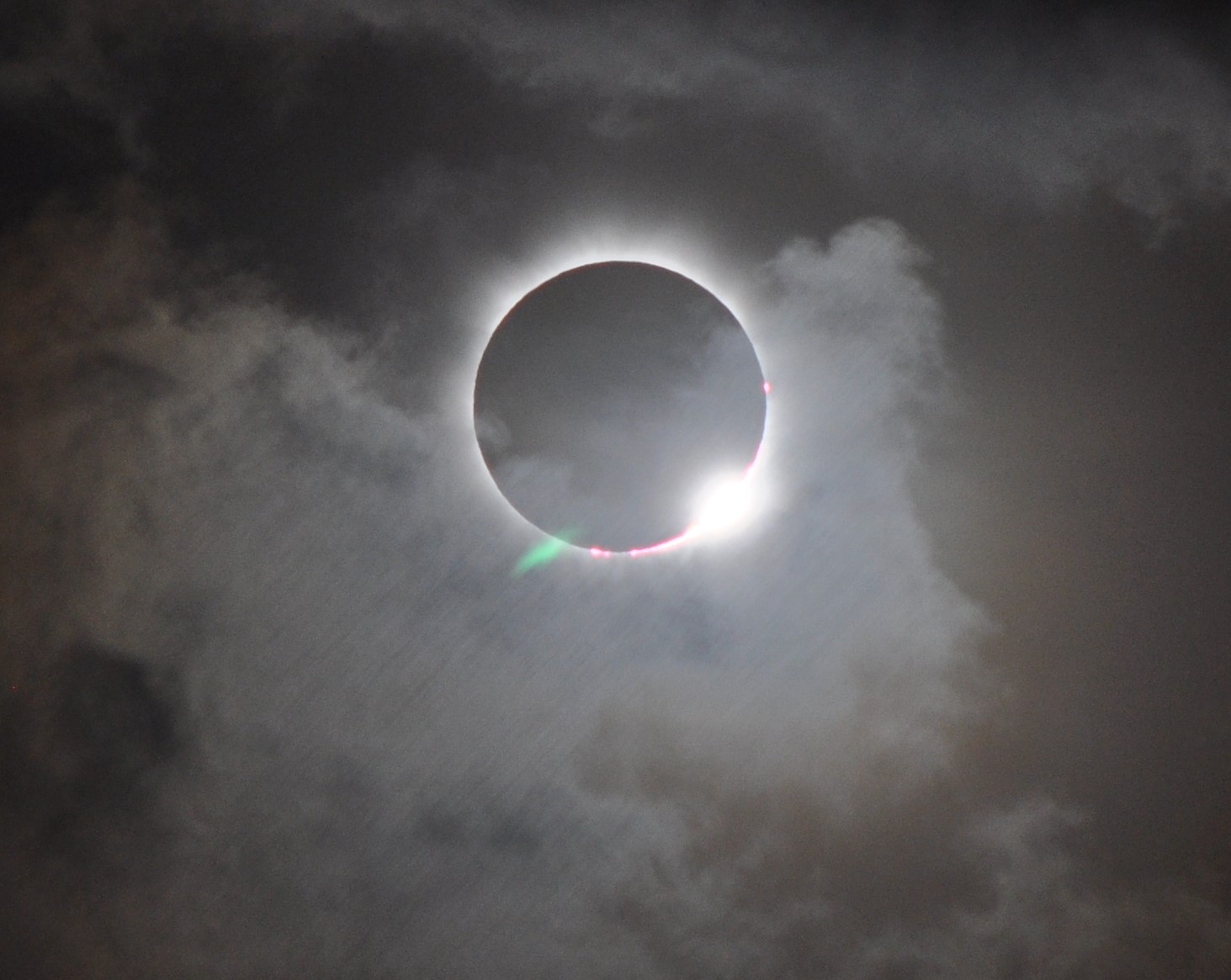
The sun’s corona gleams during a total solar eclipse seen from the northern tip of Australia in November 2012. (Credit: Romeo Durscher via NASA)

It’s exactly one year before the “Great American Eclipse” sweeps across the continent, but depending on where you want to stay, it’s already too late to make a reservation.

On one level, the solar eclipse of Aug. 21, 2017, should rank among the most accessible such phenomena for Americans – and it’s not to be missed. Partial phases of the eclipse should be visible, weather permitting, from most of North America. For example, up to 92 percent of the sun’s disk will be covered as seen from Seattle.

On another level, the eclipse is a hot ticket: Its total phase will be visible only along aroughly 70-mile-wide track that extends from Oregon to South Carolina. Totality means the moon blots out the sun’s entire disk, turning daylight to nighttime for up to two and a half minutes.

Statistically speaking, most of the best places to go for clear skies in August are in a swath of the West ranging from central Oregon to Nebraska. And by some measures, the absolute best is Madras, Ore.

But just try getting a room in Oregon.

Get the full story on GeekWire.

Categories
GeekWire

Solar eclipse spotted from air and space

Image: Solar eclipse
The moon’s shadow can be seen as a dark spot at upper right in this picture of Earth’s full disk, as captured Tuesday by Japan’s Himawari 8 satellite. (Credit: NICT)

A total solar eclipse is a rare and thrilling sight, but seeing it from a height makes it even more exotic.

Check out the view from Japan’s Himawari 8 weather satellite, stationed more than 22,000 miles above the Pacific Ocean in geostationary orbit. The satellite was perfectly placed to track the moon’s shadow as it sped from west of Indonesia to east of Hawaii on March 8. (Or was that March 9?)

Get the full story on GeekWire.