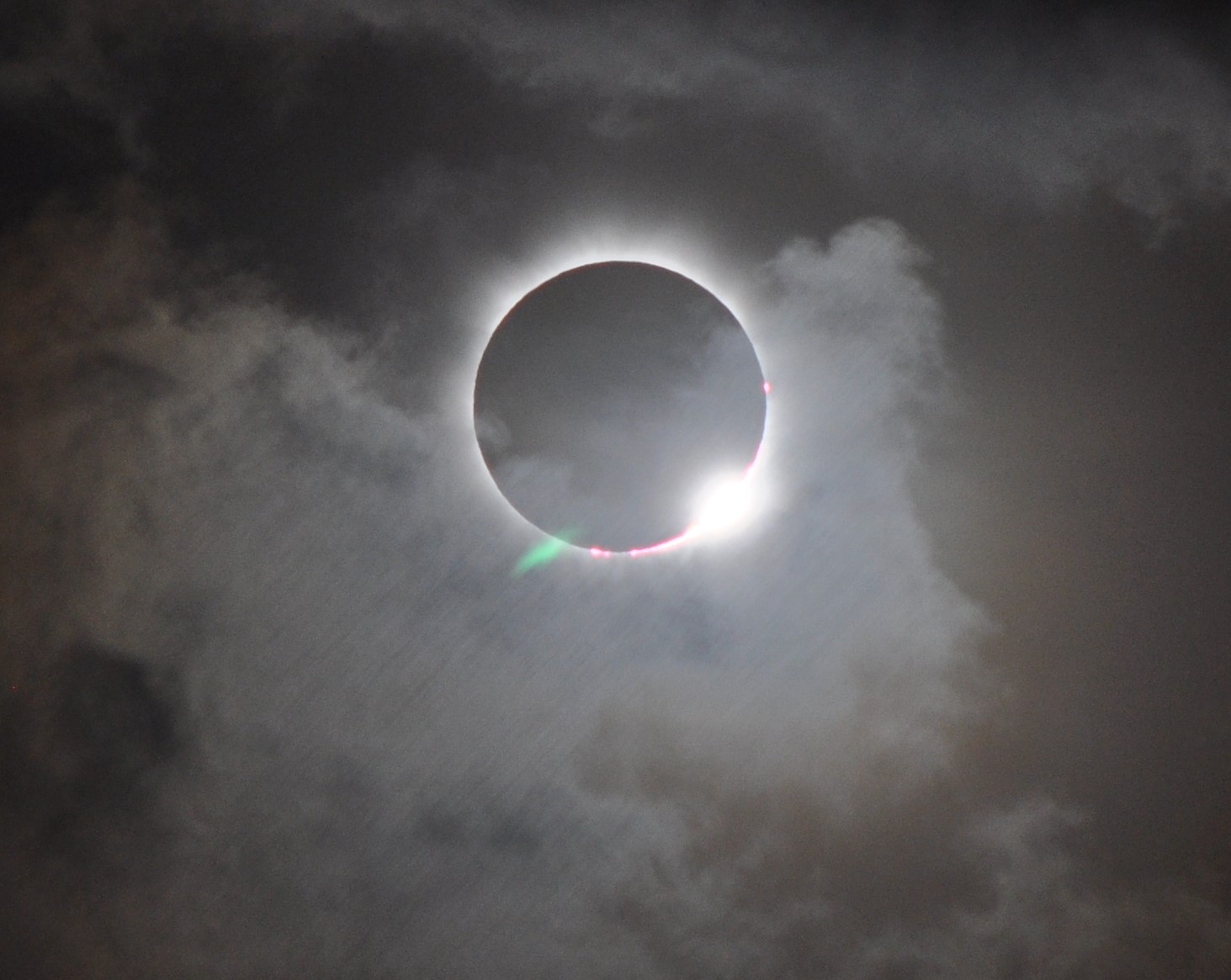
The sun’s corona gleams during a total solar eclipse seen from the northern tip of Australia in November 2012. (Credit: Romeo Durscher via NASA)
This week’s total solar eclipse is a bad-news, good-news, even-better-news situation for skywatchers in the United States.
Solar eclipses are must-see astronomical events that occur when the moon is positioned just right to block the sun’s disk, as seen from Earth. The eclipse that unfolds on Tuesday is the only time during 2016 that anyone can see the sun totally blotted out.
The bad news is that the total eclipse is visible only in the Asia-Pacific region. The moon’s shadow rolls eastward across the Indian and Pacific oceans, beginning at sunrise just west of Indonesia and ending at sunset just east of Hawaii. If you’re in the United States, you’ll totally miss seeing totality in person.
The good news is that in this age of the Internet, you can still get a peek online.
A total lunar eclipse shines dully over Seattle’s Space Needle in 2008. (Credit: Clane Gessel)
Sunday’s super-sized total lunar eclipse is special for a couple of reasons, but it’s extra-special for places like Seattle, where the timing is perfect for family viewing.
“I love it when these astronomical events are at a good time,” said Alice Enevoldsen, an astronomy educator whose home base is in West Seattle. “It’s in the evening … but not yet bedtime for little kids.”
Lunar eclipses are among the most accessible astronomical events out there: When Earth casts its shadow on the full moon’s disk, half the world can watch it — and the show usually lasts for an hour or more, in contrast to the mere minutes of duration for a total solar eclipse. (Check out this interactive feature to learn more about lunar eclipses.)
This eclipse is making headlines in part because it takes place when the full moon’s apparent size is at its maximum for the year — a so-called supermoon. Supermoons are about 7 percent bigger and 16 percent brighter than the average full moon. NASA says the most recent supermoon lunar eclipse was in 1982, and the next time will be in 2033. (However, depending on your definition of a “supermoon,” such an eclipse came in 1997 and is due in 2021 as well.)
For Seattleites, Sunday’s show begins with moonrise at 6:54 p.m. PT, when the eclipse’s partial phase is already well under way. If you’re lucky, you can catch the show’s climax at 7:11 p.m., when the last sliver of the moon’s bright disk gives way to a dull red glow.