This enhanced color image of Pluto highlights the many subtle color differences between Pluto’s distinct regions. The imagery was collected by the spacecraft’s Ralph/MVIC color camera on July 14, 2015, from a range of 22,000 miles. (Credit: NASA / JHUAPL / SwRI)
Rivers and lakes of liquid nitrogen may have splashed over Pluto’s surface hundreds of millions of years ago, and could do so again, due to shifts in the dwarf planet’s orbit and the tilt of its orbit.
That hypothesis is a good fit for the evidence collected last July when NASA’s New Horizons spacecraft zoomed past the dwarf planet and its moons, scientists said today.
Today’s revelations came during a review of New Horizons’ findings at the Lunar and Planetary Science Conference in The Woodlands, Texas. Research teams shared their latest findings about the mission, including some that have yet to be published in journals such as Icarus.
An image captured by NASA’s New Horizons spacecraft last July 14 shows the edge of Pluto and its atmospheric haze, including what appears to be a light wispy cloud toward the right side of the image. (Credit: NASA / JHUAPL / SwRI via New Scientist)
One of the pictures from last July’s flyby, published by New Scientist today, shows what appears to be a light-colored wisp amid the dwarf planet’s haze.
Michael Buckley, a spokesman for Johns Hopkins University Applied Physics Laboratory, told GeekWire that the science team is still discussing the data.
“What the team can say at this point is Pluto’s atmosphere, including hazes, is complex, and scientists continue to analyze and discuss incoming data as part of the normal science process,” Buckley said in an email. “As always, we’ll post a feature just as soon as we have more analysis and consensus.”
The inset pictures show a section of Pluto’s Cthulhu Regio that includes a reddish plain as well as a 260-mile-long mountain range. The far right inset indicates the distribution of methane ice in purple, as observed by New Horizons’ Ralph/MVIC imager during the spacecraft’s flyby on July 14, 2015.
The dark terrain informally known as Cthulhu Regio sweeps nearly halfway around Pluto’s equator, with light-colored peaks sticking up from the surrounding plains. What is that light-colored stuff? Apparently, it’s methane frost.
Evidence for Pluto’s methane meteorology was laid out today by the science team behind NASA’s New Horizons mission.
The piano-sized spacecraft’s cameras zeroed in on Cthulhu when it flew past Pluto last July 14. Most of the region is covered with a layer of dark reddish tholins, a substance that forms when sunlight breaks down hydrocarbons such as methane.
Then there are those bright peaks in southeast Cthulhu: When the scientists looked closely at compositional data collected by New Horizons’ Ralph/Multispectral Visible Imaging Camera, they found that the bright areas on top of Cthulhu’s mountains matched up with the spectral signature of methane ice.
This enhanced-color image was obtained by New Horizons’ MVIC camera about 45 minutes before closest approach on July 14, 2015, when the spacecraft was 21,100 miles away. The lower edge of the image measures about 750 miles long. (Credit: NASA / JHUAPL / SwRI)
The heart-shaped region along Pluto’s equator has been the darling of NASA’s New Horizons mission, but it’s the north polar region that gets the love in this week’s featured image.
The area seen here is part of a region informally known as Lowell Regio. That’s a tribute to Percival Lowell, the millionaire astronomer who sparked the search that eventually led to Pluto’s discovery.
Toward the left side of the image, there’s a canyon that measures about 45 miles wide. Other canyons, to the east and west, are about 6 miles wide. These formations hint at tectonic activity in ancient times, according to the New Horizons science team.
Near the lower right corner, there are irregularly shaped pits that span as much as 45 miles. The science team says those pits are about 2.5 miles deep, and may indicate locations where subsurface ice has been lost from below. That would have caused the surface layer to collapse into the void.
This close-up of Charon’s canyons was taken by NASA’s New Horizons probe during last July’s flyby. The color-coded picture shows elevation data. Serenity Chasma’s depth can exceed 4 miles in places. In comparison, the Grand Canyon’s maximum depth is a mile. (Credit: NASA / JHUAPL / SwRI)
Scientists say the patterns of ice in canyons on Charon, Pluto’s largest moon, look as if some the frozen water was once liquid. And that suggests Charon had a subsurface ocean in ancient times.
The evidence comes from close analysis of images and elevation data collected last July when NASA’s New Horizons probe zoomed past Pluto and its moons. Even before the flyby, scientists speculated that Charon may have harbored liquid water, and that some water may still flow beneath its icy surface. The stereo measurements from New Horizons’ Long Range Reconnaissance Orbiter, or LORRI, are consistent with that hypothesis.
The clues come in the form of stretch marks in the ice around Serenity Chasma, a canyon that’s 4.5 miles deep in some places.
“Charon’s tectonic landscape shows that, somehow, the moon expanded in its past, and – like Bruce Banner tearing his shirt as he becomes the Incredible Hulk – Charon’s surface fractured as it stretched,” the science team said in an image advisory on Thursday.
This map of the left side of Pluto’s heart-shaped feature uses colors to represent Pluto’s varied terrains, which helps scientists understand the geological processes at work. (Credit: NASA / JHUAPL / SwRI)
Just in time for Valentine’s Day, the scientists behind NASA’s New Horizons mission are sharing a map that brings a different perspective to Pluto’s heart.
The map shows clearly that the dwarf planet’s bright heart-shaped region, informally known as Tombaugh Regio, can be broken into two geologically distinct areas.
The left side is dominated by an icy plain of frozen nitrogen, called Sputnik Planum. This is the part of the heart that’s dissected in the New Horizons team’s color-coded chart.
This image focuses in on a part of Pluto’s heart-shaped region where hills of water ice appear to be floating on top of a nitrogen glacier. Challenger Colles, toward the top of the inset photo, is a wide cluster of water-ice hills. (Credit: NASA / JHUAPL / SwRI)
There’s plenty of evidence that Pluto is a frozen water world, with mountains of ice that rise more than 10,000 feet in height, but here’s something even weirder: Huge chunks of frozen H2O appear to be floating in a sea of frozen nitrogen, like icebergs in Earth’s polar regions.
Those are among the findings reported on Feb. 4 in this week’s update from NASA’s New Horizons mission. The piano-sized New Horizons spacecraft collected gigabytes’ worth of observations last year during its July 14 flyby, and it’s been sending back data ever since then.
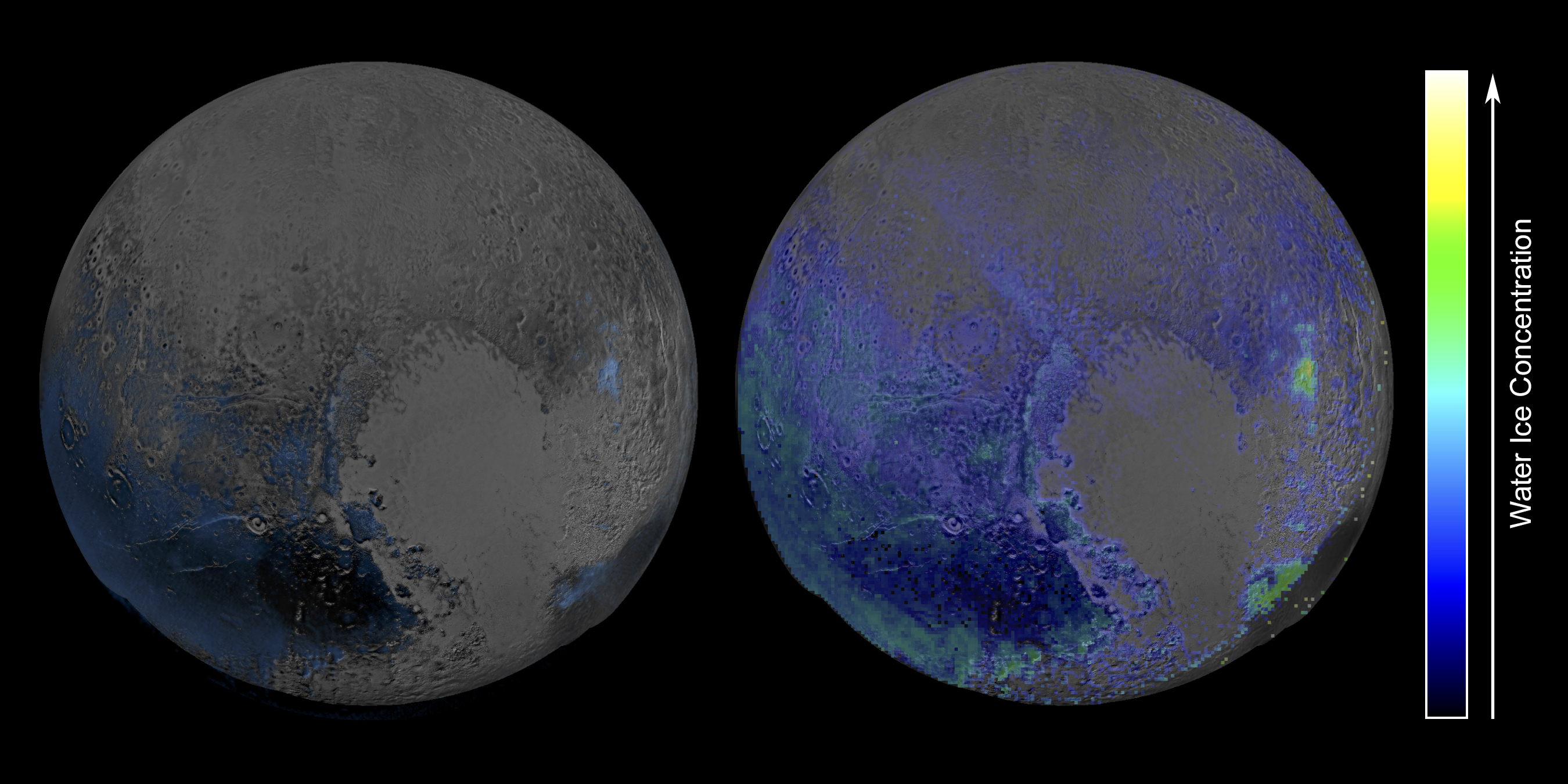
This false-color infrared image from NASA’s New Horizons spacecraft shows water ice concentrations on Pluto. The left image is the result of an initial analysis, and the right image has been reprocessed to account for mixtures with other types of ice. (Credit: NASA / JHUAPL / SwRI)
A color-coded map from NASA’s New Horizons mission shows where Pluto’s frozen water is concentrated, just in case we need to fill up our tanks on the way toAlpha Centauri or Planet Nine.
Water ice turns out to be more widespread on the dwarf planet than previously thought, the mission’s researchers reported today. They came to that conclusion after some sophisticated analysis of infrared imagery captured during the New Horizons spacecraft’s flyby last July 14.
Soon after the flyby, the mission team concluded that Pluto possessed mountains of water ice rising as high as 11,000 feet above the icy world’s surface. That conclusion was confirmed in follow-up studies based on the infrared data from the piano-sized probe’s Ralph/LEISA instrument.
LEISA’s survey mapped concentrations of water ice, but scientists figured out that the spectral readings could be thrown off if the frozen water was mixed in with frozen methane. When they modeled the contributions from other types of ice on Pluto’s surface, the resulting map showed wider stretches where water ice should be present.
This image from NASA’s New Horizons spacecraft shows patterns in the nitrogen glaciers of an area nicknamed Sputnik Planum – including an “X” to the right and below the image’s center. The darker patch at the center of the image is probably a dirty block of water ice “floating” in the denser nitrogen. (Credit: NASA / JHUAPL / SwRI)
If “X-Files” are defined as data about weird and alien phenomena, NASA’s New Horizons mission to Pluto has X-Files galore. And this week, the mission’s science team shared an X-File with an actual X on it.
The timing of Thursday’s image release couldn’t be much better, coming just a couple of weeks before “The X-Files” (the TV show, that is) returns to Fox for a six-episode run. But this is no publicity stunt; rather, it illustrates how weird geology can get on a world that features glaciers of frozen nitrogen.
The semi-solid nitrogen in a region informally known as Sputnik Planum slowly burbles up and down, due to thermal convection. When blobs of nitrogen rise up and press against each other, patterns of lines mark the boundaries between the blobs. When the blobs subside, the lines disappear.
“This part of Pluto is acting like a lava lamp, if you can imagine a lava lamp as wide as, and even deeper than, the Hudson Bay,” William McKinnon, a researcher from Washington University in St. Louis who’s the deputy lead of the New Horizons geology, geophysics and imaging team, said in a NASA feature.
The U.S. Postal Service’s souvenir sheet of four stamps contains two new stamps appearing twice. The first stamp shows an artist’s rendering of the New Horizons spacecraft and the second shows the spacecraft’s enhanced color image of Pluto taken near closest approach. (Credit: Antonio Alcala / USPS)
For the first time since 1991, Pluto and the solar system’s eight bigger planets are getting their own postage stamps – thanks to a U.S. Postal Service cosmopalooza that also spotlights Earth’s moon and “Star Trek.”
The Pluto stamp pays tribute to NASA’s New Horizons mission, and updates 1991’s speculative view of the dwarf planet. Back then, the legend on the 29-cent stamp read “Pluto – Not Yet Explored.” This time, the four-stamp sheet carries the label “Pluto – Explored!”