NASA's New Horizons probe sent back a view of a Texas-sized ice sheet known as Sputnik Planitia. (Credit: NASA GSFC / SwRI / JHUAPL)
NASA’s New Horizons mission to Pluto has forced astronomers to rewrite their textbooks — but that’s not all: New Horizons also forced Les Johnson to rewrite a novel.
The space scientist was tasked with taking notes that the famed science-fiction writer and editor Ben Bova left behind when he died in 2020, and turning them into a novel set on Pluto to close out Bova’s Grand Tour series of solar system tales.
In the material that Bova had written for “Pluto,” he described a rocky world with just a little bit of ice on it. But when Johnson sent those notes to planetary scientist Alan Stern, the New Horizons mission’s principal investigator, had to set him straight.
“His first comment back to me was, ‘We never found anything on Pluto that was anything like that,'” Johnson says in the latest episode of the Fiction Science podcast. “And so I realized at that point that I was going to have to go back and revise the science behind the story of the environment on Pluto.”
The result is one of the first works of fiction that provides detailed descriptions of Pluto’s true surroundings, right down to the orange-tinged ice sheet of Sputnik Planitia and the dark and dirty spot on Charon, Pluto’s largest moon.
Artwork shows NASA’s New Horizons probe in deep space. (Credit: NASA / JHUAPL / SwRI / Serge Brunier / Marc Postman / Dan Durda)
We know that deep space is dark, but just how dark is it? Or, put another way, how bright is it? And how much of that brightness comes from galaxies? Astronomers have gotten a clearer answer to those questions, thanks to observations sent back from billions of miles away.
Nine years after its history-making flyby of Pluto, NASA’s New Horizons spacecraft measured the brightness of the distant universe from a vantage point in deep, dark space.
“If you hold up your hand in deep space, how much light does the universe shine on it?” Marc Postman, an astronomer at the Space Telescope Science Institute in Baltimore, asked today in a news release. “We now have a good idea of just how dark space really is.”
The heart-shaped region of Pluto's surface was formed at least in part by a cataclysmic "splat," scientists say. (Credit: NASA / JHUAPL / SwRI)
The most recognizable feature on Pluto is its “heart,” a relatively bright valentine-shaped area known as Tombaugh Regio. How that heart got started is one of the dwarf planet’s deepest mysteries — but now researchers say they’ve come up with the most likely scenario, involving a primordial collision with a planetary body that was a little more than 400 miles wide.
Astronomers from the University of Bern in Switzerland and the University of Arizona looked for computer simulations that produced dynamical results similar to what’s seen in data from NASA’s New Horizons probe. They found a set of simulations that made for a close match, but also ran counter to previous suggestions that Pluto harbors a deep subsurface ocean. They said their scenario doesn’t depend on the existence of a deep ocean — which could lead scientists to rewrite the history of Pluto’s geological evolution.
An artist's conception shows NASA's New Horizons probe and a Kuiper Belt object called Arrokoth. (Credit: JHUAPL / SwRI)
Nearly eight years after its historic Pluto flyby, NASA’s New Horizons probe is getting ready for another round of observations made from the icy edge of the solar system — and this time, its field of view will range from Uranus and Neptune to the cosmic background far beyond our galaxy.
Scientists on the New Horizons team shared their latest discoveries, and provided a preview of what’s ahead, during this week’s Lunar and Planetary Science Conference in The Woodlands, Texas.
It’s been 17 years since the piano-sized New Horizons spacecraft was launched toward Pluto and the Kuiper Belt, The primary mission hit its peak in 2015 when the probe zoomed past Pluto, but the adventure moved on to a second act that focused on a smaller, two-lobed object called Arrokoth — a name derived from the Powhatan/Algonquin word for “sky.”
Scientists are still sifting through the data from the Pluto flyby, and from the Arrokoth flyby on New Year’s Day of 2019, more than 4 billion miles from the sun.
Left: White boxes indicate Ride Rupes (left) and Coleman Mons (right). Right: Features outlined in yellow. (NASA / JHUAPL / SwRI / SETI Inst.)
Two women pioneers of flight now have places of honor on Pluto, thanks to the International Astronomical Union and the team behind NASA’s New Horizons mission.
The IAU has formally approved naming a huge cliff near the southern tip of Pluto’s heart-shaped Tombaugh Regio after Sally Ride (1951-2012), who became the first American woman in space in 1983.
“Sally loved space exploration,” Tam O’Shaughnessy, Ride’s life partner, said in a NASA news release. “Even after her NASA years, she dreamed of joining a mission to the moon or Mars or Pluto. Sally also loved the debate about whether or not Pluto was a true planet. And she appreciated the new criteria for classifying a planet. After all, how else can a planetary scientist decide? Sally would be over the moon — or Pluto — with the honor of having Ride Rupes named after her.”
Not far from Ride Rupes is Coleman Mons, an ice volcano that’s named after Bessie Coleman (1892-1926) the first African-American woman and first Native American to hold a pilot’s license. She earned her license in France in 1923, at a time when U.S. flight schools didn’t admit women or Black people.
“Sally Ride and Bessie Coleman were separated by generations, but they are forever connected by their great achievements, which opened doors for women and girls around the world,” NASA Administrator Bill Nelson said. “In breaking barriers they motivated so many women to pursue dreams and careers they didn’t think were possible, and their sheer persistence and pursuit of equality inspire people to this day.”
A composite image from NASA’s New Horizons spacecraft shows enhanced-color views of Pluto at lower right and Charon, its largest moon, at upper left. (NASA / JHUAPL / SwRI Photo)
“I think the solar system literally saved the best for last with Pluto,” New Horizons’ principal investigator, Alan Stern of the Southwest Research Institute, said in his anniversary blog post. “Of course, I’m a little biased — as we all are on New Horizons — but I can’t think of a more beautiful and scientifically richer way to have completed the first era of the reconnaissance of the planets.”
This year marks another, more personal anniversary: It’s been 10 years since the publication of “The Case for Pluto,” my book about the put-upon planet. Back then, the big question was whether Pluto deserved the planet label — and although I argued the case that it does, the clash over classification really isn’t that big of a deal anymore.
You can call Pluto a dwarf planet (my preferred term), a Kuiper Belt object or a “bloog.” (That last term is the one Caltech astronomer and self-described Pluto-killer Mike Brown came up with to make fun of the tiff over terminology.)
But in light of New Horizons’ discoveries, you can never call Pluto uninteresting.
It’s interesting to leaf through the pages of “The Case for Pluto” and size up how the speculation from 2010 matches up with the science as we know it in 2020. In honor of the fifth anniversary of the flyby and the 10th anniversary of the book, here are updates on five of the big questions about Pluto:
Is there liquid water on Pluto? Looks like it. New Horizons’ pictures of tectonic structures and mountains made of water ice, plus an analysis of the dwarf planet’s mass distribution, suggest that there are bodies of liquid water hidden beneath the surface layer of nitrogen ice. What’s more, shifts in the state of that water due to freezing may be what’s driving the creation of new faults in the surface ice.
“If Pluto is an active ocean world, that suggests that the Kuiper Belt may be filled with other ocean worlds among its dwarf planets, dramatically expanding the number of potentially habitable places in the solar system,” New Horizons team member James Tuttle Keane, a planetary scientist at NASA’s Jet Propulsion Laboratory, said today in a mission recap.
Does Pluto have plains of methane? Sort of. One of Pluto’s best-known features, a light-colored, heart-shaped zone that was named Tombaugh Regio in honor of the dwarf planet’s discoverer, is dominated by a plain known as Sputnik Planitia. The plain is made up of patchy nitrogen-ice glaciers, but New Horizons also detected the presence of frozen methane, carbon monoxide and water (in the form of icebergs).
Will Pluto’s atmosphere freeze out? The latest evidence suggests a freezing trend. Pluto cycles through seasons in the course of its 248-Earth-year orbit, the dwarf planet’s elliptical orbit is currently taking it farther away from the sun. That means the already-chilly planet and its atmosphere will be getting even colder.
At the time of the New Horizons flyby, scientists saw signs that the atmosphere was still holding steady rather than freezing into flecks of ice, probably due to thermal inertia. But this year, a Japanese team reported that the pressure has apparently dropped by more than 20% since 2016. That’s a much more dramatic collapse than expected, and will need to be confirmed (or discounted) by follow-up observations.
Are there ice volcanoes? You bet … not only on Pluto but on its largest moon, Charon. The pictures from New Horizons suggest that slushy “cryolava” has blurped out onto the surfaces of the two worlds through fissures in the surface ice.
Although the flyby went by too quickly to see the actual blurping, scientists spotted large central pits on two Plutonian mountains known as Wright Mons and Piccard Mons that they believe serve as the mouths of ice volcanoes. And in a region on Charon called Vulcan Planitia, the New Horizons team saw signs of a huge flow of ammonia-rich water ice.
Is there another Planet X out there? Ask again later. Even when “The Case for Pluto” was written, there was plenty of speculation over whether an undetected planet much bigger than Pluto lurked on the solar system’s edge. Caltech’s Mike Brown and other researchers said anomalies in the orbits of objects in the Kuiper Belt hinted at the presence of what they called Planet Nine.
Years of searching through telescope data haven’t yet turned up hard evidence for Planet Nine’s presence, and some astronomers now speculate that the anomalies associated with the hypothetical planet are due instead to the gravitational influence of a grapefruit-sized black hole. Others suggest it’s just a glitch in the data.
Even if Planet X is crossed out. there’s much more to be discovered on the solar system’s last frontier.
The New Horizons team is still sorting through the data sent back from the last year’s follow-up flyby of a double-lobed Kuiper Belt object known as Arrokoth. A huge compendium of Pluto research, running to more than 1,000 pages in length, is being prepared for publication.
Stern and his colleagues are already working to identify a potential target for New Horizons’ third Kuiper Belt flyby. And they’re talking about sending out an orbiter with powerful sensors to conduct a longer-lasting survey of Pluto and the Kuiper Belt.
“By the time we mark the 10th anniversary of the Pluto flyby in July 2025, such a mission could even be under construction,” Stern wrote today.
Who knows? Maybe a 15th-anniversary edition of “The Case for Pluto” will be in the works as well.
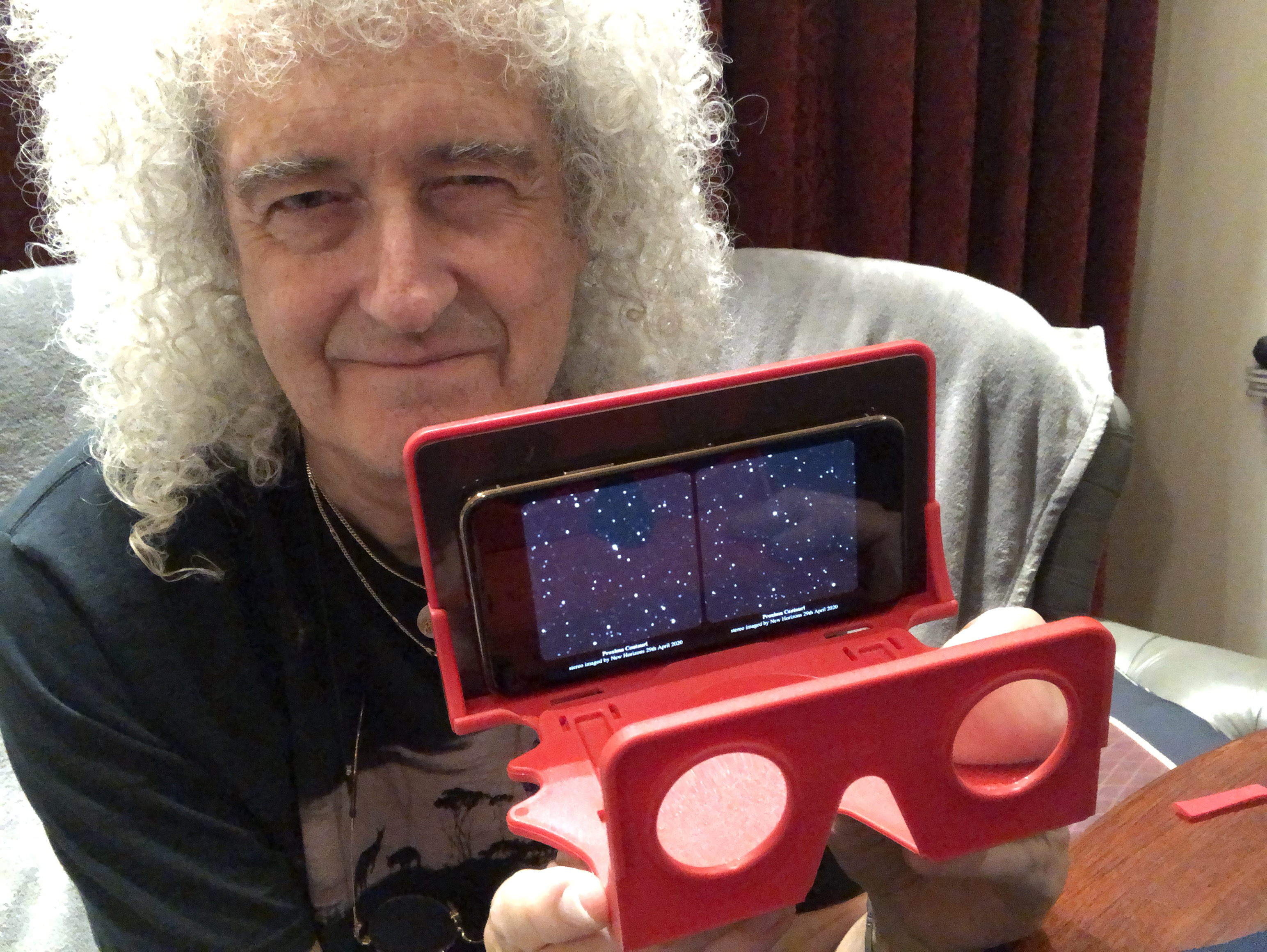
Queen guitarist (and astrophysicist) Brian May, a member of the New Horizons science team, uses his patented OWL viewer to check out the stereo images of Proxima Centauri that he created by combining pictures from Earth-based telescopes and the New Horizons spacecraft. (Photo courtesy of Brian May, via New Horizons / JHUAPL / SwRI / NASA)
NASA’s New Horizons probe has measured the distance to nearby stars using a technique that’s as old as the ancient mariners, but from a vantage point those mariners could only dream of.
The experiment, conducted on April 22-23 as the spacecraft zoomed 4.3 billion miles out from Earth, produced the farthest-out parallax observations ever made.
“It’s fair to say that New Horizons is looking at an alien sky, unlike what we see from Earth,” principal investigator Alan Stern, a planetary scientist at the Southwest Research Institute, said today in a news release. “And that has allowed us to do something that had never been accomplished before — to see the nearest stars visibly displaced on the sky from the positions we see them on Earth.”
A computer-generated reconstruction of Arrokoth’s shape makes it look like a squashed snowman, but slightly less squashed than originally thought. (NASA / JHUAPL / SwRI Image / Roman Tkachenko)
The space snowman that was the focus of a close encounter with NASA’s New Horizons probe last year is helping scientists answer a cosmic question: How did the building blocks of the solar system get their start?
“This is a game-changer,” said Alan Stern, a planetary scientist at the Southwest Research Institute and principal investigator for the New Horizons mission.
A composite image based on data from NASA’s New Horizons spacecraft shows the icy Kuiper Belt object formerly known as 2014 MU69 or Ultima Thule, and now called Arrokoth. (NASA / SwRI / JHUAPL Photo)
The snowman-shaped object that NASA’s New Horizons probe flew past nearly a year ago on the solar system’s icy fringe now has a Native American name: Arrokoth, a word that means “sky” in the Powhatan/Algonquian language.
Arrokoth replaces earlier labels for the Kuiper Belt object, including the numerical designation 2014 MU69 and the nickname Ultima Thule, which turned out to be rather controversial.
Members of the New Horizons science team announced today that their proposed name has won approval by the International Astronomical Union and its Minor Planet Center.
Different geomorphological regions on the Kuiper Belt Object known as 2014 MU69 or Ultima Thule could hint at how the icy object was formed billions of years ago. (NASA / JHUAPL / SwRI / Stern et al. / Science)
Close study of the two-lobed object — which orbits 4 billion miles from the sun within a sparse belt of icy material known as the Kuiper Belt — could shed light on how the solar system was formed, said New Horizons principal investigator Alan Stern, a planetary scientist at the Southwest Research Institute.
“We’re looking into the well-preserved remnants of the ancient past,” Stern said in a news release. “There is no doubt that the discoveries made about Ultima Thule are going to advance theories of solar system formation.”
Most of the findings published today came out informally in the aftermath of New Horizons’ flyby on New Year’s Day, but the research paper summarizes everything that’s been learned to date — and points to mysteries yet to be solved.