Pluto is all smiles in NASA’s valentine. (Credit: NASA)
Say it with Pluto? After NASA’s New Horizons spacecraft spotted a heart-shaped region on Pluto, you had to know it was just a matter of time before the dwarf planet made its appearance on a valentine.
Sure enough, this year’s crop of printable Valentine’s Day cards from NASA’s educational Space Place website includes a stylized Pluto.
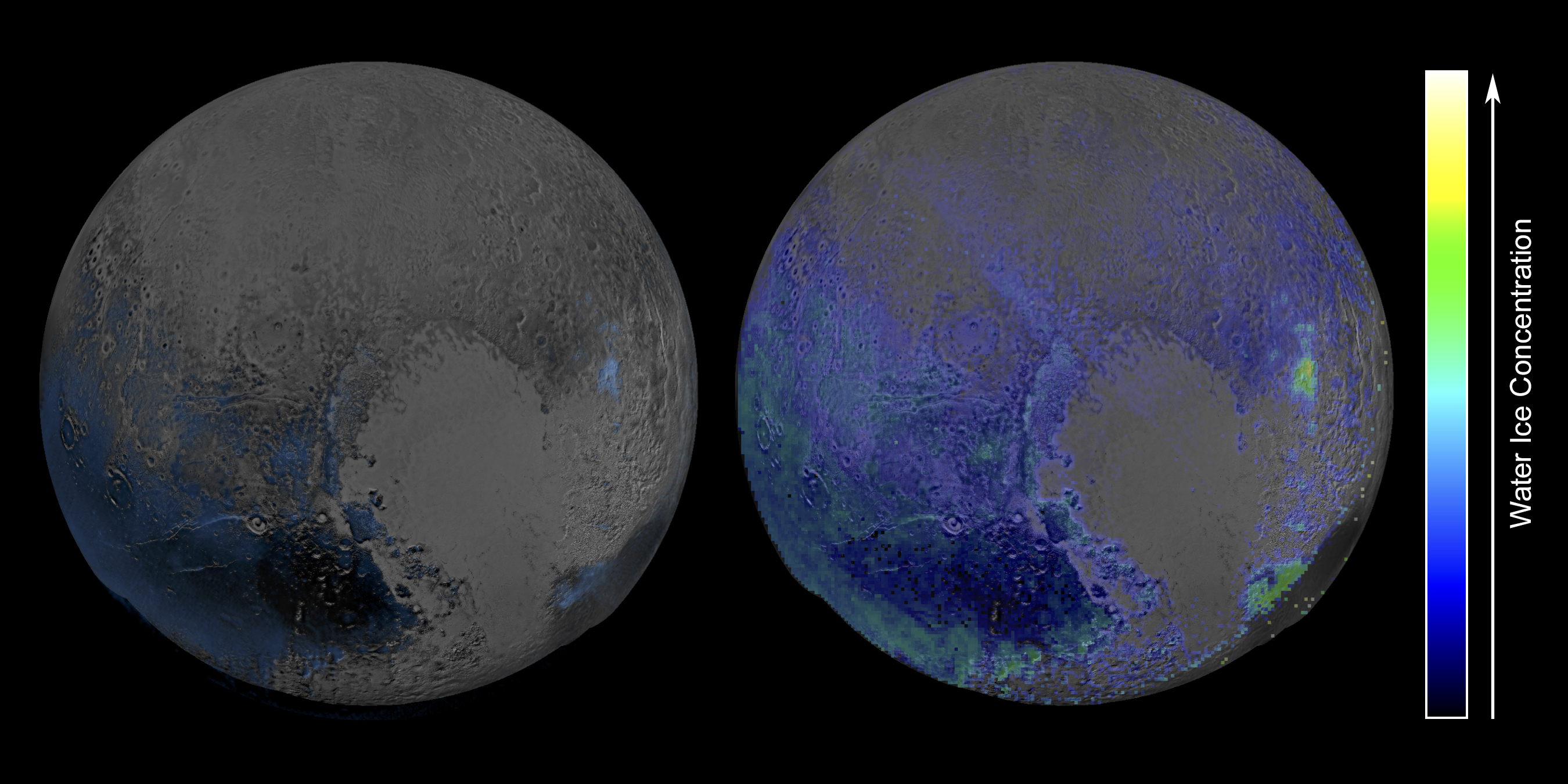
This false-color infrared image from NASA’s New Horizons spacecraft shows water ice concentrations on Pluto. The left image is the result of an initial analysis, and the right image has been reprocessed to account for mixtures with other types of ice. (Credit: NASA / JHUAPL / SwRI)
A color-coded map from NASA’s New Horizons mission shows where Pluto’s frozen water is concentrated, just in case we need to fill up our tanks on the way toAlpha Centauri or Planet Nine.
Water ice turns out to be more widespread on the dwarf planet than previously thought, the mission’s researchers reported today. They came to that conclusion after some sophisticated analysis of infrared imagery captured during the New Horizons spacecraft’s flyby last July 14.
Soon after the flyby, the mission team concluded that Pluto possessed mountains of water ice rising as high as 11,000 feet above the icy world’s surface. That conclusion was confirmed in follow-up studies based on the infrared data from the piano-sized probe’s Ralph/LEISA instrument.
LEISA’s survey mapped concentrations of water ice, but scientists figured out that the spectral readings could be thrown off if the frozen water was mixed in with frozen methane. When they modeled the contributions from other types of ice on Pluto’s surface, the resulting map showed wider stretches where water ice should be present.
This image from NASA’s New Horizons spacecraft shows patterns in the nitrogen glaciers of an area nicknamed Sputnik Planum – including an “X” to the right and below the image’s center. The darker patch at the center of the image is probably a dirty block of water ice “floating” in the denser nitrogen. (Credit: NASA / JHUAPL / SwRI)
If “X-Files” are defined as data about weird and alien phenomena, NASA’s New Horizons mission to Pluto has X-Files galore. And this week, the mission’s science team shared an X-File with an actual X on it.
The timing of Thursday’s image release couldn’t be much better, coming just a couple of weeks before “The X-Files” (the TV show, that is) returns to Fox for a six-episode run. But this is no publicity stunt; rather, it illustrates how weird geology can get on a world that features glaciers of frozen nitrogen.
The semi-solid nitrogen in a region informally known as Sputnik Planum slowly burbles up and down, due to thermal convection. When blobs of nitrogen rise up and press against each other, patterns of lines mark the boundaries between the blobs. When the blobs subside, the lines disappear.
“This part of Pluto is acting like a lava lamp, if you can imagine a lava lamp as wide as, and even deeper than, the Hudson Bay,” William McKinnon, a researcher from Washington University in St. Louis who’s the deputy lead of the New Horizons geology, geophysics and imaging team, said in a NASA feature.
The U.S. Postal Service’s souvenir sheet of four stamps contains two new stamps appearing twice. The first stamp shows an artist’s rendering of the New Horizons spacecraft and the second shows the spacecraft’s enhanced color image of Pluto taken near closest approach. (Credit: Antonio Alcala / USPS)
For the first time since 1991, Pluto and the solar system’s eight bigger planets are getting their own postage stamps – thanks to a U.S. Postal Service cosmopalooza that also spotlights Earth’s moon and “Star Trek.”
The Pluto stamp pays tribute to NASA’s New Horizons mission, and updates 1991’s speculative view of the dwarf planet. Back then, the legend on the 29-cent stamp read “Pluto – Not Yet Explored.” This time, the four-stamp sheet carries the label “Pluto – Explored!”
The New Horizons probe got a look at these craters during its July 14 Pluto flyby. (Credit: NASA / JHUAPL / SwRI)
The hits just keep on coming from NASA’s New Horizons mission to Pluto: This week’s stunners include views of the surface that look weirder than the terrain in “Star Wars: The Force Awakens,” plus a close look at Nix, one of Pluto’s five moons.
During its July 14 flyby, the piano-sized New Horizons spacecraft captured a string of pictures showing the eastern edge of a dark region nicknamed Cthulhu Regio and apotential ice volcano called Wright Mons. You can also see light-colored craters that have been partially filled in with darker material.
“Pluto has greatly exceeded our expectations in diversity of land forms and processes — processes that continue to the present,” New Horizons team member Alan Howard, a planetary scientist from the University of Virginia at Charlottesville, said in Thursday’s update from NASA.
This enhanced color mosaic combines image data from two cameras on NASA’s New Horizons probe. (Credit: NASA / JHUAPL / SwRI)
The Pluto pictures from NASA’s New Horizons probe just keep getting better and better: Feast your eyes on this colorized view of the border between the towering al-Idrisi mountains made of water ice, and the rippled nitrogen-rich plains of Sputnik Planum.
The view combines high-resolution black-and-white imagery from New Horizons’ Long Range Reconnaissance Imager, or LORRI; and lower-resolution color data from the Ralph/Multispectral Visible Imaging Camera, or MVIC.
The two sets of images were taken about 25 minutes apart on July 14, while the piano-sized probe zoomed within 10,000 miles of the dwarf planet’s surface. Check out the full-size mosaic.
A heart-shaped patch of nitrogen-rich ice (outlined in red) lies next to a mountain range on Pluto, as seen in a picture from NASA’s New Horizons probe. (Credit: NASA / JHUAPL / SwRI with heartification by Vicknesh Selvamani / @Vicknesh96)
If you heart Pluto, you’ll love the sharpest, closest close-up of the dwarf planet, just sent back by NASA’s New Horizons probe.
The images, captured from a distance of 10,000 miles during the July 14 flyby, include a heart-shaped block of nitrogen-rich ice right on the edge of the big heart-shaped region known informally as Tombaugh Regio.
You can also see the craggy blocks of water ice that form the al-Idrisi mountains, bull’s-eye impact craters on Sputnik Planum, and ripples and layers in Pluto’s icy crust. The pictures have a maximum resolution of 250 feet per pixel, which is less than the length of a football field.
An array of images shows Pluto from all sides, as seen by NASA’s New Horizons probe over the course of one full Plutonian day (6.4 Earth days) from July 7 to 13. (Credit: NASA / JHUAPL / SwRI)
The bright heart of Pluto has been burned into our consciousness, thanks to scads of high-resolution pictures. But a new set of images from NASA’s New Horizons mission provides an all-around view of the dwarf planet, including the splotchy shapes that went out of view days before the time of closest approach on July 14.
Another 10-picture set shows Pluto’s biggest moon, Charon, from all sides.
The imagery was captured over the course of a full Plutonian day, which is 6.4 Earth days long. New Horizons’ Long Range Reconnaissance Imager and the Ralph / Multispectral Visible Imaging Camera were trained on the icy worlds as the distance to Pluto decreased from 5 million miles on July 7 to 400,000 miles on July 13.
A color-coded topographical map, based on New Horizons data, shows Piccard Mons on the surface of Pluto. The mountain’s structure suggests that it’s an ice volcano. (Credit: NASA / JHUAPL / SwRI)
Scientists with NASA’s New Horizons mission say that at least a couple of the miles-high mountains on Pluto look as if they’re ice-belching volcanoes, providing further evidence that the dwarf planet is geologically active.
Although the case for cryovolcanoes isn’t yet rock-solid, it’s the “least weird explanation” for the observations of 2-mile-high Wright Mons and 3-5-mile-high Piccard Mons, said Oliver White of NASA’s Ames Research Center, a member of the mission’s geology team.
If the mountains’ status is confirmed, “that would be one of the most phenomenal discoveries of New Horizons,” White told reporters. “Whatever they are, they’re definitely weird.”
Like Piccard Mons, Wright Mons has a summit depression that suggests it’s an ice volcano on Pluto. (Credit: NASA / JHUAPL / SwRI)
Pluto’s potential status as a volcanic world was just one of the revelations that came to light on Monday during a review of New Horizons’ latest discoveries at the annual meeting of the American Astronomical Society’s Division for Planetary Sciences in National Harbor, Md.
“The New Horizons mission has taken what we thought we knew about Pluto and turned it upside down,” Jim Green, director of planetary science at NASA Headquarters, said in a news release about the findings.
This image of Kerberos was created by combining four individual images from New Horizons’ Long Range Reconnaissance Imager that were captured on July 14, approximately seven hours before the spacecraft’s closest approach to Pluto, at a range of 245,600 miles (396,100 kilometers) from Kerberos. The image has bee processed to recover the highest possible resolution. (Credit: NASA / JHUAPL / SwRI)
NASA’s New Horizons probe has finally filled out its family portrait of Pluto and its moons – and Kerberos, the last moon to get its closeup, turns out to be nothing like what scientists expected.
Before the piano-sized spacecraft’s July flyby, an analysis of Kerberos’ gravitational influence on Pluto’s four other moons suggested that it had some heft. But the fact that it was so dim led the mission team to conclude it must have a dark surface. Otherwise, why would an object so large reflect so little light?
It turns out that Kerberos is almost as tiny as Pluto’s smallest moon, Styx. Like Styx, Kerberos’ surface appears to consist of relatively clean water ice, making it bright enough to reflect about half of the sunlight it receives.