Categories
GeekWire

Scientists get a fix on coronavirus’ deadly weapon

Coronavirus spike protein
These diagrams show the protein structure for the “spike” that’s used by the coronavirus known as COVID-19 to force its way into cells. The diagram at left shows the spike with a molecular key known as the RBD in the “down” position. The middle diagram shows the RBD-up conformation, and the diagram at right shows the spike on the SARS virus for comparison’s sake. (Wrapp, Wang et al. / UT-Austin / NIH via Science / AAAS)

Biochemists have created the first 3-D, atomic-scale map of key proteins in the killer coronavirus, opening up new possibilities for developing treatments and a vaccine.

Researchers at the University of Washington and its Institute for Protein Design are among the sleuths who’ll be taking advantage of the new clues.

The map shows the 3-D arrangement of proteins in the molecular “spike” that the virus known as COVID-19 uses to force its way into the cells that it infects. Once the virus gains entry, it delivers genetic code that takes control of the cells to spread the infection.
Get the full story on GeekWire.

Categories
GeekWire

A-Alpha Bio raises $2.8M for drug discovery

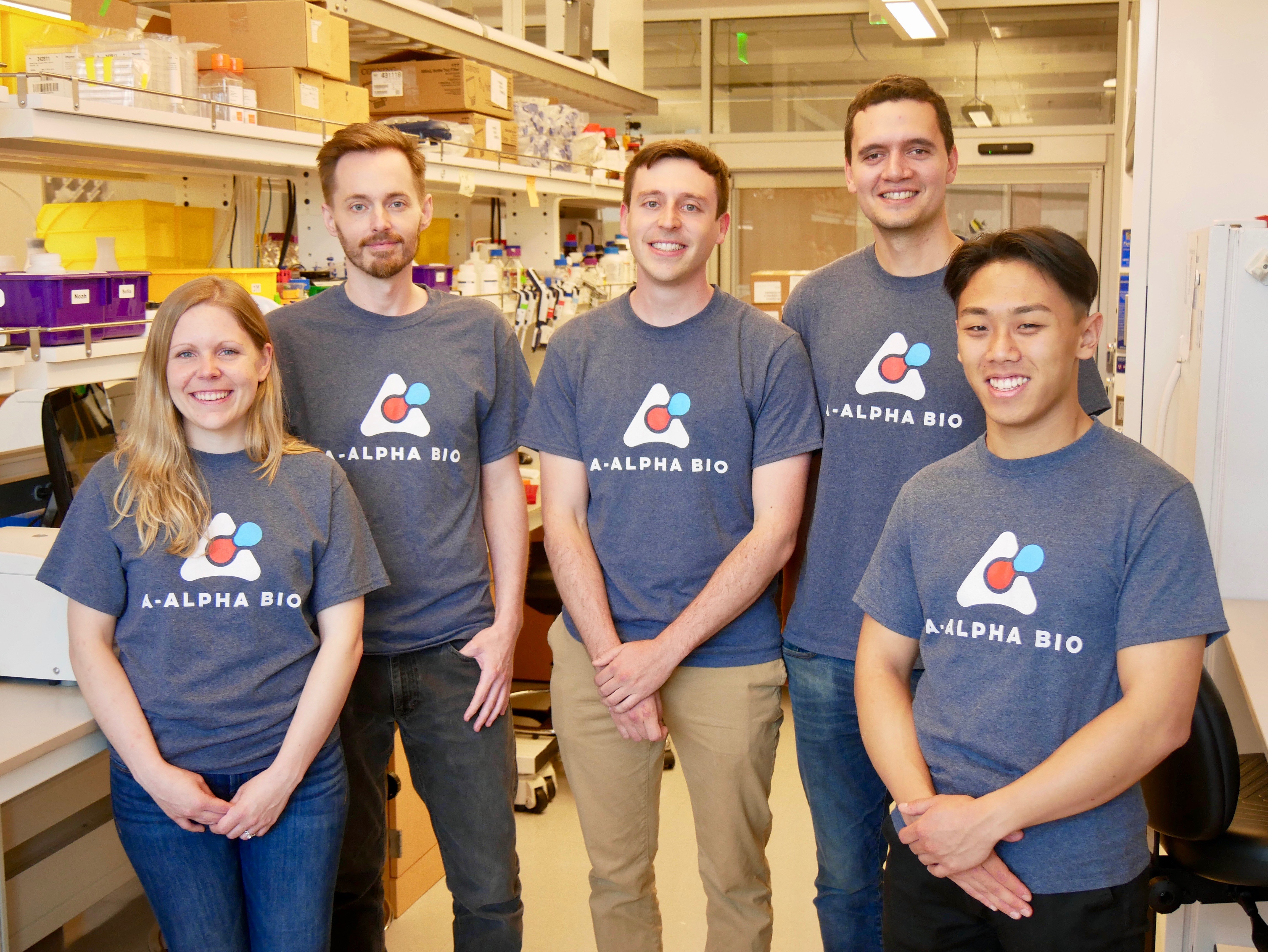
A-Alpha Bio team
The A-Alpha Bio team includes scientist Emily Engelhart, principal scientist David Colby, co-founder and CEO David Younger, co-founder and chief technology officer Randolph Lopez and engineering associate Charles Lin. (A-Alpha Bio Photo)

A Seattle startup that took root at the University of Washington has closed a $2.8 million seed round for a drug discovery platform that can sort through millions of protein interactions at once.

“We expect that we can go considerably further than that,” said David Younger, the co-founder and CEO of A-Alpha Bio.

A-Alpha Bio’s genetically engineered protein analysis technology, known as AlphaSeq, has the potential to speed up the process of evaluating drug candidates. That’s what attracted interest from investors including OS Fund, which led the seed round, plus AME Cloud Ventures, Boom Capital, Madrona Venture Group, Sahsen Ventures, Washington Research Foundation and a number of angel investors.

Get the full story on GeekWire.

Categories
GeekWire

Protein designers get a $45 million boost

David Baker and Neil King
University of Washington biochemists David Baker and Neil King show off molecular models of proteins at UW’s Institute for Protein Design. (UW IPD Photo / Ian Haydon)

The era of engineering proteins for medical applications just got a lot closer, thanks to a five-year, $45 million grant from The Audacious Project at TED to the Institute for Protein Design at the University of Washington School of Medicine.

The institute, headed by UW biochemist David Baker, is among eight recipients of Audacious grants announced today at the annual TED conference in Vancouver, B.C.

“We’re really thinking of this as a protein design revolution, parallel to the digital revolution at Bell Labs. … If you can design proteins exactly to order from first principles, you can solve a lot of problems that are facing humans today — primarily in medicine, but also in materials and energy,” Baker told GeekWire.

Among the potential products are a universal flu vaccinenon-addictive painkillers, smart proteins capable of identifying and treating cancer cells or the out-of-control cells that cause autoimmune disorders, potential treatments for neurodegenerative disorders and self-assembling proteins for solar cells or nanofabrication.

Get the full story on GeekWire.

Categories
GeekWire

Scientists design proteins that snap together

Protein assembly
This molecular visualization shows how proteins are assembled like building blocks. (UW Illustration)

Researchers have created molecular building blocks that can weave themselves into long threads of protein.

Well, maybe not all that long. Each protein-based building block measures only a nanometer in length, and the self-assembled filaments get about as long as 10,000 nanometers. It’d take more than 2,500 of those filaments, laid end to end, to amount to an inch in total length. Nevertheless, the feat described in this week’s issue of the journal Science demonstrates the power and beauty of protein design.

“Being able to create protein filaments from scratch — or de novo — will help us better understand the structure and mechanics of naturally occurring protein filaments and will also allow us to create entirely novel materials, unlike any found in nature,” senior study author David Baker of the University of Washington said today in a news release.

Baker is a biochemist at the UW School of Medicine and director of UW’s Institute for Protein Design, which has pioneered the protein-folding field for years.

Get the full story on GeekWire.

Categories
GeekWire

Scientists pull out protein data from single cells

NanoPOTS protein analysis
Ying Zhu, a chemist at Pacific Northwest National Laboratory, places a chip containing samples for analysis into the automated NanoPOTS system. (PNNL Photo / Andrea Starr)

Scientists have developed a technique that can analyze fluid from a single human cell to identify its proteins — which could open the way for tracking the progression of cancer one cell at a time.

The method is known as NanoPOTS, or “nanodroplet processing in one pot for trace samples.” It was developed by scientists at the the Department of Energy’s Pacific Northwest National Laboratory, and detailed in a study published in the German journal Angewandte Chemie.

“NanoPOTS is like a molecular microscope that allows us to analyze samples that are 500 times smaller than we could see before,” PNNL analytical chemist Ryan Kelly, the study’s senior author, said in a news release. “We can identify more proteins in one cell than could previously be identified from a group of hundreds of cells.”

Get the full story on GeekWire.

Categories
GeekWire

Protein designers get a boost for flu vaccine project

David Baker
David Baker heads the University of Washington’s Institute for Protein Design. (UW Medicine Photo)

The University of Washington’s Institute for Protein Design has won an $11.3 million grant from the Open Philanthropy Project to cook up a public health breakthrough: a universal flu vaccine.

This marks the San Francisco-based nonprofit group’s first gift to a research effort in the Seattle area, and one of its largest gifts to date. Open Phil’s main funders are Facebook co-founder Dustin Moskovitz and philanthropist Cari Tuna, a husband-and-wife team.

The grant will accelerate the institute’s efforts to advance the field of protein design and put it to use in real-world applications.

Get the full story on GeekWire.

Categories
GeekWire

Scientists build proteins into molecular capsules

Nucleocapsid
This cutaway view shows the protein design for a synthetic nucleocapsid known as I53-50-v1. (Nature / UW Graphic / Butterfield, Lajoie et al.)

University of Washington researchers have taken a page from the viral playbook to create microscopic assemblies for packaging genetic material — with the goal of using the system for targeted drug delivery.

The assemblies, known as synthetic nucleocapsids, work like viruses to protect their payloads as they enter cells. They can even evolve over time. That may sound like the start of a science-fiction novel, but  the authors emphasize that their plot doesn’t have a scary ending.

“Our nucleocapsids are not viruses, because they have no way to get into cells, out of cells, or replicate on their own without our direct intentional assistance,” they said in an email sent to GeekWire by UW biochemist Marc Lajoie.

Lajoie is one of the authors of the study, published today by the journal Nature.

Get the full story on GeekWire.

Categories
GeekWire

Cyrus Biotech raises $8M for protein toolkit

Cyrus Bench on laptop
Cyrus Bench is a software platform for protein engineering. (Cyrus Biotech Photo)

Cyrus Biotechnology is getting an $8 million infusion for its cloud-based protein modeling and design toolkit, thanks to a Series A financing round.

The investment round was led by Trinity Ventures, with participation from OrbiMed AdvisorsSpringRock Ventures, the W Fund and individual investors, the Seattle-based venture said today in a news release.

Cyrus Biotech’s primary product, Cyrus Bench, is a software package based on Rosetta, a protein-modeling platform that was created at the University of Washington. Rosetta lets researchers twist and turn virtual models of protein molecules to create novel configurations. (It’s even spawned a video game for citizen scientists called Foldit and a screensaver called Rosetta@Home.)

Protein-folding has been compared to solving puzzles, or building molecular-scale keys for cellular locks. A protein molecule with the right shape could block a virus from invading a cell, or unlock a therapy for disease.

Get the full story on GeekWire.

Categories
GeekWire

Big data helps scientists solve protein puzzles

Protein models
The molecular diagram at left is a representation of a protein molecule known as DMT superfamily transporter YddG, generated by Rosetta@Home software. The diagram at right is a representation of the molecule as determined by experiments. (Sergei Ovchinnikov et al. / UW via AAAS / Science)

Molecular biologists have enlisted cutting-edge trends in genomics and big data to get a grip on one of the grand challenges of biotech: figuring out how protein molecules fold.

But they couldn’t have done it without the help of tens of thousands of volunteers.

The fruits of all that crowdsourced computer labor went public today in the journal Science. Researchers from the University of Washington and other institutions say they’ve solved more than 600 protein-folding mysteries – which represents a fair proportion of the estimated 5,200 protein families whose molecular structure was unknown.

Still more solutions are in the works, and solving those puzzles could lead to new types of medicines and synthetic molecular machinery.

Get the full story on GeekWire.

Categories
GeekWire

Scientists find ways to pick a protein’s pockets

Folded protein
This graphic shows the structure of a computationally designed protein that incorporates sheet-like structures with pockets, known as beta sheets. The beta sheets are the wavy “noodles” in the diagram. The structure also incorporates curled-up molecular spirals. (UW Institute for Protein Design / AAAS)

Researchers at the University of Washington have cracked the code for producing molecular structures with tiny pockets – structures that are likely to expand the repertoire for custom-designed proteins.

The structures, technically known as beta sheets, are thought to have an effect on metabolic pathways and cell signaling. Knowing how to produce them synthetically in precise configurations could lead to new treatments for maladies such as AIDS, cancer and Alzheimer’s disease.

Get the full story on GeekWire.