Caltech says the two-story, 21,000-square-foot facility is the first corporate partnership building on its campus. “Day One” came in August, said Oskar Painter, a Caltech physics professor who’s leading the center.
“We’re in the building,” Painter, the AWS center’s head of quantum hardware, told GeekWire. “Our people have been working there, which has been great. Obviously, we would have been remote regardless, given the COVID [pandemic], but it’s been a really great time to come back and see each other, and celebrate this facility.”
The center will bring together AWS developers and academic researchers, not just from Caltech but from other institutions around the country, to solve problems standing in the way of a quantum computing revolution. Among the collaborators are researchers from the University of Washington, Stanford, MIT, Harvard and other computer science powerhouses.
To back up that claim, IonQ is turning to a metric known as quantum volume. That’s a multidimensional yardstick that combines stats ranging from the number of quantum bits (a.k.a. qubits) in a computer to the system’s error rate and cross-qubit connectivity.
In today’s news release, IonQ says its next-generation system will feature 32 “perfect” qubits with low gate errors, penciling out to a quantum volume value in excess of 4 million.
The numbers game highlights the fact that the competition in quantum computing is just getting started, more than two decades after computer scientists laid out the theoretical foundations for the field.
Under the best of circumstances, quantum computing is hard to wrap your brain around. Rather than dealing with the cold, hard ones and zeroes of classical computing, the quantum paradigm relies on qubits that can represent multiple values at the same time.
The approach is particularly well-suited for solving problems ranging from breaking (or protecting) cryptographic codes, to formulating the molecular structures for new materials and medicines, to optimizing complex systems such as traffic patterns and financial markets.
Players in the quantum computing game include heavy-hitters such as IBM, Google and Honeywell — as well as startups such as Maryland-based IonQ, California-based Rigetti and B.C.-based D-Wave Systems.
The important thing to keep in mind is that different technologies from different providers (including IonQ, Rigetti and D-Wave) are being offered on the quantum cloud platforms offered by Amazon and Microsoft. IBM and Google, meanwhile, provide their quantum tools as options on their own cloud computing platforms.
Developers who want to make use of quantum data processing aren’t likely to go out and buy a dedicated quantum computer. They’re more likely to choose from the cloud platforms’ offerings — just as a traveler who wants to rent a snazzy car from Hertz or from Avis can go with a Corvette or a Mustang.
That’s where metrics make the difference. If you can show potential customers that your quantum machine has more horsepower, you’re likely to do better in an increasingly competitive market.
In contrast, IonQ emphasizes qubit quality over quantity. “We’re not going to throw a million qubits on the table unless we can do millions of operations,” co-founder and chief scientist Chris Monroe told me last December.
Peter Chapman, the former Amazon exec who now serves as IonQ’s CEO and president, said quantum computing should prove its worth well before the million-qubit mark.
“In a single generation of hardware, we went from 11 to 32 qubits, and more importantly, improved the fidelity required to use all 32 qubits,” Peter Chapman, the former Amazon exec who now serves as IonQ’s CEO and president, said in today’s news release.
“Depending on the application, customers will need somewhere between 80 and 150 very high-fidelity qubits and logic gates to see quantum advantage,” Chapman said. “Our goal is to double or more the number of qubits each year.”
IonQ’s 32-qubit hardware will be rolled out initially as a private beta, and then will be made commercially available via Amazon Braket and Microsoft Azure Quantum.
As we await the next raise in the numbers game, it might be a good idea to set up a trusted authority to take charge of the standards and benchmarking process for quantum computing — similar to how the TOP500 has the final word on which supercomputers lead the pack.
Such an authority could definitively determine who has the world’s most powerful quantum computer. Or would that violate the weird rules of quantum indeterminacy?
Update for 3:35 p.m. PT Oct. 5: We’ve added more precise language and links to describe the distinctions between different types of quantum computing technology.
Krysta Svore, who leads the Microsoft Quantum – Redmond group at Microsoft Research, explains how quantum computing hardware works at a Seattle science meeting in February. (GeekWire Photo / Alan Boyle)
Those three organizations have already been working together through the Northwest Quantum Nexus to develop the infrastructure for quantum computers, which promise to open up new possibilities in fields ranging from chemistry to systems optimization and financial modeling.
The initiatives announced today are likely to accelerate progress toward the development of commercial-scale quantum computers, Chetan Nayak, Microsoft’s general manager for quantum hardware, said in a blog posting.
“Today marks one of the U.S. government’s largest investments in the field,” he said. “It is also a noteworthy moment for Microsoft, which is providing scientific leadership in addition to expertise in workforce development and technology transfer.”
In contrast to the rigid one-or-zero realm of classical computing, Braket and similar platforms take advantage of the fuzziness of quantum algorithms, in which quantum bits — or “qubits” — can represent multiple values simultaneously until the results are read out.
Quantum computing is particularly well-suited for tackling challenges ranging from cryptography — which serves as the foundation of secure online commerce — to the development of new chemical compounds for industrial and medical use. Some of the first applications could well be in the realm of system optimization, including the optimization of your financial portfolio.
But wait … there’s more: D-Wave’s partners and customers are providing expertise to help researchers use quantum tools to study the virus and how to stop it.
The companies joining the quantum fray alongside D-Wave include Volkswagen, Kyocera, NEC Solution Innovators, Denso, Cineca, Forschungszentrum Jülich, MDR/Cliffhanger, Menten AI, OTI Lumionics, QAR Lab at LMU Munich, Sigma-i and Tohoku University.
D-Wave Systems is unveiling its Leap 2 quantum cloud computing service. (D-Wave Graphic)
What comes after a quantum leap? For Burnaby, B.C.-based D-Wave Systems, it’s Leap 2, the latest iteration of its cloud-based quantum computing service.
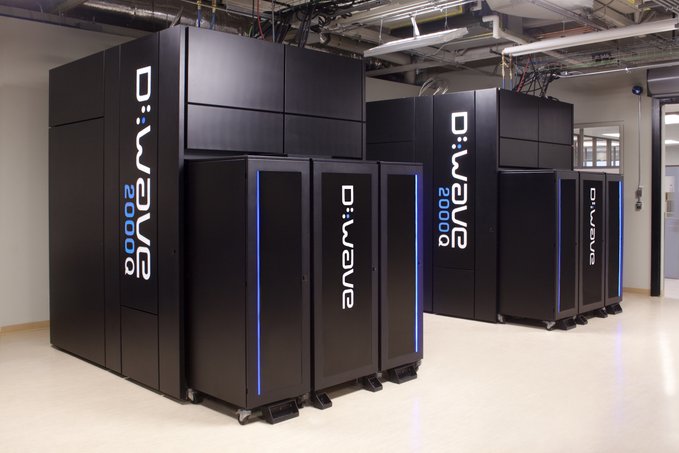
A team member at D-Wave Systems, based in Burnaby, B.C.,, works on the dilution refrigerator system that cools the processors in the company’s quantum computer. (D-Wave Systems Photo)
Snarled traffic in Seattle’s South Lake Union neighborhood. (GeekWire Photo / Kevin Lisota)
Traffic congestion in Seattle can get so bad that it seems as if you need a next-generation quantum computer to make sense of it — and that’s exactly what Microsoft and Ford are aiming to do.
The quantum frontier hasn’t yet reached the point at which a general-purpose computer can solve the mother of all traffic jams. But the two companies are using quantum-inspired simulations to address the optimization problem that arises when all the drivers are following the same app-generated driving directions.
“While we’re still in the early stages of quantum computing development, encouraging progress has been made that can help us take what we’ve learned in the field and start to apply it to problems we want to solve today, while scaling to more complex problems tomorrow,” Ken Washington, chief technology officer at Ford Motor Company, wrote today in a Medium post.
Stefano Pellerano, principal engineer at Intel Labs, holds the cryogenic control chip known as Horse Ridge. (Intel Photo / Walden Kirsch)
Microsoft, Amazon and Google aren’t the only companies making headway in quantum computing. Intel is showing off a new type of chip for processing qubits, D-Wave Systems is getting a new CEO, and IBM is gearing up for quantum-safe cryptography.
The Amazon Braket quantum computing service will take advantage of hardware devices developed by Rigetti Computing and other companies. (Rigetti Photo)
Amazon Web Services is leaping into quantum computing with both feet — or maybe more than both feet, in keeping with the weird world of quantum physics.
AWS’ quantum initiative, announced today in conjunction with its re:Invent cloud computing conference in Las Vegas, includes the unveiling of a cloud-based quantum computing service called Amazon Braket, as well as the creation of the AWS Center for Quantum Computing and the Amazon Quantum Solutions Lab.
But wait … there’s more: The Braket computing platform, which is analogous to the Microsoft Azure Quantum platform announced last month, brings together three different hardware approaches to quantum calculation.
The broad sweep of AWS’ quantum initiative demonstrates that one of the titans of cloud computing is covering its bets as quantum information science matures..