Categories
GeekWire

How will we get our message across to E.T.?

Beaming signals to GJ273 b
Astronomers and artists sent a binary-coded radio transmission in the direction of an extrasolar planet known as GJ273 b in 2017. (METI International Illustration / Danielle Futselaar)

LOS ANGELES — Last year, scientists sent a binary-coded message telling the aliens what time it was. Next year, it’ll be the periodic table of the elements. And someday, they hope to transmit a universal language that even extraterrestrials might relate to.

“I think we should treat this as a multigenerational, true experiment as opposed to an observational exercise, like archaeology,” said Doug Vakoch, a veteran of the search for extraterrestrial intelligence who is now president of METI International.

Vakoch and other researchers, including linguists, gathered here this weekend at the National Space Society’s International Space Development Conference to consider the content for future messages to E.T.

In the process, they considered the meaning of language as well.

Get the full story on GeekWire.

Categories
GeekWire

Astrobiologist wins SETI Institute’s Drake Award

Victoria Meadows
University of Washington astrobiologist Victoria Meadows holds up a rock sample. (UW Photo)

University of Washington astrobiologist Victoria Meadows has become the first woman to receive the SETI Institute’s Frank Drake Award, named after a pioneer in the search for extraterrestrial intelligence.

Meadows directs UW’s graduate program in astrobiology and is the principal investigator for the Virtual Planetary Laboratory, which is based at UW and administered by the NASA Astrobiology Institute.

Under Meadows’ guidance, researchers affiliated with the VPL use computer modeling to assess the potential habitability of planets beyond our solar system. About two dozen institutions, including UW and other universities as well as NASA centers, participate in the VPL program.

Get the full story on GeekWire.

Categories
GeekWire

Scientists will seek signs of aliens’ bad behavior

HabEx telescope and sunshade
An artist’s conception shows the Habitable Exoplanet Imaging Mission’s space telescope and its starshade. (NASA / JPL Illustration)

Global warming and nuclear blasts may be bad for humanity, but astrobiologists say they could be good indicators of the presence of intelligent life on distant worlds.

Such signatures of risky biological behavior should therefore be included in the list of things for future space telescopes to seek out, researchers say in a white paper prepared for the National Academy of Sciences.

The strategy would add a contemporary twist to the search for extraterrestrial intelligence, or SETI, reflecting the view that Earth is transitioning into a technology-driven geological era some call the Anthropocene.

“Examining the Anthropocene epoch through the lens of astrobiology can help to understand the future evolution of life on our planet and the possible evolution of technological, energy-intensive life elsewhere in the universe,” the researchers write.

Get the full story on GeekWire.

Categories
GeekWire

How scientists are expanding the SETI spectrum

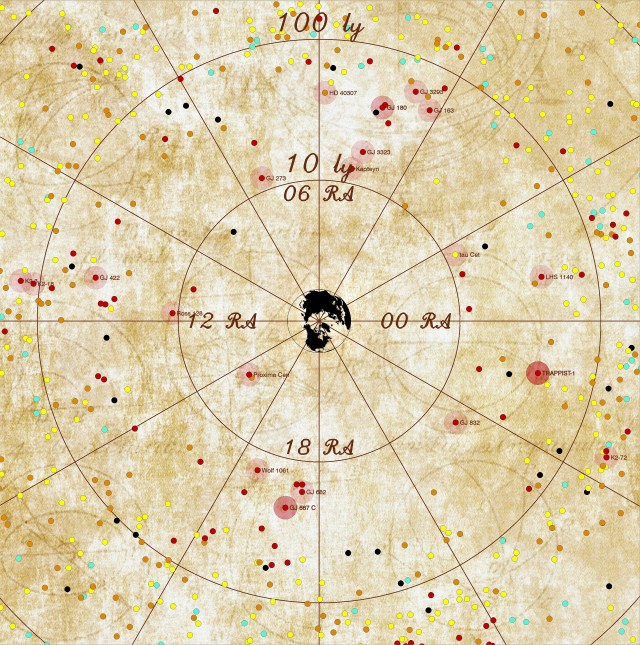
Habitable planet map
This map from the University of Puerto Rico’s Planetary Habitability Laboratory shows the known planetary systems within about 100 light-years from Earth, plotted on a logarithmic scale. The systems with potentially habitable exoplanets are highlighted with red circles. (PHL @ UPR Arecibo)

BERKELEY, Calif. — Twenty years after the movie “Contact” brought the search for extraterrestrial intelligence, or SETI, to the big screen, it’s dawning on astronomers that the real-world plotline might turn out to be totally different 20 years from now.

So far, SETI has been dominated by radio telescope surveys looking for anomalous patterns that may point to alien transmissions. But SETI’s practitioners are realizing that E.T. may make its presence known in other ways.

Over the next 20 years, or 200 years, SETI may come to stand for sensing extraterrestrial irregularities, ranging from unusual atmospheric chemistry to higher-than-expected thermal emissions. The telltale signs of life beyond our solar system may even be associated with phenomena we haven’t yet come across.

Get the full story on GeekWire.

Categories
GeekWire

SETI scientists hear nothing from interstellar object

Green Bank Telescope
The Breakthrough Listen initiative uses the Green Bank Telescope in West Virginia. (NRAO Photo)

The scientists behind the Breakthrough Listen initiative say they haven’t detected any radio signals coming from a strange interstellar object known as ‘Oumuamua, but there are still more observations to be made and analyzed.

Get the news brief on GeekWire.

Categories
GeekWire

Is weird object a starship? Scientists will check

'Oumuamua
An artist’s conception shows what the interstellar asteroid ‘Oumuamua might look like. (ESO Illustration / M. Kornmesser)

Is that cigar-shaped, fast-moving interstellar object a spaceship? Almost certainly not, but Breakthrough Listen will check just to make sure.

The Breakthrough Listen campaign, which checks celestial targets for radio signals from intelligent civilizations, will turn the Green Bank Telescope in West Virginia toward the object, known as ‘Oumuamua, starting Dec. 13.

Scientists will check for emissions across four radio bands from 1 to 12 GHz. The first phase of observations will take up 10 hours, divided into four key time periods based on ‘Oumuamua’s period of rotation.

Get the full story on GeekWire.

Categories
GeekWire

Messages and music beamed to alien super-Earth

Beaming signals to GJ273 b
The target of the “Sonar Calling” binary-coded radio transmission is a planet known as GJ273 b. (METI International Illustration / Danielle Futselaar)

Scientists and artists have banded together to beam coded radio transmissions toward a star that has a potentially habitable planet, just 12.4 light-years from Earth.

“Sónar Calling GJ273b” is the latest effort to communicate with aliens, 43 years since the first attempt was made using the 1,000-foot Arecibo radio telescope in Puerto Rico.

The “Sónar Calling” messages were sent on three successive days, Oct. 16-18, from the 32-meter EISCAT radio antenna in Tromsø, Norway, just inside the Arctic Circle. Each transmission was directed at peak power of 2 megawatts toward a red dwarf star known as GJ273, or Luyten’s Star, in the constellation Canis Major.

Astronomers say Luyten’s Star harbors a planet that’s more than twice as massive as Earth, in an orbit where water could conceivably exist in liquid form. “Sónar Calling” aims to communicate with any radio-savvy life forms on that planet, called GJ273 b.

Get the full story on GeekWire.

Categories
GeekWire

Billionaire wants to look for life on Enceladus

Oliver Morton and Yuri Milner
Russian billionaire Yuri Milner, at right, chats with The Economist’s Oliver Morton during the “New Space Age” conference at Seattle’s Museum of Flight. (GeekWire Photo / Alan Boyle)

Russian billionaire Yuri Milner today laid out his vision to send the first privately funded interplanetary space mission to look for life at the Saturnian moon Enceladus — but first he had to address less lofty matters.

Milner has been in the news for the past week because newly published confidential documents known as the “Paradise Papers” revealed that two firms controlled by the Russian government backed his early investments in Facebook and Twitter.

So, of course, that was the first topic Milner was asked about during an onstage fireside chat at The Economist’s “New Space Age” conference at the Museum of Flight in Seattle.

Get the full text on GeekWire.

Categories
GeekWire

Alien hunters track strange radio bursts

Green Bank Telescope
Intriguing signals have been picked up via West Virginia’s Green Bank Telescope. (NRAO Photo)

Breakthrough Listen, a $100 million initiative aimed at stepping up the search for alien signals, says it’s picked up an intriguing series of 15 fast radio bursts emanating from a dwarf galaxy 3 billion light-years away.

It’s way too early to claim that the signals from the galaxy, which hosts a radio source known as FRB 121102, constitute the kind of evidence sought for decades by researchers specializing in the search for extraterrestrial intelligence, or SETI.

But Breakthrough Listen’s researchers say that possibility can’t yet be ruled out.

Get the full story on GeekWire.

Categories
GeekWire

Scientists know what that ‘weird’ signal was

Weird Signal
The “Weird! Signal” from Ross 128, detected on May 12, is highlighted by the red box in this chart of frequency signal strength over time. (PHL @ UPR Arecibo)

A week ago, astronomers using the Arecibo radio telescope in Puerto Rico were intrigued about a radio signal they picked up in May, apparently from the vicinity of the red dwarf star Ross 128. Now they think they know what it was.

Spoiler alert: It’s not aliens.

To gather more evidence about the source of the quasi-periodic signal, astronomers took a closer look at the star on July 16 – not only with the 1,000-foot-wide Arecibo Observatory, but with the Green Bank Telescope in West Virginia and the SETI Institute’s Allen Telescope Array in California.

“We are now confident about the source of the ‘Weird! Signal,’” Abel Mendez, a planetary astrobiologist at the University of Puerto Rico at Arecibo, said today in an update.

Get the full story on GeekWire.