This image shows field lines of a solar coronal magnetic model based on measurements from the National Solar Observatory Integrated Synoptic Program, one solar rotation before the Aug. 21 total solar eclipse. (NSO / NSF Graphic)
Skywatchers will see a rare celestial sight during the Aug. 21 total solar eclipse: the sun’s shimmering outer atmosphere, known as the corona. What will it look like? Astronomers worked their magic to give us a glimpse.
The corona is more than just a fuzzy halo: The superheated gas that makes up the sun’s outermost layer tends to follow the patterns of magnetic force that arc around the sun.
To come up with their preview of the corona, researchers at the National Solar Observatory in Arizona modeled the sun’s magnetic field as of July 25, which was 27 days in advance of the solar eclipse. That’s important, because it takes the sun 27.2753 days to make a complete rotation.
Oregon’s Mount Jefferson looms on the western horizon outside Madras. The fields on either side of the blacktop road will be turned into a “Solartown” campground for 4,900 tents during the runup to the Aug. 21 total solar eclipse. (GeekWire Photo / Alan Boyle)
MADRAS, Ore. – If there’s one thing central Oregon has in abundance, it’s open space. And that’s a good thing for the total solar eclipse that’s due to sweep through the region on Aug. 21.
Even though hotel rooms are sold out anywhere that’s even near the 70-mile-wide zone of totality running across the state, there’s still a good chance of finding an enterprising landowner who’ll rent you a camping spot.
But if there’s one thing central Oregon doesn’t have a whole lot of, it’s four-lane highways.
That’s likely to be an issue for the hundreds of thousands of eclipse-chasers who are expected to swarm into towns like Madras, Prineville, Mitchell and John Day. Or maybe not.
“The bad thing about it is that nobody knows how bad it’s going to get,” said Terry Hansen, park host for Round Butte Overlook Park, just west of Madras.
GeekWire’s Cara Kuhlman, Clare McGrane and Chelsey Ballarte give their eclipse glasses a test drive. (GeekWire Photo / Kurt Schlosser)
All of the continental United States and Canada will witness a solar eclipse on Aug. 21, but you’ll need eye protection to see the partial phase safely. This may be the event that turns solar-filter glasses into a mass-market fashion statement.
If you think regular sunglasses, compact discs or exposed photographic film will do the trick, think again. (Besides, who has film lying around anymore?) As long as even a sliver of the sun’s disk is uncovered, virtually the only safe way to see the spectacle directly is through special spectacles.
Fortunately, there should be plenty of solar-viewing glasses to go around. The Robert D. and Jessie L. Stinnett Trust is facilitating distribution of glasses from American Paper Optics through the 2017solar.com website: You can order four pairs of glasses online for $5, but the offer ends on Aug. 1.
Astronomers Without Borders and other nonprofit groups are shipping glasses as well. Plenty of other online outlets sell the glasses (as well as solar filters for cameras, binoculars and telescopes), but whatever you do, make sure your shipment arrives before Aug. 21.
The northern lights shine above Seattle’s Space Needle and Queen Anne Hill in a photo captured by Tim Durkan from West Seattle in May. (Tim Durkan Photo)
What could make a summer weekend with clear skies even more perfect? How about the northern lights?
The chances of seeing auroral displays are better than usual tonight and Sunday night. That’s due to a geomagnetic storm that’s expected to sweep past Earth this weekend.
The storm was spawned on July 13 by an outburst of electrically charged particles from the sun, known as a coronal mass ejection or CME. The National Oceanic and Atmospheric Administration’s Space Weather Prediction Center says the outburst is directed at Earth, and the peak of the wave should arrive sometime on Sunday.
The most violent outbursts have been known to disrupt satellite communications and power grids, but this one is expected to be merely moderate to strong – producing heightened auroras but no big disruptions.
For most people, the big questions are: Can I see the aurora? And if so, where and when?
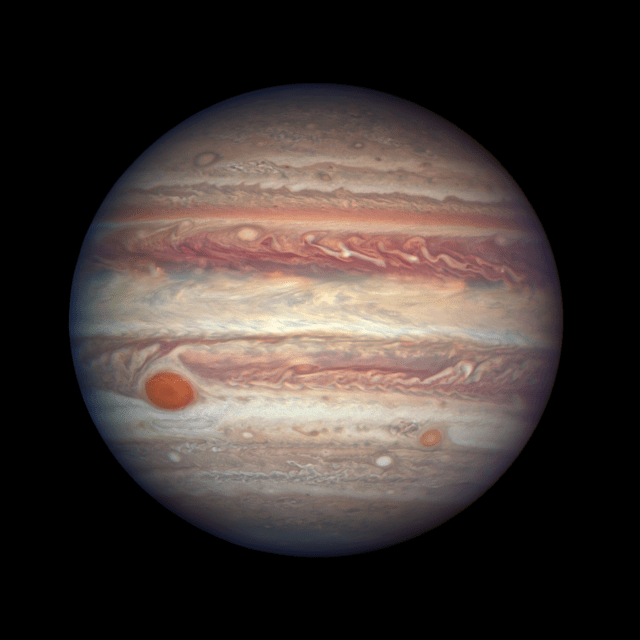
As Jupiter made its nearest approach to Earth in a year, the Hubble Space Telescope viewed the solar system’s largest planet in all of its up-close glory. This picture was taken on April 3 from a distance of 415 million miles. (STScI / ESA / NASA / GSFC Photo / A. Simon)
Astronomer Amy Simon of NASA’s Goddard Space Flight Center arranged to have Hubble trained on the hemisphere that includes Jupiter’s Great Red Spot and another whirling storm to the south, dubbed “Red Spot Jr.” You can also see white spots speckling the planet’s cloud tops.
The interplay of orbits for Jupiter and Earth brought our two planets just 415 million miles apart, which means Hubble’s Wide Field Camera 3 could pick up features as small as 80 miles across.
The greenish streak just to the left of the streetlight in this dashcam video marks the flash of a fireball. (Michael Lee via YouTube)
Dozens of reports have streamed in about a fireball that was seen in the skies over Washington state, Oregon, Idaho and British Columbia on March 16.
The American Meteor Society’s online tracker lists more than 70 reports from locales over a wide area, ranging southward to Eugene, Ore., northward to Vancouver and Enderby, B.C., and eastward to Grangeville, Idaho. Most of the reports were registered around 9:40 p.m.
Michael Lee, one of the founders of the Seattle-based Jobscan resume service, captured the pop and flash of the fireball in a dashcam video.
A montage of images shows the progression of an annular solar eclipse in May 2012, as seen from Red Bluff, Calif. (Brocken Inaglory Photo via Wikimedia – CC BY-SA 3.0)
Skywatchers in South America and Africa will be seeing an unusual “Ring of Fire” solar eclipse on Feb. 26, and the rest of us should be able to look over their shoulders online.
But you might have to get up before sun-up to catch the show.
The event is known as an annular solar eclipse, with “annular” coming from the Latin word for “ring.”
All solar eclipses take place when the moon comes between Earth and the sun, blocking out the sun’s disk. If the orbital mechanics are such that the moon totally blocks the disk, that’s a total eclipse. But if the moon is too far away from Earth to cover all of the sun, the bright edge of the disk is still exposed at the height of the event. Hence the ring of fire.
Certified solar glasses are required to watch a partial solar eclipse. The total phase, however, should be enjoyed without wearing shades. (Rainbow Symphony Photo / Mark Margolis)
BOSTON – Six months from today, millions of Americans will watch the sun darken during a rare coast-to-coast eclipse – and it’s not too early to get into the spirit of totality.
It’s definitely not too early to figure out where you’re going to be: Hotel rooms in the track of the total solar eclipse for the time around Aug. 21 were scarce six months ago, and they’re virtually impossible to find now. In the Pacific Northwest, you’ll have to settle for a room in, say, Portland or Walla Walla, plus a significant drive.
What’s the attraction? You’ll be in on one of our planet’s weirdest phenomena, a minute or two when the sun turns black, surrounded by a shimmering corona. It’ll be much more than an astronomical event.
“This will be the most photographed, the most shared, the most tweeted event in human history,” artist-astronomer Tyler Nordgren said over the weekend in Boston at the annual meeting of the American Association for the Advancement of Science.
A penumbral lunar eclipse not quite as deep as the one we’re about to see occurred over the Far East in November 2012. (Hong Kong Space Museum Photo via Sky & Telescope)
Tonight’s the night when a lunar eclipse dims the full moon, and when a recently discovered green comet comes closest to our planet. But unless you know what’s coming, you’re almost certain to miss them.
You may miss them anyway, depending on the sky conditions. The forecast for the Seattle area calls for partly cloudy skies with a 20 percent chance of rain.
Seattle photographer Tim Durkan captured this view of the full moon behind the Space Needle. (Credit: TimDurkan.com)
The full moon is looking bigger and brighter this week than it’s looked since 1948 – and although you may not notice just how much more super this “supermoon” is, it’s definitely worth looking up. If the skies are ever clear, that is.
The moon is due to be at its closest at 3:22 a.m. PT Nov. 14, and it’ll reach the peak of its full phase a few hours later at 5:52 a.m. The bottom line is that the lunar disk will look about 14 percent wider than it does at its farthest distance from Earth, and shine about 30 percent brighter.
This doesn’t mean you’d have to get up in the wee hours to catch a super view.
“I’ve been telling people to go out at night on either Sunday or Monday night to see the supermoon,” Noah Petro, deputy project scientist for NASA’s Lunar Reconnaissance Orbiter mission, said in a NASA feature about the phenomenon. “The difference in distance from one night to the next will be very subtle, so if it’s cloudy on Sunday, go out on Monday.”