Categories
GeekWire

Check out a ‘Ring of Fire’ eclipse over Africa

Image: Annular eclipse
A series of images shows the progression of the Sept. 1 annular solar eclipse as seen from Reunion Island. (Credit: Slooh / Weathernews Japan)

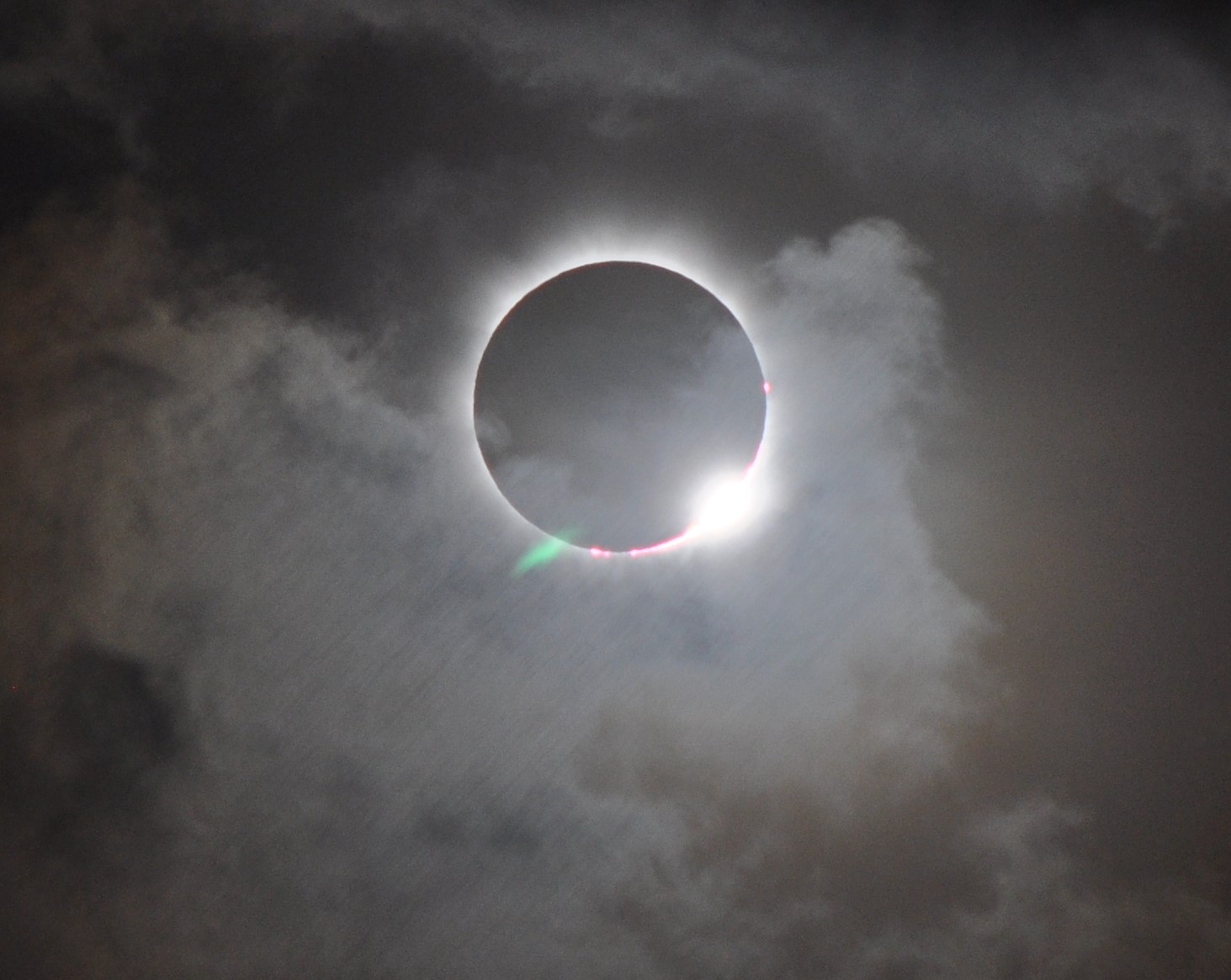
An annular solar eclipse swept across Africa today, treating skywatchers to a “Ring of Fire” eclipse and whetting appetites for next August’s all-American total eclipse.

The eclipse occurred in the middle of the night, Seattle time, but it was prime time for a roughly 100-mile wide swath of territory stretching from Gabon on Africa’s west coast to Mozambique, Madagascar and Reunion Island in the Indian Ocean.Those places are where the “Ring of Fire” effect was visible in all its glory.

Annular solar eclipses are similar to total eclipses, except that the orbital positions of the sun, moon and Earth are such that the moon doesn’t quite cover up all of the solar disk. As a result, the dark moon is surrounded by a blazing O.

About 3,000 eclipse fans gathered on Reunion Island to witness the spectacle, Reuters reported. “I saw a solar eclipse … but I have never seen an annular solar eclipse,” Austrian tourist Beate Sosz was quoted as saying. “It is great.”
Get the full story on GeekWire.

Categories
GeekWire

One year before eclipse, spots are filling up fast

Image: 2012 eclipse
The sun’s corona gleams during a total solar eclipse seen from the northern tip of Australia in November 2012. (Credit: Romeo Durscher via NASA)

It’s exactly one year before the “Great American Eclipse” sweeps across the continent, but depending on where you want to stay, it’s already too late to make a reservation.

On one level, the solar eclipse of Aug. 21, 2017, should rank among the most accessible such phenomena for Americans – and it’s not to be missed. Partial phases of the eclipse should be visible, weather permitting, from most of North America. For example, up to 92 percent of the sun’s disk will be covered as seen from Seattle.

On another level, the eclipse is a hot ticket: Its total phase will be visible only along aroughly 70-mile-wide track that extends from Oregon to South Carolina. Totality means the moon blots out the sun’s entire disk, turning daylight to nighttime for up to two and a half minutes.

Statistically speaking, most of the best places to go for clear skies in August are in a swath of the West ranging from central Oregon to Nebraska. And by some measures, the absolute best is Madras, Ore.

But just try getting a room in Oregon.

Get the full story on GeekWire.

Categories
GeekWire

Relive the peak of the Perseid meteor shower

Image: Perseids and Milky Way
Perseid meteors flash with the Milky Way as a backdrop. (GeekWire photo by Kevin Lisota)

Crowds of skywatchers turned the peak of the Perseid meteor shower into a mass spectator event overnight – and you can catch an encore presentation this weekend, if you know where to go.

For me, last night’s arena was Rattlesnake Lake, about 35 miles east of Seattle. Cars were lined up for miles along the blacktop leading off from Interstate 90’s Exit 34, even though it was 1 o’clock in the morning.

That’s just about the time the moon set, leaving the stage of the clear, black sky open for the meteor performance. My stargazing friend and I settled in right at the lake’s edge, along with hundreds of other people scattered in the darkness. We saw roughly one meteor a minute: Sometimes they came in bunches. Sometimes we just waited and stared. And sometimes we’d miss a flash, only to hear the “oooh” rising up from the surrounding crowd of skywatchers.

Get the full story on GeekWire.

Categories
GeekWire

Perseid meteor shower should pack extra punch

Image: Perseids
A composite view from an all-sky camera in Chickamauga, Ga., shows Perseid meteors flashing on the night of Aug. 11, 2010. (Credit: NASA / MSFC / Meteoroid Environment Office)

August’s Perseid meteor shower is always one of the most accessible sky spectaculars of the year, but this year’s show is expected to be even more spectacular than usual.

The meteoric display is due to reach its peak on the night of Aug. 11, heading into the morning of Aug. 12. But you should be able to see shooting stars all this week, assuming the skies are clear. The best time is after moonset, which occurs around 1 a.m. on the peak night.

The Perseids pop up every year, reaching their height around Aug. 11-13. That’s when Earth passes through a stream of cosmic grit left behind by Comet Swift-Tuttle. When those flecks of grit streak through the upper atmosphere, they ionize the surrounding air and create the flashes we know and love.

Get the full story on GeekWire.

Categories
GeekWire

Atlas shows where you’ll miss the Milky Way

Image: Night sky atlas
A Google Earth visualization shows the effect of light pollution on night-sky viewing in North America. Darker colors indicate lower light pollution, while warmer colors indicate higher levels. (Credit: Falchi et al., Science Advances; Jakob Grothe / NPS; Matthew Price / CU-Boulder)

Eighty percent of Americans can’t see the Milky Way from where they live, according to a new analysis of light pollution’s effect on the night sky. The global dark sky atlas, produced by an international team of researchers, suggests there’s only one spot in Washington state that’s untouched by the effect of artificial light.

“I hope that this atlas will finally open the eyes of people to light pollution,” Fabio Falchi of Italy’s Light Pollution Science and Technology Institute said in a news release. Falchi is the lead author of the analysis, published today by Science Advances.

The atlas is based on readings from the Suomi NPP satellite, which was launched in 2011 and is managed by NASA and the National Oceanic and Atmospheric Administration. Suomi’s main purpose is to provide weather data, but it’s equipped with imagers that can pick up low-light readings at night.

Get the full story on GeekWire.

Categories
GeekWire

Meteors bring holiday cheer – if it’s clear

Image: Geminids
A Geminid meteor makes an impression in an all-sky photo captured in 2011. (Credit: NASA)

The most reliable meteor shower of the year reaches its peak tonight – but to catch the Geminids, you’ll have to find a patch of clear, dark sky.

That’s difficult to do in the Seattle area. There’s a glimmer of hope, however: Theweather outlook improves as Sunday night turns into Monday morning, and it gets a lot better by Monday night. With any luck, there’ll still be some Geminids to see. So let’s assume you do find clear skies sometime in the next couple of days.

The Geminids appear every year from Dec. 4 to 17. They peak on Dec. 13-14, when Earth passes right through the trail of cosmic grit and pebbles left behind by an asteroid or burned-out comet called 3200 Phaeton. When those bits of debris pass through the upper atmosphere, they leave bright meteoric trails behind.

This year is a good one because the crescent moon makes an early exit, leaving a nice glare-less sky to look up into. Under peak conditions, you could see as many as 100 meteors per hour, including showy fireballs.

Get the full story on GeekWire.

Categories
GeekWire

Make the most of the supermoon eclipse

Image: Seattle lunar eclipse
A total lunar eclipse shines dully over Seattle’s Space Needle in 2008. (Credit: Clane Gessel)

Sunday’s super-sized total lunar eclipse is special for a couple of reasons, but it’s extra-special for places like Seattle, where the timing is perfect for family viewing.

“I love it when these astronomical events are at a good time,” said Alice Enevoldsen, an astronomy educator whose home base is in West Seattle. “It’s in the evening … but not yet bedtime for little kids.”

Lunar eclipses are among the most accessible astronomical events out there: When Earth casts its shadow on the full moon’s disk, half the world can watch it — and the show usually lasts for an hour or more, in contrast to the mere minutes of duration for a total solar eclipse. (Check out this interactive feature to learn more about lunar eclipses.)

This eclipse is making headlines in part because it takes place when the full moon’s apparent size is at its maximum for the year — a so-called supermoon. Supermoons are about 7 percent bigger and 16 percent brighter than the average full moon. NASA says the most recent supermoon lunar eclipse was in 1982, and the next time will be in 2033. (However, depending on your definition of a “supermoon,” such an eclipse came in 1997 and is due in 2021 as well.)

For Seattleites, Sunday’s show begins with moonrise at 6:54 p.m. PT, when the eclipse’s partial phase is already well under way. If you’re lucky, you can catch the show’s climax at 7:11 p.m., when the last sliver of the moon’s bright disk gives way to a dull red glow.

Get the full story from GeekWire.