Categories
GeekWire

This asteroid is spinning fast enough to set a record

Astronomers say they’ve found an asteroid that spins faster than other space rocks of its size.

The asteroid, known as 2025 MN45, is nearly half a mile (710 meters) in diameter and makes a full rotation every 1.88 minutes, based on an analysis of data from the Vera C. Rubin Observatory. “This is now the fastest-spinning asteroid that we know of, larger than 500 meters,” University of Washington astronomer Sarah Greenstreet said today at the American Astronomical Society’s winter meeting in Phoenix.

Greenstreet, who serves as an assistant astronomer at the National Science Foundation’s NOIRLab and heads the Rubin Observatory’s working group for near-Earth objects and interstellar objects, is the lead author of a paper in The Astrophysical Journal Letters that describes the discovery and its implications. It’s the first peer-reviewed paper based on data from Rubin’s LSST Camera in Chile.

2025 MN45 is one of more than 2,100 solar system objects that were detected during the observatory’s commissioning phase. Over time, the LSST Camera tracked variations in the light reflected by those objects. Greenstreet and her colleagues analyzed those variations to determine the size, distance, composition and rate of rotation for 76 asteroids, all but one of which are in the main asteroid belt between the orbits of Mars and Jupiter. (The other asteroid is a near-Earth object.)

The team found 16 “super-fast rotators” spinning at rates ranging between 13 minutes and 2.2 hours per revolution — plus three “ultra-fast rotators,” including 2025 MN45, that make a full revolution in less than five minutes.

Categories
Cosmic Space

Hubble gets a wide-screen view of Andromeda galaxy

Over the course of more than a decade, astronomers used the Hubble Space Telescope to gather up 2.5 billion pixels’ worth of imagery focusing on the Andromeda galaxy — and the results could provide clues to the evolutionary history of our galaxy’s celestial neighbor.

The panoramic mosaic of the Andromeda galaxy was unveiled last week in Maryland at the winter meeting of the American Astronomical Society, and in an accompanying research paper published in The Astrophysical Journal.

It’s not just a pretty picture. Hubble was able to resolve more than 200 million of the galaxy’s stars. “This detailed look at the resolved stars will help us piece together the galaxy’s past merger and interaction history,” University of Washington astronomer Benjamin Williams, principal investigator for the project, said in a news release.

Categories
GeekWire

Webb Space Telescope scores big at astronomy meet-up

It’s not yet clear whether the Seahawks will be in the Super Bowl, but Seattle is in the spotlight this week for the “Super Bowl of Astronomy” — and there’s already an obvious choice for MVP.

NASA’s James Webb Space Telescope is taking center stage at the 241st meeting of the American Astronomical Society, which has drawn more than 3,400 masked-up registrants to the Seattle Convention Center to share astronomical research and figure out their next moves on the final frontier.

The twice-a-year AAS meetings are often compared to scientific Super Bowls — although the fact that this week’s meeting came on the heels of the soccer world’s biggest event led the National Science Foundation’s NOIRLab to call it the “World Cup of Astronomy and Astrophysics” instead.

This is the second post-pandemic, in-person meeting for AAS, following up on last June’s AAS 240 meeting in Pasadena, Calif. The $10 billion James Webb Space Telescope was launched a little more than a year ago, but the telescope’s first full-color images and science data weren’t released until July — a month after AAS 240. That makes this week’s gathering something of a coming-out party for JWST.

Jane Rigby, an astrophysicist at NASA’s Goddard Space Flight Center who serves as JWST’s operations project scientist, said there’s “nothing but good news” about the telescope’s performance. “The science requirements are met or exceeded across the board,” she said during a plenary lecture. “It’s just all so gorgeous.”

Categories
GeekWire

Could Barnard’s Star harbor an icy home for life?

Red dwarf and planets
An artist’s conception shows three planets around a red dwarf star. (NASA / JPL-Caltech Illustration)

Where’s the nearest exoplanet with conditions that are right for life? Over the past couple of years, astrobiologists have talked up Proxima Centauri b, which is sitting just 4.2 light-years away.

But Villanova University astrophysicist Edward Guinan favors a world that’s just a bit farther out, at least in astronomical terms. It’s Barnard’s Star b, a super-Earth that orbits Barnard’s Star, 6 light-years from our solar system.

Get the full story on GeekWire.

Categories
GeekWire

Supernova leftovers point to a messy blowup

White dwarf and red giant
This artist’s view shows a white dwarf star accumulating material from a nearby red giant star. Ultimately, the white dwarf erupts into a supernova. (Instituto de Astrofísica de Canaria Illustration / Romano Corradi)

In what sounds like a cosmic episode of “CSI,” sleuthing astronomers have figured out what touched off a stellar explosion 545 million light-years away, based on evidence left behind at the scene of the crime.

An international team of astronomers used the Hubble Space Telescope and other observatories to sift through the chemical fingerprints left behind in the remnants of a Type Ia supernova known as SN 2015cp. The astronomers knew the type of star that blew up: It was a carbon-oxygen white dwarf. But they wanted to find out whether a different kind of star had a hand in the blast.

Today the astronomers reported the detection of hydrogen-rich debris in the vicinity of the supernova site — which cracks the case wide open.

Get the full story on GeekWire.

Categories
GeekWire

Scientists seek new ways to track technosignatures

Image: Alien megastructure
An artist’s conception shows a crumbling megastructure known as a Dyson sphere orbiting a distant star. Could such structures produce detectable technosignatures? (Danielle Futselaar Illustration)

Could extraterrestrial civilizations leave their fingerprints as chlorofluorocarbons in planetary atmospheres, or the waste heat generated by industrial processes, or artificial bursts of neutrinos or gravitational waves?

That’s what a vanguard of astronomers would like to find out, and they’re hoping to win more support for an approach that widens the nearly 60-year-old search for alien radio signals to include other alien indicators.

Those indicators — which could include anomalous chemicals in exoplanet atmospheres or readings that hint at the presence of alien megastructures — have come to be known collectively as technosignatures. It’s a term that originated with Jill Tarter, one of the pioneers in the search for extraterrestrial intelligence, or SETI.

“When the astrobiology people started talking about ‘biosignatures,’ it just seemed obvious,” Tarter told GeekWire this week at the American Astronomical Society’s winter meeting in Seattle.

Tarter said the term crystallizes the idea that scientists should look for a variety of technological traces potentially pointing to intelligent life beyond Earth.

“We’re really talking about more than just searching for radio signals or optical signals,” she said. “What is it that technology does to modify its environment in a way that we can detect over interstellar distances, and distinguish from what life does?”

Get the full story on GeekWire.

Categories
GeekWire

Search for fast radio bursts enters a new era

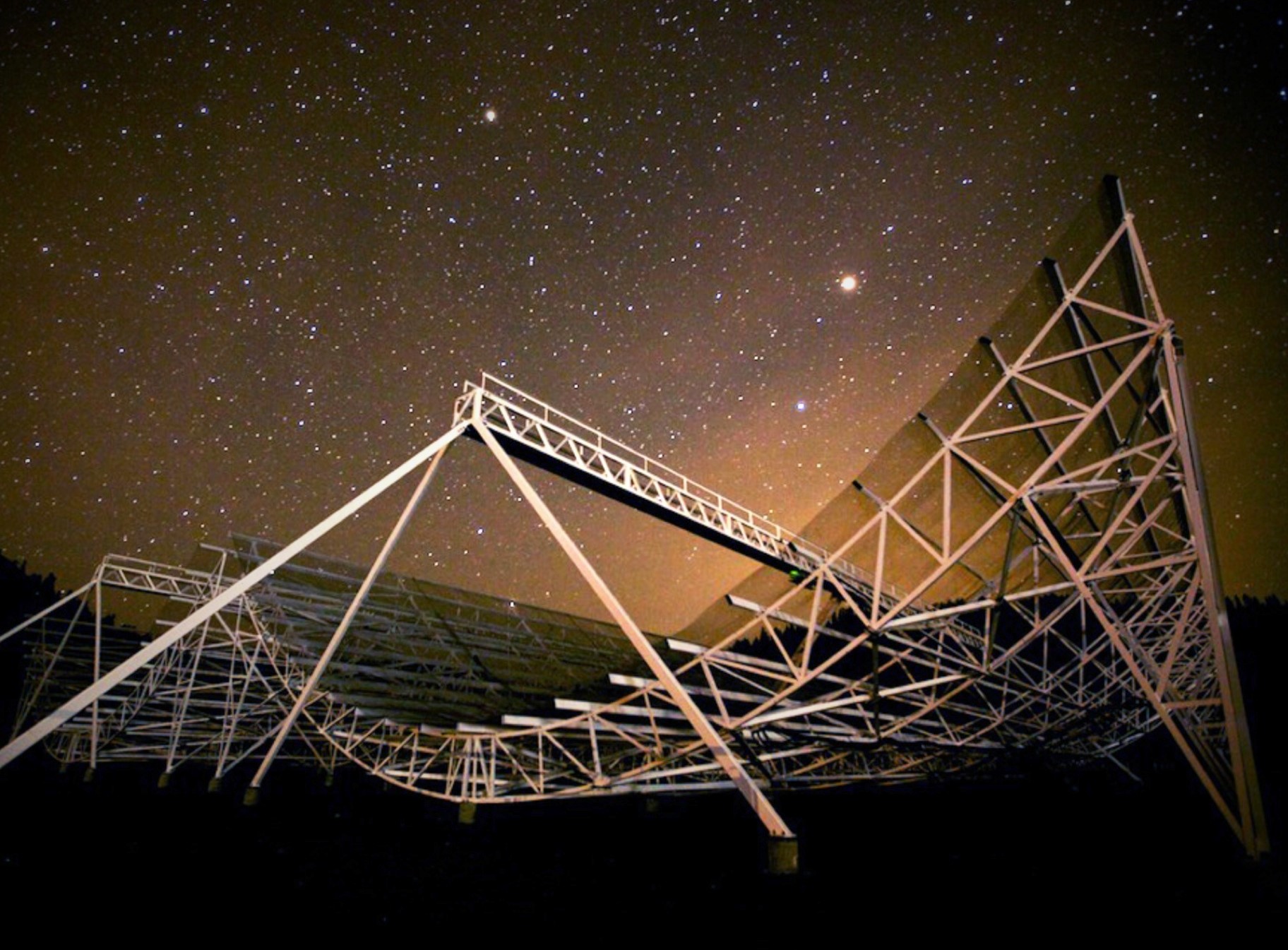
CHIME antenna
One of the radio antennas of the Canadian Hydrogen Intensity Mapping Experiment, or CHIME, spreads out beneath the night sky near Penticton, B.C. (CHIME Photo)

A new radio telescope in British Columbia’s Okanagan Valley has detected 13 new sources of mysterious extragalactic phenomena known as fast radio bursts, including the second known source of repeated bursts.

And the experiment is just barely getting started.

The Canadian Hydrogen Intensity Mapping Experiment, or CHIME, picked up the radio signatures of the bursts over the course of three weeks in July and August, while the telescope was in its pre-commissioning phase and running at only a fraction of its design capacity.

Fast radio bursts, also known as FRBs, are powerful spikes of radio emissions that emanate from galaxies beyond our own Milky Way and last for mere milliseconds. Only 60 FRB sources have been detected, including the 13 announced today.

“Their origin is still unknown,” said the University of British Columbia astronomer Deborah Good, one of the co-authors of two papers about the detections published today by the journal Nature.

Get the full story on GeekWire.

Categories
GeekWire

Red dwarfs seem to wipe out life’s necessities

AU Microscopii with planet
An artist’s conception shows the red dwarf star AU Microscopii with a hypothetical planet and moon in the foreground. (NASA / ESA Illustration / G. Bacon)

Red dwarf stars have been seen as the biggest potential frontier for alien life, in part because they’re the most common stars in our galaxy. But observations made using the Hubble Space Telescope suggest that the frontier might turn out to be a desert.

“We may have found the limit to habitable planets,” said Carol Grady, a co-investigator on the Hubble observations from Eureka Scientific in Oakland, Calif. She laid out the research team’s findings today at the American Astronomical Society’s winter meeting in Seattle.

Get the full story on GeekWire.

Categories
GeekWire

TESS mission adds ‘sub-Neptune’ to discovery list

TESS probe
An artist’s conception shows NASA’s Transiting Exoplanets Survey Satellite, or TESS, with an assortment of exoplanets. (NASA / GSFC / MIT Illustration)

Less than a year after NASA’s TESS spacecraft was launched, the scientists behind the mission have unveiled their third confirmed planet, a weird alien world that’s between Earth and Neptune in size. And hundreds of additional potential finds are in the pipeline.

The latest exoplanet on the list is HD 21749b, which orbits a star that’s about 80 percent as massive as our sun, located about 53 light-years away in the southern constellation Reticulum. Its 36-day orbital period is a record high for the TESS mission.

The “sub-Neptune” planet is about three times Earth’s size, but 23 times its mass. In comparison, Neptune is almost four times as wide as Earth but only 17 times as massive.

Get the full story on GeekWire.

Categories
GeekWire

3-D views reveal ‘Orion’s Dragon’ in space

Orion's Dragon
A color-coded image that’s based on SOFIA infrared data shows “Orion’s Dragon” in the Orion Nebula, more than 1,300 light-years from Earth. (NASA / USRA / DLR Image)

Spectral readings from the Orion Nebula have charted the cosmic weather patterns for powerful stellar winds that have created a bubble of material that’s 12 light-years wide, as well as a structure that’s been nicknamed “Orion’s Dragon.”

The dragon shape stands out in a 3-D video produced using data from NASA’s Stratospheric Observatory for Infrared Astronomy, or SOFIA, a Boeing 747 jet that’s been converted to carry a 106-inch telescope and other scientific instruments.

“When we first saw it, we were standing around my computer screen looking at it and say, ‘Hey, doesn’t that look like a dragon?’ And everybody said, ‘Yeah, that looks like a dragon,’ ” Joan Schmelz, the SOFIA project’s associate director for science and public outreach at the Universities Space Research Association, said today at the American Astronomical Society’s winter meeting in Seattle.

There’s even a stereoscopic video clip that pops out when seen with red-blue 3-D glasses. (You can download the MPG file via the SOFIA website.)

Get the full story on GeekWire.