This is a 1.9-billion-year-old stromatolite — or mound made by microbes that lived in shallow water — called the Gunflint Formation in northern Minnesota. Such formations provide evidence of oxygen-rich settings on ancient Earth.. (UW Photo / Eva Stüeken)
Researchers say multicellular life could have arisen in Earth’s oceans more than 2 billion years ago, only to fall victim to a drop in oxygen levels.
That scenario is based on a study of concentrations of the element selenium of sedimentary shale, led by researchers at the University of Washington. The findings – published online in the Proceedings of the National Academy of Sciences – shed light not only on the origins of life on Earth, but on the potential for detecting life on distant planets.
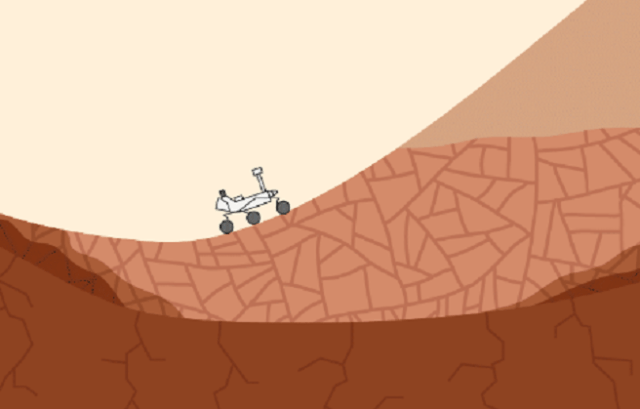
This schematic illustrates how the creation and disappearance of a Martian lake created different layers of rock in the region being explored by NASA’s Curiosity rover. (NASA / JPL Graphic)
Scientists say they’re putting together the puzzle pieces provided by NASA’s Curiosity rover to get a better picture of how the outlook for habitability on Mars brightened and dimmed over the course of billions of years.
“We see all the properties in place that we like to associate with habitability,” Caltech planetary scientist John Grotzinger said today during a session at the American Geophysical Union’s fall meeting in San Francisco.
As Curiosity makes its way up the layered slopes of a 3-mile-high peak known as Aeolis Mons or Mount Sharp, it’s encountering different layers of material that hint at how the region around the mountain was formed.
Grotzinger and his colleagues said that clay minerals, boron and an iron-bearing mineral known as hematite are more abundant in the higher layers. Their presence suggests that there was dynamic chemical interaction between the rocks and groundwater in ancient times.
Positron Dynamics’ concept calls for cooling down a stream of positrons — the antimatter equivalent of electrons — and smashing them into a stream of electrons. Theoretically, that could produce enough oomph to accelerate a probe to more than one-tenth of the speed of light.
An artist’s conception shows a fanciful view of organosilicon-based life. (Lei Chen and Yan Liang / BeautyOfScience.com for Caltech)
Using directed evolution, researchers say they’ve “bred” protein molecules from an unusual type of bacteria to create chemical bonds between silicon atoms and carbon atoms efficiently.
Chemists have been able to do that in the lab, but it’s not been done biologically before.
“No living organism is known to put silicon-carbon bonds together, even though silicon is so abundant, all around us, in rocks and all over the beach,” Caltech researcher Jennifer Kan, the lead author of a report on the experiment published in the journal Science, said in a news release.
Silicon is the second most abundant element in Earth’s crust (after oxygen), and the idea of living organisms based on silicon rather than carbon has been a science-fiction standard for decades. The best-known example is the Horta, the rock-eating creature on the planet Janus VI in the original “Star Trek” TV series.
The European Extremely Large Telescope is one of the yet-to-be-built observatories that could target the nearest exoplanet, Proxima Centauri b, for direct imaging.. (Credit: ESO)
GUADALAJARA, Mexico – A multimillion-dollar campaign to look for evidence of extraterrestrial civilizations has added telescopic observations of the nearest known exoplanet, Proxima Centauri b, to its agenda.
Last month’s announcement about the detection of Proxima b caused a sensation because scientists said the planet is only a little more massive than Earth, orbiting in the habitable zone of Proxima Centauri, the red dwarf star that’s closest to our own solar system. That put Proxima b at the top of the list of prospects in the search for life beyond the solar system.
It may take a decade or two, but the Breakthrough Prize Foundation says it is looking into the options for direct imaging of Proxima b, a mere 4.3 light-years away,
An artist’s conception shows a view of the surface of the planet Proxima b, with the red dwarf Proxima Centauri near the horizon. (Credi:t: M. Kornmesser / ESO)
The alien planet orbits a red-dwarf star at a distance that puts it in a zone where liquid water could conceivably exist. The fact that such a world circles the sun’s nearest stellar neighbor, 4.2 light-years away, puts it on top of the list of potentially habitable planets beyond our solar system.
Barnes, however, emphasizes the word “potentially.” During a lecture at Seattle’s Pacific Science Center, set for 7:30 p.m. tonight, the UW astronomer will delve into the opportunities and obstacles for life on Proxima Centauri b.
“We’re looking at a 15- to 20-year time frame before we can answer this question of whether it’s habitable,” Barnes told GeekWire in advance of the talk.
An artist’s conception shows Proxima Centauri b orbiting its parent star, a red dwarf, with the two other stars of the Alpha Centauri system in the far background. (Credit: M. Kornmesser / ESO)
The rumors you’ve heard are mostly true: Scientists say the star that’s closest to our solar system has a planet that could be at the right temperature for liquid water and life.
The star is called Proxima Centauri, a red dwarf that’s part of the Alpha Centauri system, 4.2 light-years away. The planet is called Proxima Centauri b, and it’s a terrestrial world whose existence has now been confirmed after 16 years of study.
It’s not yet known whether Proxima b has an atmosphere, or liquid water. But the computer models don’t rule out the possibility. That would make it the closest known exoplanet – and the closest known exoplanet with the potential for life.
As such, it could be the nearest haven for humanity in case things go horribly wrong in our own solar system. And it just so happens that scientists are working on a robotic mission to the Alpha Centauri system: The Breakthrough Starshot initiative received a $100 million kick-start from Russian billionaire Yuri Milner in April.
“We expect either to characterize it, if we get lucky, or maybe visit it in a couple of centuries,” Guillem Anglada-Escude, an astronomer at Queen Mary University of London, told reporters.
The propylene oxide molecules were detected in a massive star-forming region known as Sagitttarius B2, which is close to the supermassive black hole at the center of our Milky Way Galaxy (noted as Sgr A* in this image). The white features in this composite image are bright radio sources. The background image is from the Sloan Digital Sky Survey. (Credit: B. Saxton / NRAO / AUi / NSF / NRL / SDSS)
Researchers say they’ve found the first evidence of mirror-image molecules in interstellar space – a discovery that relates to the chemistry that gave rise to life here on Earth.
The molecules of propylene oxide were detected in a huge cloud known as Sagittarius B2 North, about 28,000 light-years from Earth, during a scan that used the Green Bank Telescope in West Virginia.
Mirror-image molecules are notable because they come in left-handed or right-handed molecular orientations, like the molecules that serve as the building blocks for life on Earth. That “handedness” is known as chirality.
“This is the first molecule detected in interstellar space that has the property of chirality, making it a pioneering leap forward in our understanding of how prebiotic molecules are made in the universe and the effects they may have on the origins of life,” Brett McGuire, a chemist with the National Radio Astronomy Observatory, said in a news release.
Ellie Arroway (played by Jodie Foster) listens for alien signals in the movie “Contact.” (Credit: Warner Bros.)
Are we alone? Fifty-five years ago, astronomer Frank Drake came up with an equation that weighed the odds for aliens, and now two astronomers have tweaked the formula to come up with a slightly different spin.
Their bottom line? There’s an astronomically high chance that other civilizations have arisen elsewhere in the universe at some point in its 13.8 billion-year history.
“While we do not know if any advanced extraterrestrial civilizations currently exist in our galaxy, we now have enough information that they almost certainly existed at some point in cosmic history,” Frank writes.
This artist’s impression shows Mars as it might have looked 4 billion years ago, with the complex shoreline of Chryse Planitia front and center. (Credit: M. Kornmesser / ESO)
Liquid water is almost non-existent on modern Mars, but scientists say sedimentary deposits show signs that tsunami waves as high as 400 feet washed over Martian shorelines billions of years ago.
The claim, laid out on Thursday in Nature Scientific Reports, may sound like the Red Planet equivalent of “The Day After Tomorrow,” the 2004 climate-scare movie that showed New York getting drowned. There is a climate angle to the newly published research, but a more apt comparison would be 1998’s “Deep Impact,” in which a crashing comet did something similar.
“The tsunamis could have been triggered by bolide impacts, which, about every 3 million years, generated marine impact craters approximately 30 kilometers in diameter,” study co-author Thomas Platz, a research scientist at the Planetary Science Institute in Arizona, said in a news release about the study.
As spectacular as it sounds, the findings are consistent with how mega-tsunamis happen on Earth, and what scientists expected on Mars as well. There’s lots of other geological evidence that Mars once harbored a large northern ocean. But if that’s the case, there should have been occasional asteroid or cosmic strikes that produced giant waves.