Categories
GeekWire

How we’re turning Earth into alien planet

Earth at night
Imagery from the NASA-NOAA Suomi National Polar-Orbiting Partnership satellite shows Earth’s lights at night. In a newly published study, researchers argue that planets could be classified based on the effects of energy on the environment. (NASA Photo / Joshua Stevens / Miguel Roman)

A trio of scientists has just laid out a new classification scheme for planets that would put Earth into a hybrid category, making the transition from a diverse, photosynthetic-based biosphere to a world dominated by an energy-intensive civilization.

The researchers’ analysis meshes with the view that humanity’s influence has spawned a new geological epoch known as the Anthropocene Age.

“Our premise is that Earth’s entry into the Anthropocene represents what might, from an astrobiological perspective, be a predictable planetary transition. … In our perspective, the beginning of the Anthropocene can be seen as the onset of the hybridization of the planet,” they say in a study published by the journal Anthropocene.

Get the full story on GeekWire.

Categories
GeekWire

‘Search for Life in Space’ hits the big screen

"Search for Life in Space"
“The Search for Life In Space” touches on several frontiers in astrobiology. (MacGillivray Freeman)

What better way to celebrate 40 years of NASA’s interplanetary Voyager mission than with an eye-filling movie that brings the decades-old story up to date?

“The Search for Life in Space,” an IMAX 3-D documentary that opens at the Pacific Science Center today, begins with the twin Voyager probes’ exploration of the solar system and beyond. Voyager’s “Grand Tour” got off the ground in 1977 and continues to this day.

The film touches on astronomer Carl Sagan’s campaign to send a message to extraterrestrial civilizations that may someday come across the probe, in the form of a Golden Record that was launched aboard each of the two spacecraft.

Get the full story on GeekWire.

Categories
GeekWire

Hubble keeps hope alive for alien oceans

Red dwarf planet
This artist’s impression shows how the surface of a planet orbiting a red dwarf star may appear. The planet is in the habitable zone, so liquid water exists. (CFA Illustration / M. Weiss)

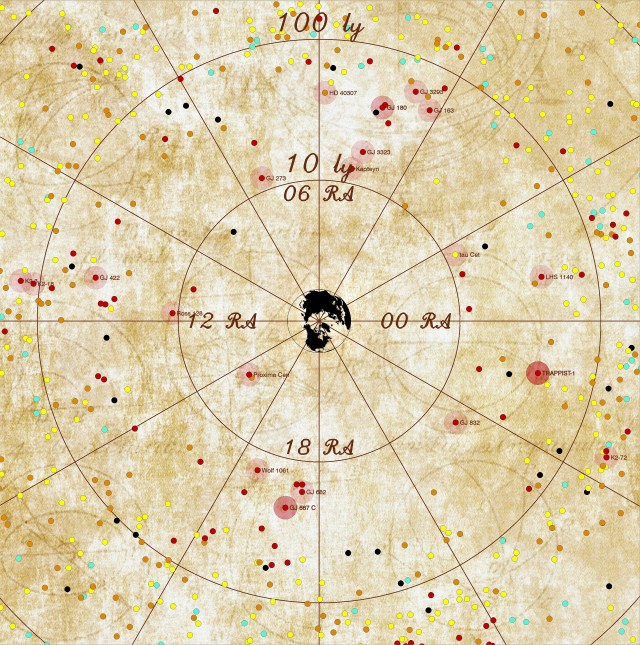
Do some of the Earth-sized planets around a dwarf star called TRAPPIST-1, just 40 light-years away, have liquid water? Newly reported findings from the Hubble Space Telescope give astrobiologists continued cause for hope.

The seven TRAPPIST-1 planets created a sensation in February because they’re the biggest assemblage of Earth-scale worlds known to exist in a single planetary system. What’s more, three of the planets – known by the letters e, f and g – are in an orbital region where scientists say water could exist in liquid form.

That’s thought to be a key condition for life as we know it, which is why the region is known as TRAPPIST-1’s “habitable zone.”

But is the water really there? To get at that question, astronomers used Hubble to study the amount of ultraviolet radiation received by the planets, and what that might be doing to their atmospheres.

Get the full story on GeekWire.

Categories
GeekWire

Super-Earth may reveal secrets of alien air

LHS 1140
An artist’s impression shows a super-Earth passing across the disk of the faint red star known as LHS 1140. (CfA Illustration / M. Weiss)

It’s not the closest potentially habitable planet, but astronomers say a world 40 percent wider than Earth could be one of the best places to target in the search for life beyond our solar system.

“This is the most exciting exoplanet I’ve seen in the past decade. We could hardly hope for a better target to perform one of the biggest quests in science – searching for evidence of life beyond Earth,” Jason Dittmann, an astronomer at the Harvard-Smithsonian Center for Astrophysics, said today in a news release.

Dittmann is the lead author of a paper published by the journal Nature describing the exoplanet, known as LHS 1140 b.

Get the full story on GeekWire.

Categories
GeekWire

Hubble sees more signs of Europa’s water

Europa plumes
These composite images show a suspected plume of material erupting two years apart from the same location on Jupiter’s icy moon Europa. Both plumes, photographed in ultraviolet light by Hubble, were seen in silhouette as the moon passed in front of Jupiter. (NASA / ESA / STScI / USGS)

Scientists say Europa, a mysterious moon of Jupiter, has shown fresh signs of watery plumes that may hint at a habitable environment beneath the ice.

Last year, the Hubble Space Telescope picked up observations of what appeared to be a plume of watery material, emanating from the same area where a plume was spotted in 2014.

The most recent plume rises about 62 miles (100 kilometers) above Europa’s surface, which is twice as high as the earlier plume.

The source of the activity is an unusually warm region of ice that appears to be crisscrossed by cracks, based on pictures captured in the late 1990s by NASA’s Galileo spacecraft.

Get the full story on GeekWire.

Categories
GeekWire

Enceladus shows signs of hydrothermal vents

Enceladus' plumes
This composite image shows how plumes of water emanate from fissures in the surface ice of Enceladus, one of Saturn’s moons. (NASA / JPL Illustration)

Scientists have detected molecules of hydrogen in plumes of watery material erupting from cracks in the ice of Enceladus, a moon of Saturn – and that suggests an ocean beneath the ice has hydrothermal vents that just might be capable of sustaining life.

The findings, based on an analysis of data from the Cassini orbiter, are the subject of a study published today in Science as well as a NASA news briefing.

“We’ve always wondered, ‘Are we alone in the universe?’” Linda Spilker, project scientist for the Cassini mission at NASA’s Jet Propulsion Laboratory, told GeekWire. “Now, as we look out from our own planet, we find worlds in our own solar system that might have life.”

The direct evidence is still wanting, however. The research team, headed by the Southwest Research Institute’s Hunter Waite and Christopher Glein, made their conclusions based on a chain of evidence that started with observations from Cassini’s Ion Neutral Mass Spectrometer.

Get the full story on GeekWire.

Categories
GeekWire

‘Life’ movie sparks reality check about Mars

Planetary protection officer in "Life."
Rebecca Ferguson plays Miranda North, a planetary protection officer aboard the International Space Station, in the movie “Life.” (Sony Pictures Digital Productions)

Let sleeping Martians lie, particularly if they have a strong grip: That’s one of the lessons you could take away from “Life,” the first monster movie set on the International Space Station.

The movie – which opens today and stars Jake Gyllenhaal, Rebecca Ferguson and Ryan Reynolds – blends the gory horror of “Alien” with the harrowing suspense of “Gravity.” It’s a tour de force of simulated zero-G acrobatics (done mostly with ropes and wires). And it’s an orbital illustration of Murphy’s Law: Anything that can go wrong with having an alien on board does go wrong.

Purists may have questions about just how wrong it goes. Could a minuscule life form brought back from Mars really get that big that quickly? Is it really possible to combine neural, muscular and sensory functions in one cell? And just how easy is it for things to come loose (or get loose) on the space station?

The deepest question may well be, does this nightmare have any chance of happening in real life?

Get the full story on GeekWire.

Categories
GeekWire

‘Life’ draws upon worst-case space scenarios

Scene from 'Life'
An astronaut administers a shock to an alien life form in a Petri dish aboard the International Space Station, in a scene from the movie “Life.” Bad idea? (CTMG via YouTube)

A real-life organism provides the inspiration for the alien monster at the center of “Life,” a horror movie that’s set on the International Space Station. But you’d never guess which one.

Would you believe … slime mold?

“We used that as a model, working with the effects team, but ramped it up enormously,” said Adam Rutherford, who served as a science consultant for the film. Moviegoers can get a glimpse at the results in the online trailers for “Life,” which opens in theaters on March 24.

Get the full story on GeekWire.

Categories
GeekWire

Could this seven-planet system harbor life?

A diagram shows seven exoplanets orbiting an ultracool dwarf star known as TRAPPIST-1. If the planets were transported to our own solar system, they’d all lie within Mercury’s orbit. (ESO Illustration)

A second look at an exoplanet system 39 light-years from Earth has brought a bonanza for astronomers: not two, not three, but seven alien worlds – some of which could have acceptable conditions for life.

“I think that we’ve made a crucial step towards finding if there is life out there. … Before, it was indications,” said study co-author Amaury Triaud of Cambridge University’s Institute of Astronomy. “Now we have the right target.”

That claim is debatable, but in any case, the discovery suggests that there are even more planets out there than astronomers previously thought. Which is what astronomers have been saying repeatedly for the past decade.

“The solar system with its four (sub-)Earth-sized planets might be nothing out of the ordinary,” Ignas Snellen of the Leiden Observatory wrote in a commentary on the findings, published in this week’s issue of the journal Nature.

Get the full story on GeekWire.

Categories
GeekWire

Scientists revive weird cave crystal microbes

Cave crystals
Crystals dwarf an explorer in Mexico’s Naica cave complex. (Photo by Alexander Van Driessche – CC BY 3.0)

BOSTON – It sounds like a sci-fi tale: Scientists manage to revive strains of microbes that have been trapped inside giant cave crystals for tens of thousands of years, and find out that they seem positively alien.

But this tale is totally real. And although these organisms are so unlike anything else on Earth that they haven’t yet been given a genus or species name, they’re totally terrestrial.

“They’re really showing us what our kind of life can do,” said Penny Boston, director of the NASA Astrobiology Institute.

Get the full story on GeekWire.