Categories
GeekWire

Alaska Air completes takeover of Virgin America

Alaska-Virgin branded plane
An Alaska Airlines jet sports a paint job that pays homage to Virgin America’s red color scheme as it taxis at San Francisco International Airport. (Boeing Airplanes Photo via Twitter)

Alaska Air Group completed its acquisition of Virgin America today, celebrating the rise of the nation’s No. 5 air carrier with a co-branded jet painted in blue, purple and red.

“Alaska Airlines and Virgin America are different airlines, but we believe different works – and we’re confident fliers will agree,” Brad Tilden, CEO of Alaska Air Group, said in a news release.

The acquisition follows through on months of work to seal the $2.6 billion deal ($4 billion, including debt and aircraft operating leases). The U.S. Department of Justice gave its regulatory approval last week after tweaking the terms to comply with antitrust requirements.

The combined airlines vaulted Alaska Air Group from No. 6 to No. 5 on the list of U.S. carriers – past JetBlue, which had courted Virgin America as well. Alaska and Virgin America are projected to generate more than $7 billion in annual revenue and operate about 280 aircraft.

For the time being, the all-Boeing Alaska Airlines fleet and the all-Airbus Virgin America fleet will retain their separate brands. Except for one plane.

Get the full story on GeekWire.

Categories
GeekWire

Boeing trims 777 jet production, raises dividend

Boeing 777
A Boeing 777 jet is assembled at the company’s plant in Everett. (Boeing Photo)

The Boeing Co.’s decision to trim back production of its wide-body 777 jet is likely to bring bad news for employment at its plant in Everett, Wash., while a boost in the company’s quarterly dividend should come as good news for investors.

The bad-news, good-news situation was laid out on Dec. 12, sparking ups and downs in Boeing’s share price. By the end of today’s trading, the price was slightly down.

The planned cutback in 777 production from the current 8.3 jets per month to five per month next August points to a dramatic softening in the market for twin-aisle, wide-body jets. Production of Boeing’s 747 jumbo jets has been reduced as well. “The twin-aisle market is glutted,” Teal Group analyst Richard Aboulafia told Reuters.

Get the full story on GeekWire.

Categories
GeekWire

Lockheed Martin takes a hit after Trump tweet

F-35 jet
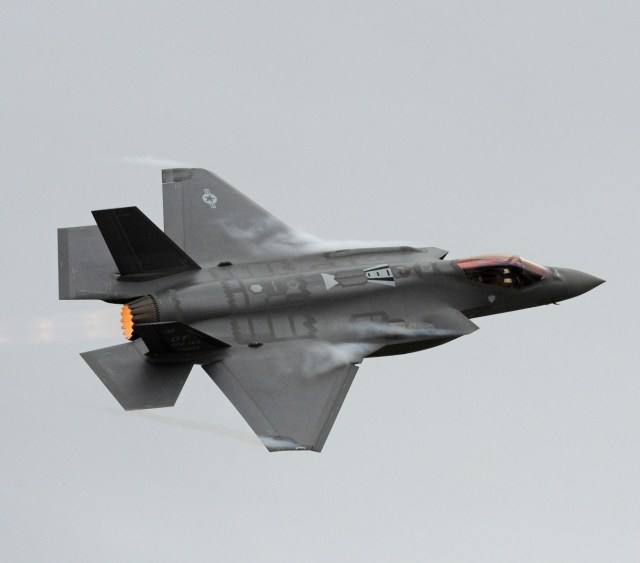
An F-35 Lightning II fighter jet prepares to land. (U.S. Air Force Photo / Alex R. Lloyd)

Today it was Lockheed Martin’s turn to feel the Twitter burn from President-elect Donald Trump over the cost of the F-35 fighter jet program: Its stock dropped by as much as 5 percent after Trump’s complaint.

Share prices for other aerospace companies such as Boeing and Northrop Grumman went through twists and turns as well.

Trump set the stage for criticizing the $400 billion program on Dec. 9 when he complained about the cost of “some of the fighter jets that are being built.” Then, in today’s tweet, he specifically called out the F-35.

Get the full story on GeekWire.

Categories
GeekWire

Boeing and Iran Air announce $16.6 billion deal

Iran Air 747 jet
Iran Air already operates Boeing planes such as this 747 jet. (Aero Icarus Photo – CC BY-SA 2.0)

The Boeing Co. and Iran Air say they have signed a sale agreement for 80 jets, valued at a list price of $16.6 billion.

The deal announced today follows through on a memorandum of agreement that was laid out in June, as well as a U.S. government license that was issued to Boeing in September. The big question is whether the sale will continue to pass muster next year once the Trump administration and a new Congress have a chance to weigh in.

The agreement covers 50 single-aisle 737 MAX 8 jets, 15 wide-body 777-300ER jets, and 15 777-9s. That last bunch of jets will be derivatives of the 777-300ER, part of the 777X program that has yet to enter production.

Boeing said the first deliveries would be made in 2018, while Iran’s state-owned IRNA news agency quoted an aviation official as saying the jets will be delivered over the course of 10 years.

Get the full story on GeekWire.

Categories
GeekWire

Donald Trump disses Air Force One price tag

Air Force One
The Air Force One planes are Boeing 747-200s, to be replaced by the Boeing 747-8. (Boeing Photo)

By Todd Bishop and Alan Boyle

President Obama has expressed a deep appreciation for Air Force One, describing the current Boeing 747-200 planes as the best perk of the job. President-elect Donald Trump, who is accustomed to flying in his own Boeing 757, isn’t as enamored with Boeing’s contract to build a new generation of Air Force One planes.

In a tweet today, Trump claimed that costs on the project are “out of control” and called for the cancellation of a deal with the Boeing Co. for two 747-8 aircraft that would serve as Air Force One.

In follow-up comments to reporters in New York, Trump said the cost of the planes was “ridiculous.”

“I think Boeing is doing a little bit of a number,” he said. “We want Boeing to make a lot of money, but not that much money.”

Get the full story on GeekWire.

Categories
GeekWire

Workhorse works on electric trucks, flying cars

Workhorse's Surefly drone
Workhorse Group is working on a two-seat personal flying machine. (Workhorse Photo)

BELLEVUE, Wash. – A company called the Workhorse Group wants to beat Amazon to the punch and provide the U.S. Postal Service with thousands of electric-powered mail trucks equipped with delivery drones. But that’s not all: CEO Steve Burns sees flying cars in the company’s future.

It’s a dream that’s already attracting tens of millions of dollars in funding for Silicon Valley startups.

“I know a couple of people who are working on it,” Burns acknowledged today at Bellevue’s Meydenbauer Conference Center. “But we’re trying to do it first.”

Burns provided a sneak peek at his Indiana-based company’s plans for a hybrid flying car – or, to use his preferred term, the Surefly personal flying machine – during the Advanced Transportation Technologies Conference, organized by the Center for Advanced Transportation and Energy Solutions.

Get the full story on GeekWire.

Categories
GeekWire

WTO rules against Boeing’s 777X tax break

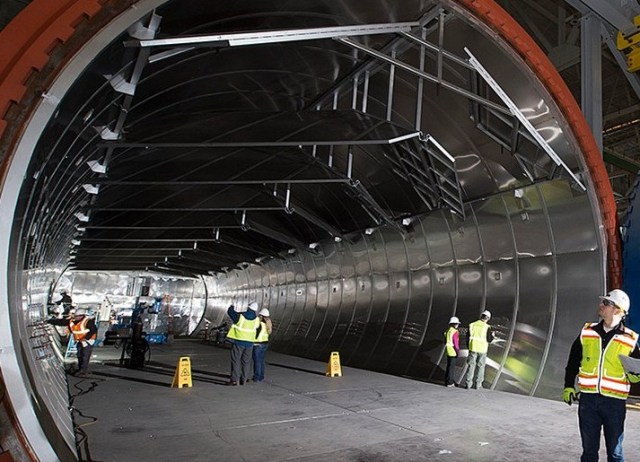
Wing autoclave
A giant autoclave is ready to “cook” parts for the Boeing 777X wings. (Credit: Boeing)

In the latest chapter of a years-long legal battle, the World Trade Organization says Washington state’s tax break for production of the Boeing 777X jetliner runs counter to international trade rules.

“We expect the U.S. to respect the rules, uphold fair competition, and withdraw these subsidies without any delay,” Cecilia Malmström, the European Union’s trade commissioner, said in a statement issued after today’s ruling.

However, U.S. officials and Boeing executives signaled that the battle would continue. The fight over the tax breaks is part of a larger dispute between the Boeing Co. and its European rival, Airbus, with U.S. and EU officials in the middle.

Boeing’s general counsel, J. Michael Luttig, went so far as to claim in a statement that today’s ruling was “a complete victory for the United States, Washington state and Boeing.”

The way Luttig saw it, the WTO rejected “virtually every claim made by the EU in this case” and found that Boeing “has not received a penny of impermissible subsidies.”

Get the full story on GeekWire.

Categories
GeekWire

How Britain sees the drone revolution

Amazon drone
Amazon is testing its delivery drone system in Britain. (Amazon Photo)

Regulators have to work out lots of issues before they let drones start delivering packages routinely, but in Britain at least, there’s a timetable.

“We’ve got a soft target of 2020,” Michael Clark, deputy director at Britain’s Department for Transport, told GeekWire. And although the Federal Aviation Administration hasn’t announced its own timetable, 2020 could well be a soft target for U.S. operations as well.

Clark and other British transport officials discussed the U.K. perspective on unmanned aircraft systems last week while visiting the States for the Drone World Expo in San Jose, Calif.

Britain’s Civil Aviation Authority is playing a key role in Amazon’s plans to develop delivery drones, highlighted by the Seattle-based retailer’s flight test program near Cambridge.

Amazon CEO Jeff Bezos spoke warmly about the company’s relationship with British regulators last month at Seattle’s Museum of Flight. “We’re getting really good cooperation from the British equivalent of the FAA, the CAA,” he said. “It’s incredible. It’s really cool.”

For what it’s worth, the feeling is mutual: “Amazon is a pathfinder,” Clark said.

Get the full story on GeekWire.

Categories
GeekWire

Boeing names its next CEO for commercial jets

Boeing logo
The Boeing Co., which has its corporate headquarters in Chicago, has created a new business unit for aviation services with its headquarters in Dallas. (Boeing Photo)

The Boeing Co. set a huge organizational transition into motion today by bringing in an outside aerospace executive as the next head of its commercial airplane unit and setting up a new business unit for aviation services.

GE Aviation Services’ president and CEO, Kevin McAllister, will become the next president and CEO of Boeing Commercial Airplanes. The business unit’s current head, Ray Conner, will ease out of that role during a transitional period culminating in his retirement at the end of 2017, the company said in a statement.

The new unit, called Boeing Global Services, will integrate the customer service operations currently provided through Boeing Commercial Airplanes and Boeing Defense, Space and Security.

Veteran Boeing executive Stanley Deal will be president and CEO of the services unit, which will have a small core headquarters based in Dallas.

Get the full story from GeekWire.

Categories
GeekWire

Biofuel boost: Waste wood helps power jet

Biofuel bottles
Sample bottles of biofuel sit on an Alaska Airlines counter at Sea-Tac. (Credit: Alaska Airlines)

Alaska Airlines says it sent a Boeing 737 jet on the first commercial airline flight that was partially fueled by branches, stumps and other leftovers from forests in the Pacific Northwest.

The jet took off this morning from Seattle-Tacoma International Airport and headed for Reagan National Airport in Washington, D.C., with its tanks full of a new type of biofuel blend.

Twenty percent of the jet fuel came from wood waste that was collected during timber harvests or thinning operations on land owned by Weyerhaeuser in Oregon, the Muckleshoot Indian Tribe in Washington and the Confederated Salish Kootenai Tribes in Montana, plus rejected wood fibers from Cosmo Specialty Fibers in Cosmopolis, Wash.

In a typical timber harvest, some of the leftover limbs, branches and stumps are left behind to replenish the land and provide cover. The rest is typically pushed into a pile and burned.

Those practices provided an opportunity for the Northwest Advanced Renewables Alliance, a public-private consortium led by Washington State University. Researchers took advantage of a grant from the U.S. Department of Agriculture to demonstrate a technology that converts the excess waste wood into isobutanol.

Get the full story on GeekWire.