Categories
GeekWire

Mars Society is gaining a foothold in AI and biotech

The Mars Society says it’s making progress on launching a startup incubator in the Seattle area, with artificial intelligence and biotech as its first targets. Its long-term goal? To make a profit, yes, but also to support the development of technologies needed to sustain settlements on the Red Planet.

“A successful Mars colony will need to be highly innovative, and it will have the chance to be highly innovative — and because of those facts, it will make inventions that will meet its own needs but also be licensable on Earth,” Mars Society President Robert Zubrin said last week at the nonprofit group’s annual conference at the University of Washington.

“Those inventions — as it were, IP as exports from Mars — will be one of the main economic supports of the Mars city-state,” Zubrin said. “So, people sometimes ask me, ‘Well, if you think that a Mars inventors colony could actually be profitable, why not create it here on Earth first?’”

That’s the idea behind the Mars Technology Institute. James Burk, the Mars Society’s Seattle-based executive director, said the institute would be modeled on the tech industry’s Y Combinator, a California-based startup accelerator that provides seed money and guidance for promising ventures in return for a share of their equity.

Burk said he’s been talking government officials and representatives of other organizations in the Seattle area — including Bellevue College — about setting up a home base for the institute. Those talks could bear fruit in the months ahead.

In the meantime, the Mars Society is moving ahead with initiatives in AI, biotech for food production, and robotics. In addition to those target areas, Zubrin would also like to get involved in advanced nuclear fission and fusion technologies — another tech frontier that the Pacific Northwest is known for. “But the entry point for getting involved with those [technologies] is high, and so we chose to defer that,” he said.

Get a status report on the Mars Society’s startup efforts…

Categories
GeekWire

Adaptive joins Microsoft to track virus-fighting cells

Seattle-based Adaptive Biotechnologies and Microsoft have launched an open-access database called ImmuneCODE to catalog the many ways in which our immune systems fight off a coronavirus infection.

Get the news brief on GeekWire.

Categories
GeekWire

Biotech experts gather for White House summit

White House summit
Federal officials discuss America’s bioeconomy during a White House summit. (OSTP Photo via Twitter)

More than 100 biotech researchers, industry executives and government officials met at the White House today for a summit focusing on America’s bioeconomy — the range of products, services and data derived from biological processes and bioscience research.

“The bioeconomy is already an integral part of the general economy,” White House chief technology officer Michael Kratsios told the attendees. “In 2017, revenues from engineered biological systems reached nearly $400 billion.”

He cited figures from SynBioBeta suggesting that the private sector alone invested more than $3.7 billion in early-stage biological engineering and manufacturing tech companies during 2018.

“But we are not only here because of what biotechnology has done — we are invested in what biotechnology is going to do,” Kratsios said.

Get the full story on GeekWire.

Categories
GeekWire

A-Alpha Bio raises $2.8M for drug discovery

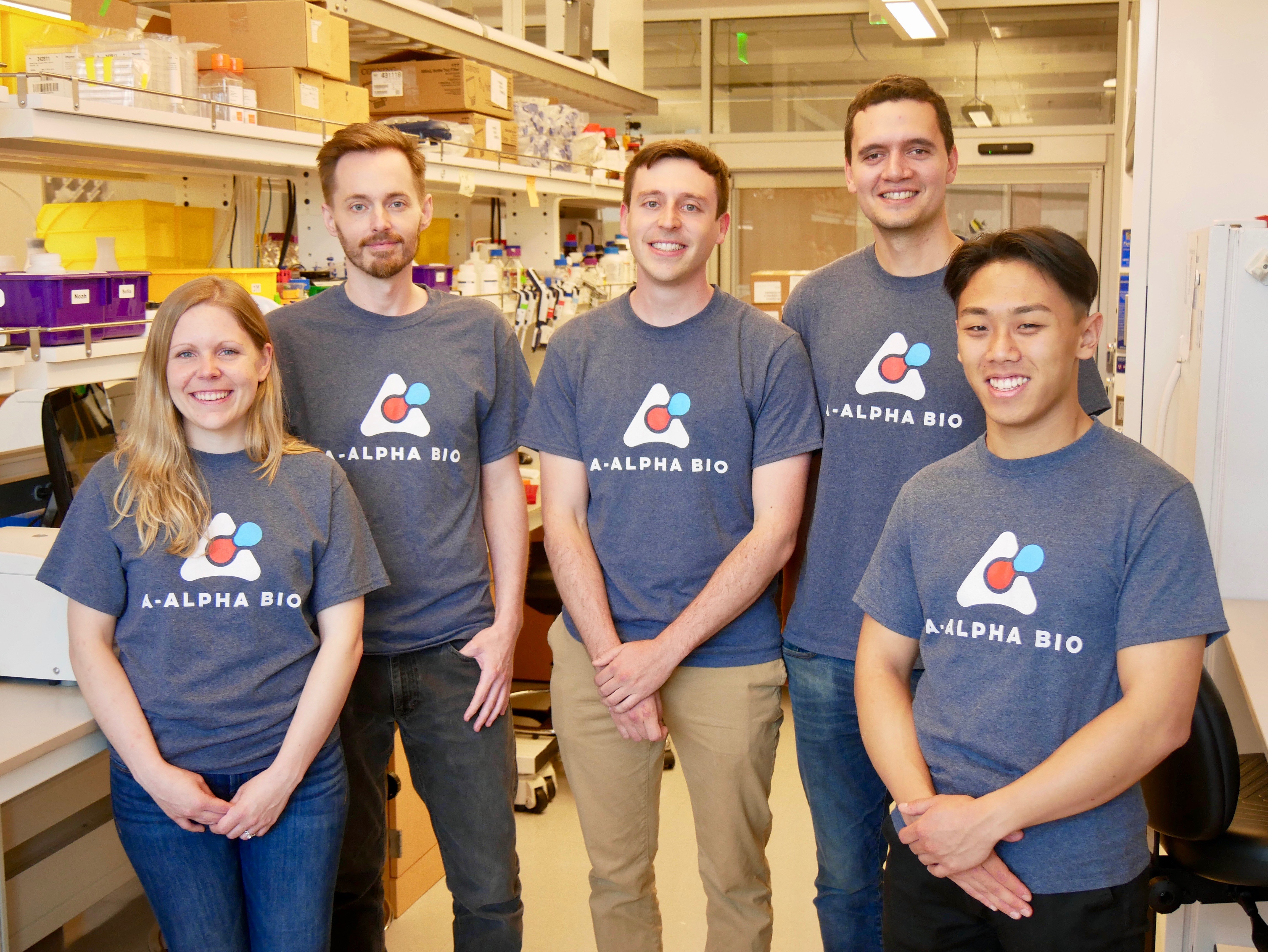
A-Alpha Bio team
The A-Alpha Bio team includes scientist Emily Engelhart, principal scientist David Colby, co-founder and CEO David Younger, co-founder and chief technology officer Randolph Lopez and engineering associate Charles Lin. (A-Alpha Bio Photo)

A Seattle startup that took root at the University of Washington has closed a $2.8 million seed round for a drug discovery platform that can sort through millions of protein interactions at once.

“We expect that we can go considerably further than that,” said David Younger, the co-founder and CEO of A-Alpha Bio.

A-Alpha Bio’s genetically engineered protein analysis technology, known as AlphaSeq, has the potential to speed up the process of evaluating drug candidates. That’s what attracted interest from investors including OS Fund, which led the seed round, plus AME Cloud Ventures, Boom Capital, Madrona Venture Group, Sahsen Ventures, Washington Research Foundation and a number of angel investors.

Get the full story on GeekWire.

Categories
GeekWire

Grail raises $300 million for cancer detection tools

Grail, a biotech company with early backing from Microsoft co-founder Bill Gates and Amazon founder Jeff Bezos, says it’s raised $300 million in an oversubscribed Series C financing round. Gates and Bezos got in on a $100 million Series A round in 2016, and since then, total investment has risen to $1.5 billion.

Get the news brief on GeekWire.

Categories
GeekWire

Chinese team clones monkeys from fetal cells

Zhong Zhong
Zhong Zhong is a cloned monkey. (Chinese Academy of Sciences / Qiang Sun and Mu-ming Poo)bio

Researchers at the Chinese Academy of Sciences Institute of Neuroscience in Shanghai have produced identical primate clones using the same procedure that brought Dolly the sheep into the world more than two decades earlier.

The procedure, known as somatic cell nuclear transfer, involves removing the nucleus of an egg cell and replacing it with nuclear material from a body cell.

Chinese researchers described the experiment in a research paper published today by the journal Cell.

Get the full story on GeekWire.

Categories
GeekWire

Viome raises millions for wellness monitoring

Naveen Jain
Viome CEO Naveen Jain shows how a stool sample would be placed into a kit for an analysis of gut microbes. (GeekWire Photo / Alan Boyle)

Viome, the wellness monitoring service founded by Seattle-area tech entrepreneur Naveen Jain, has raised $15 million this month in an investment round, according to documents filed today with the Securities and Exchange Commission.

The equity sale boosts the first commercial venture brought to life by Jain’s BlueDot innovation factory.

Jain deferred comment on the details of the investment today, but in an April interview, he said Viome was just the kind of technological moonshot BlueDot was designed to foster.

“Our moonshot here is, can we create a world where chronic illness becomes a matter of choice?” he said at the time.

Get the full story on GeekWire.

Categories
GeekWire

Cyrus Biotech raises $8M for protein toolkit

Cyrus Bench on laptop
Cyrus Bench is a software platform for protein engineering. (Cyrus Biotech Photo)

Cyrus Biotechnology is getting an $8 million infusion for its cloud-based protein modeling and design toolkit, thanks to a Series A financing round.

The investment round was led by Trinity Ventures, with participation from OrbiMed AdvisorsSpringRock Ventures, the W Fund and individual investors, the Seattle-based venture said today in a news release.

Cyrus Biotech’s primary product, Cyrus Bench, is a software package based on Rosetta, a protein-modeling platform that was created at the University of Washington. Rosetta lets researchers twist and turn virtual models of protein molecules to create novel configurations. (It’s even spawned a video game for citizen scientists called Foldit and a screensaver called Rosetta@Home.)

Protein-folding has been compared to solving puzzles, or building molecular-scale keys for cellular locks. A protein molecule with the right shape could block a virus from invading a cell, or unlock a therapy for disease.

Get the full story on GeekWire.

Categories
GeekWire

‘Kidney on a chip’ gets set for space

Kidney on a chip
The “kidney on a chip” is about the size of a credit card. (UW Photo / Alex Levine)

A stack of card-sized gizmos that test the effects of drugs, toxins and weightlessness on human kidney cells is due to take a ride to the International Space Station as early as next year – and researchers at the University of Washington can’t wait.

“Use of the human kidney-on-a-chip here on Earth has already taught us a lot about kidney function and kidney diseases,” Jonathan Himmelfarb, director of the Kidney Research Institute and a professor at the UW School of Medicine, said today in a news release.

“The opportunity to study how physical cues emanating from loss of gravitational forces affect kidney cellular function has the potential to improve the health of people living on Earth, as well as prevent medical complications that astronauts experience from weightlessness,” he added.

Get the full story on GeekWire.

Categories
GeekWire

Life Science Hall of Fame gets first members

Image: Defibrillator
In 1972, Physio-Control’s Lifepak 2 was the first portable defibrillator to allow ECG signal transmission by telephone. (Credit: Physio-Control)

Six medical pioneers were inducted into the newly created Washington Life Science Hall of Fame today, and although some of them have passed away, all of them have contributed to lifesaving technologies that are still works in progress.

Take Karl William Edmark, for example: The founder of Redmond-based Physio-Control invented a direct-current heart defibrillator that was first used to save the life of a 12-year-old girl in Seattle in 1961. Edmark, who was a cardiovascular surgeon as well as a lifelong inventor, died in 1994. But the devices he developed have been repeatedly improved and miniaturized since then.

The improvements were an important factor behind the advent in 1970 of Seattle’s Medic One, a pioneering emergency medical service. Just today, the Medic One Foundation and the Seattle Fire Department announced the city’s official launch of PulsePoint, a smartphone app that alerts citizen responders when someone needs CPR in their vicinity.

“If you’re going to have a cardiac arrest, do it right here in Seattle,” said Cam Pollock, Physio-Control’s executive vice president and chief marketing officer, who accepted the Hall of Fame honors on Edmark’s behalf.

The Hall of Fame was established this year by Life Science Washington (which was previously known as the Washington Biotechnology and Biomedical Association) to honor the state’s pioneers in biotech and biomedicine.

Find out about the five other inaugural inductees on GeekWire.