Categories
GeekWire

Navy investigates mystery drone sighting

Image: Drone
Drones are raising issues as they become more widespread. (Credit: DJI)

The Navy has confirmed that it’s investigating the illegal flight of an unidentified drone over Naval Base Kitsap-Bangor, the home base for Trident submarines that carry nuclear weapons.

In an email, Navy spokeswoman Silvia Klatman said the drone was sighted in prohibited airspace by a civilian employee on Feb. 8.

“Any operation over the base without prior permission and coordination with appropriate authorities is both illegal and hazardous,” she said. “It’s our intent to support the investigation and prosecution of this reported act, and any others that may occur, in coordination with civilian law enforcement.”

The Seattle Times and the Kitsap Sun quoted a nearby resident, Al Starcevich, as saying that he and his neighbors were interviewed by investigators last week, and that he was told there were repeated drone flights at night.
Get the full story on GeekWire.

Categories
GeekWire

How much should drones and people mix?

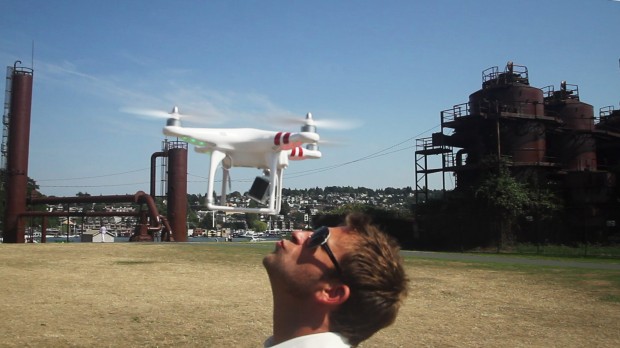
Image: Photographer with drone
Photographer Chase Jarvis with a drone at Gas Works Park in Seattle.

What are the rules for letting a drone get in your face? Right now, there are no rules, but today the Federal Aviation Administration said it’s setting up a committee to come up with a proposal.

The announcement marks the latest step in the FAA’s effort to get a handle on the rapidly rising fleets of small drones, also known as unmanned aircraft systems or UAS.

A year ago, regulators issued draft rules for the operation of commercial drones, like the ones Amazon is working on for package deliveries. Last December, the FAA set up a system for registering recreational drones. Now the FAA and industry representatives will be taking on one of the thornier questions relating to drones: How close can they get to the folks who aren’t operating them?

The newly announced aviation rulemaking committee is due to begin its work in March, and issue its final report to the FAA on April 1.

Get the full story on GeekWire.

Categories
GeekWire

How Amazon inspired birth-control drones

Image: Drone in Ghana
Aerial vehicles are used to deliver medical supplies in Ghana. (Credit: Drones for Development)

When U.N. health experts were trying to come up with a way to deliver contraceptives to women in hard-to-reach areas of Ghana, they took a page from Amazon’s drone delivery playbook.

Their pilot project, known as Dr. One, was reportedly inspired in late 2014 by the Seattle-based online retailer’s plans for aerial package deliveries.

“We thought, ‘Hang on a minute. We can use this for something else!” Kanyanta Sunkutu, a South African public health specialist with the U.N. Population Fund, was quoted as saying in The Huffington Post’s report about the project.

Get the full story on GeekWire.

Categories
GeekWire

FAA goes long with Super Bowl no-drone zone

Image: No drone zone
The FAA is spreading the word about the Super Bowl “no-drone zone.” (Credit: FAA)

No means no when it comes to the Federal Aviation Administration’s no-drone zone for Super Bowl Sunday.

Not even CBS, which is broadcasting the big football game between the Carolina Panthers and the Denver Broncos starting at 3:30 p.m. PT Sunday, will be allowed to send unmanned aerial vehicles into the red zone, the FAA says.

The red zone is unusually large this weekend: It extends across a 74-mile-wide circle centered on Levi’s Stadium in Santa Clara, Calif., in the heart of Silicon Valley. The FAA’s temporary flight restrictions block out the airspace to a height of 18,000 feet from 2 to 11:59 p.m. PT.

The FAA typically restricts the airspace around sporting events with a seating capacity of 30,000 spectators or more, but for the Super Bowl, the no-drone zone is bigger than usual: 37 statute miles (32 nautical miles) in radius, as opposed to the standard 3.5 statute miles. That’s because the Super Bowl is considered a “special security event.”

Get the full story on GeekWire.


Categories
GeekWire

Google tests Internet drones at spaceport

Image: Titan drone
Titan Aerospace, which was acquired by Google in 2014, has been working on solar-powered drones that could provide high-speed Internet access from a high altitude. (Credit: Titan file)

The latest twist in the race to provide high-speed Internet access from above comes in the form of a report in The Guardian, to the effect that a hush-hush Google project called SkyBender is testing drones in the skies above Spaceport America in New Mexico.

The Guardian says it’s obtained documents laying out how high-altitude drones could relay gigabits of data per second, using millimeter-wave, phased-array transmissions. Jacques Christophe Rudell, an electrical engineering professor at the University of Washington, is quoted as saying that “the huge advantage is access to new spectrum, because the existing cellphone spectrum is overcrowded.”

Millimeter-wave communications could open the way for 5G wireless service that’s 40 times faster than the current 4G LTE standard. But millimeter-wave signals have a relatively short range: According to The Guardian, Project SkyBender would have to use thousands of transceiver-equipped aerial vehicles to knit together the network.

The system is reportedly being tested using Aurora Flight Sciences’ Centaur optionally piloted aircraft as well as the solar-powered drones made by Titan Aerospace, which was acquired by Google in 2014 after a fling with Facebook.

Get the full story on GeekWire.

Categories
GeekWire

Get a drone’s-eye view of global destinations

Image: Seattle vista
“View From Above” shows the Space Needle and a Seattle sunset. (Credit: Emirates Airline)

Seattle is one of the stars of the show in “View From Above,” a series of aerial videos shot by drones over 19 destinations for Emirates Airline and the Boeing Co.

The Emerald City looks like the gorgeous place it is, with awesome views of the waterfront and skyline, Gasworks Park and the University District, ferries plying Elliott Bay, plus mountains, lakes and waterways galore.

But that’s not the only reason why Seattle made the list: Because Boeing is one of the project’s sponsors, the aerospace giant’s facilities around Puget Sound are featured as well.

Get the full story on GeekWire.

Categories
GeekWire

Amazon’s drone plan leaves issues up in the air

Image: Amazon drone
One of the Amazon Prime Air prototypes has horizontal and vertical rotors. (Amazon photo)

How much will it cost to get a 30-minute drone delivery from Amazon Prime Air? A newly published interview with Amazon executive Paul Misener suggests that the pricing question and other key issues have yet to be figured out.

In the interview with Yahoo Tech columnist David Pogue, Amazon’s vice president for global public policy provides a detailed run-through of the Seattle-based online retailer’s plan for aerial delivery dominance.

Many of the details have been laid out before. Others appear to remain up in the air.

Get the full story on GeekWire.

Categories
GeekWire

Lily’s $34M boom signals age of ‘selfie drones’

Image: Lily flying camera
Lily’s “flying camera” is designed to be thrown into the air to take selfies. (Credit: Lily)

If you ever needed evidence that “selfie drones” are the hot thing for 2016, you can find it in last week’s reports from the International CES show that a startup named Lily Robotics has collected 60,000 pre-orders for its flying camera, amounting to a potential $34 million payoff.

Supporting evidence came in the form of other selfie drones that were shown off in Las Vegas, including the Qualcomm-backed Ying quadcopter and the crowdfunded Onagofly nano-drone. Still other selfie-copters are waiting in the wings, including the tethered Fotokite Phi, the watch-controlled Hawk and the Nixie wearable drone.

Selfie drones are designed to follow you at a standoff distance and take videos, guided by your smartphone’s signal or a homing device you can tuck in somewhere.

Get the full story on GeekWire.

Categories
GeekWire

Human-sized drone unveiled – but is it a drone?

Image: Ehang 184 drone
The Ehang 184 drone has been tested in China. (Credit: Ehang)

Look! Up in the air! It’s a drone, it’s a plane, it’s … Super-Quadcopter!

Droves of drones were unveiled this week at the International CES show in Las Vegas, but the one that made the biggest splash was arguably the Chinese-made Ehang 184, a remote-controlled quadcopter that’s so big it can accommodate a 220-pound passenger.

Guangzhou-based Ehang says the electric-powered, 440-pound craft can be charged up in two to four hours and fly for 23 minutes. It’s designed to fly at an altitude of about a quarter-mile at speeds of up to 62 mph, but if you push it, the vehicle can go as high as 11,000 feet.  It even has air conditioning and a reading light.

Get the full story on GeekWire.

Categories
GeekWire

FAA says drone signup list has hit 181,000

Image: Parrot Disco
The Parrot Disco is one of the new drones introduced at CES 2016. (Parrot photo)

The Federal Aviation Administration’s chief says he’s happy to see about 181,000 Internet users register recreational drones in less than three weeks’ time – and to help new drone owners, the agency has unveiled a smartphone app that shows no-fly zones.

Even if there’s a chance you might own a drone someday, you could save $5 by taking the FAA up on its introductory offer of free registration through Jan. 20. (That’s what I did.) The FAA requires all recreational drones heavier than a half-pound to be registered by Feb. 19, but the registration website actually registers people and their contact information rather than the hardware. No drones required.

FAA officials hurried up to establish a registration system because they were concerned about a series of high-profile drone crashes last year – including an intrusion on White House grounds. They tallied hundreds of occasions when drones interfered with air traffic. The Computer Technology Association estimates that about 400,000 drones were sold during the holiday season, and the FAA wants to get a better handle on all those flying robots.

During today’s drone panel at the International CES show in Las Vegas, FAA Administrator Michael Huerta said he was “very encouraged by the numbers” that have been racked up since the registration website went live on Dec. 21.

Get the full story on GeekWire.