A student from Seattle’s Rainier Prep listens to NASA astronaut Jessica Meir answer a question posed via an Earth-to-space video link. (GeekWire Photo / Alan Boyle)
Astronauts on the International Space Station get thick calluses on the tops of their feet instead of the bottoms, but today students tried out ways to make the final frontier a little friendlier for feet.
Not only did they get a chance to talk with NASA astronaut Jessica Meir about socks in space, over a video link between the space station and Seattle’s Museum of Flight, but they also ran their own experiment as part of an Astro Socks Challenge created by NASA and Microsoft Education.
The challenge, and the Earth-to-space chat, made a teachable moment out of a fact of life for long-duration spacefliers.
More than 28,000 students submitted names for the rover that NASA plans to launch toward Mars in July. (NASA / JPL-Caltech Illustration)
NASA and an army of nearly 4,700 volunteer judges have selected nine potential names for a rover that’s due to be launched to Mars in July, and you have just six days to cast an online vote for your favorite name.
A drone’s-eye view shows Blue Origin’s New Shepard spaceship blasting off from its West Texas launch pad. (Blue Origin via YouTube)
Thousands of postcards, an array of science experiments and a couple of art projects took a suborbital ride to space today on Blue Origin’s New Shepard spaceship, during a test flight aimed at blazing a trail for space travelers.
Today’s uncrewed flight was the 12th test mission for the New Shepard program, which is just one of the space initiatives being pursued by Amazon CEO Jeff Bezos’ space venture. It’s been seven months since the previous test flight in May.
Liftoff from Blue Origin’s suborbital launch facility in West Texas came one day after weather concerns forced a postponement. Even today, the launch team had to wait for heavy fog to clear before sending up the 60-foot-tall reusable spacecraft at 11:53 a.m. CT (9:53 a.m. PT).
Amazon CEO Jeff Bezos, the founder of Blue Origin, checks out some of the postcards submitted for spaceflight as part of his nonprofit Club for the Future campaign. (Jeff Bezos via Twitter)
Its first project? A campaign to solicit postcards that would be flown into space aboard Blue Origin’s suborbital New Shepard rocket, and then sent back to the kids who submitted them.
Tech billionaire Elon Musk, at center, awards an XPRIZE trophy to KitKit School creators Sooinn Lee and Gunho Lee, with XPRIZE executives Peter Diamandis, Anousheh Ansari and Emily Church in on the picture. (XPRIZE via YouTube)
Two educational companies shared the $10 million top award in the Global Learning XPRIZE, a contest backed by Elon Musk, the billionaire CEO of SpaceX and Tesla.
Musk provided a total of $15 million in prize money for the project, which is designed to boost open-source educational software. The $10 million grand prize was shared by KitKit School and Onebillion.
NASA Administrator Jim Bridenstine, at left, discusses the plan to send astronauts to the moon by 2024 as three of his associate administrators — William Gerstenmaier, Jim Reuter and Thomas Zurbuchen — look on during a town hall at NASA headquarters. (NASA Photo / Joel Kowsky)
Will NASA’s plan to land astronauts on the moon by 2024 fly with Congress? The Artemis program’s implications are still sinking in on Capitol Hill, but there’s already a political problem having to do with where the money’s supposed to come from.
Trump administration officials confirmed that the $1.6 billion being sought as a “down payment” for accelerating the push to the moon would be taken from a roughly $8 billion reserve account for the popular Pell Grant program, which funds education for millions of low-income students annually.
Due to the economy’s rebound from the 2008-2009 Great Recession, the number of Pell Grant recipients has been declining in recent years, leading to a buildup in reserves. Because of that, taking money from the reserves would not affect current recipients, who will be receiving up to $6,195 for the 2019-2020 academic year..
“This does not cut any spending for Pell Grant programs as the budget continues to ensure all students will get their full Pell Grant and keeps the program on sound fiscal footing,” Office of Management and Budget spokesman Wesley Denton told The Associated Press in a statement.
However, that glosses over the fact that the carryover reserve is meant to buoy the Pell Grant program through hard times, and avoid the multibillion-dollar shortfalls that were experienced during the last recession.
Islamic State forces blew up the Al-Nuri Mosque in Mosul, Iraq, as they withdrew from the city in 2017. (Photo Courtesy of History Blocks)
Can a video game reclaim centuries’ worth of lost cultural heritage in the Middle East? Microsoft’s Minecraft Education Edition is being used to do just that, in league with UNESCO and schools around the world.
History Blocks takes advantage of the educationally oriented Minecraft platform to build virtual versions of ancient monuments — starting with sites that were destroyed by the Islamic State group in Syria and Iraq, and by the Taliban in Afghanistan.
The project was conceived and developed by Agencia Africa in Brazil, and put to its first test this February at Escola Bosque, a private school in São Paulo.
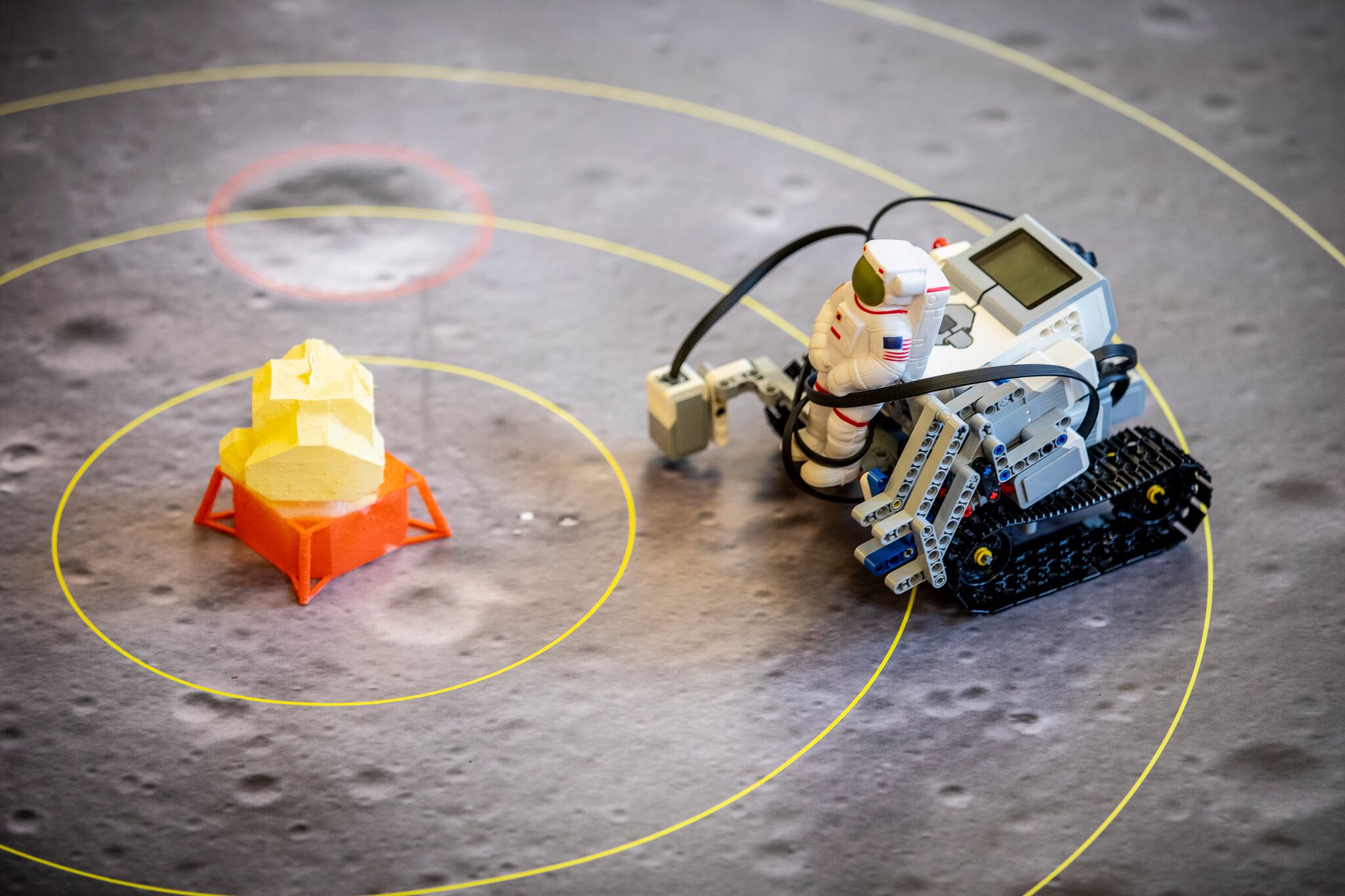
A Lego Mindstorms robot, with a plastic astronaut strapped to the front, approaches a toy lunar lander during an Apollo moon mission re-enactment. (University of Washington Photo / Dennis Wise)
Fifty years after the first Apollo moon landing, students from across the country will get a chance to re-enact the feat with drones and robots, thanks to an educational challenge orchestrated by NASA and the University of Washington’s Northwest Earth and Space Sciences Pipeline.
The event — known as the Apollo 50 Next Giant Leap Student Challenge, or ANGLeS Challenge for short — got its official kickoff today at Kent-Meridian High School in Kent, Wash.
“This is a truly interdisciplinary challenge, involving computer programming, robotics, remote sensing and design,” Robert Winglee, who’s the director of the Northwest Earth and Space Sciences Pipeline as well as a UW professor of Earth and space sciences, said in a news release.
A global contest will give the 1974 Arecibo Message a reboot. (Arecibo Observatory Illustration)
The Arecibo Observatory today kicked off a student-focused competition to design a new message to beam to extraterrestrials, 44 years to the day since the first deliberate message was sent out from Arecibo’s 1,000-foot-wide radio telescope.
“Our society and our technology have changed a lot since 1974,” Francisco Cordova, the observatory’s director, said in a news release. “So if we were assembling our message today, what would it say? What would it look like? What one would need to learn to be able to design the right updated message from the earthlings? Those are the questions we are posing to young people around the world through the New Arecibo Message – the global challenge.”
It’s not just about the message, however: Competitors will have to solve brain-teasing puzzles posted on Arecibo’s website in order to qualify, get instructions, register and submit their designs. Along the way, they’ll learn about space science, the scientific method and Arecibo’s story.
The National Science Foundation’s director, France Cordova, worked on the STEM training partnership with Heidi Capozzi, senior vice president of human resources at Boeing. (NSF Photo)
The National Science Foundation and Boeing say they’ve forged a $21 million partnership to accelerate skill development and increase diversity in the fields of science, technology, engineering and math, known collectively as STEM.
Supported by $10 million in funding from Boeing, NSF will team up with learning institutions to develop online training in critical skill areas for students and Boeing employees.
The skill areas being targeted include model-based engineering and systems engineering, mechatronics, robotics, data science and sensor analytics, program management and artificial intelligence. Boeing and NSF expect the first project to launch in 2019.
To complement that part of the program, NSF’s Directorate for Education and Human Resources will invest $10 million in awards focused on skill development and training for America’s STEM workforce.
Boeing also will contribute $1 million to the NSF INCLUDES initiative, which aims to boost U.S. innovation by broadening participation in STEM fields. INCLUDES stands for “Inclusion across the Nation of Communities of Learners of Underrepresented Discoverers in Engineering and Science.”