Lab workers process coronavirus test samples at UW Medicine’s virology lab. (UW Medicine Photo)
The University of Washington School of Medicine says its virology lab is now capable of performing 1,000 genetic tests for the COVID-19 coronavirus every day — but all that capacity hasn’t yet fully come into play.
“We’ve performed a little more than 400 tests to date over this week,” Alex Greninger, assistant director of UW Medicine Clinical Virology Laboratories, explained in an email. “We have much more capacity to perform tests than we are currently receiving. We perform tests on the specimens we are sent. Our current capacity in just over a thousand tests per day, and we are building out to perform 4,000 to 5,000 per day.”
Vice President Mike Pence gives an elbow bump to Washington Gov. Jay Inslee during a news briefing about the coronavirus outbreak. (Global News via YouTube)
Washington Gov. Jay Inslee and other state officials say they’re acting to reduce medical costs for people who have to be tested or treated for the COVID-19 coronavirus.
The state will cover the costs of testing for state residents who don’t have health insurance, Inslee said today at a news briefing in Olympia.
“For the uninsured in our state, whose doctors believe they need testing, I am announcing that we have the authority and intention to cover those costs by the state of Washington,” Inslee said.
One of the lead authors of the scorpion venom study, Fred Hutch staff scientist Emily Girard (center), says she hopes her work “results in a therapeutic that will help a lot of people.” (Fred Hutch News Service Photo / Robert Hood)
Scientists at Seattle’s Fred Hutchinson Cancer Research Center have identified a mini-protein in scorpion venom that can target joint inflammation in arthritic rats — and they’re hoping it can do the same thing for human patients.
It’s too early to say whether the technique will work as well in humans as it does in rats. But the experiments reported today in Science Translational Medicine hold the promise of delivering the benefits of steroid-based therapies for arthritis while avoiding the side effects that come with the use of those steroids.
An artist’s conception shows microscopic coronavirus particles. (CDC Illustration)
As the coronavirus epidemic widens, public health officials in Seattle-King County are recommending that people work at home if possible — and that large gatherings of people should be postponed if feasible.
The recommendations were issued today in an advisory that also updated the statistics for the epidemic’s spread in King County. Ten new confirmed cases were reported, including one additional death. That brings the total for King County to 31 confirmed cases, including nine deaths.
A new lab test to detect the COVID-19 coronavirus is ready for prime time. (UW Medicine via YouTube)
The University of Washington School of Medicine is moving forward with a new clinical lab test for the COVID-19 coronavirus, and plans to be able to test up to 1,500 samples per day by the end of the week.
Implementation of the test, which will be available only through physicians and healthcare providers, was announced today. The effort follows up on the Food and Drug Administration’s announcement that it would allow labs to develop their own diagnostic tests for the virus under expedited approval.
Also today, the Bill & Melinda Gates Foundation announced that it’s committing an additional $5 million to help public health agencies in the Seattle area enhance their capacity to detect the virus. The response to the coronavirus’ spread was stymied in the Seattle area, where the first U.S. cases were reported, because effective lab tests weren’t available in the first weeks of the epidemic.
A diagram shows how a thin film of patterned nitinol can be used to hold CAR T cells, with fibrin protein used as a binding agent. (Fred Hutchinson Cancer Research Center Graphic)
Researchers at Seattle’s Fred Hutchinson Cancer Research Center have demonstrated the effectiveness of a new method for getting immune cells to fight solid tumors — by spreading them like jam onto ultra-thin sheets of metal mesh, and then laying the mesh onto the tumors.
So far, the technique for delivering genetically engineered T cells has been used only on mice — but the preclinical study published today in Nature Biomedical Engineering could help set the stage for the mesh to be used on humans as well.
“Cell therapies to fight cancer have had great success in blood cancers, but haven’t worked well with solid tumors,” senior study author Matthias Stephan, a faculty member in the Fred Hutch Clinical Research Division, explained in a news release.
“Our findings take a significant step toward making cell therapies effective against solid tumors by showing that a thin metal mesh loaded with T cells engineered to fight ovarian cancer cleared tumors in 70% of the treated mice,” he said.
A team at Oak Ridge National Laboratory opens a uranium-233 canister inside a glovebox. (ORNL Photo)
TerraPower, the nuclear research venture founded by Bill Gates, is joining with Isotek Systems and the U.S. Department of Energy in a public-private partnership aimed at turning what otherwise would be nuclear waste into radiation doses for cancer treatment.
The partnership matches TerraPower’s demand for radioisotopes with the federal government’s need to dispose of nuclear material that’s been stored for decades at Oak Ridge National Laboratory in Tennessee.
Isotek, a DOE contractor that’s responsible for overseeing Oak Ridge’s inventory of uranium-233, will use the proceeds from the sale of extracted thorium-229 to accelerate the schedule for disposal of the Cold War stockpile. In a news release, the Department of Energy said the deal will save $90 million in taxpayer dollars.
TerraPower will use the thorium that it purchases from Isotek to further medical applications of radioisotope technologies.
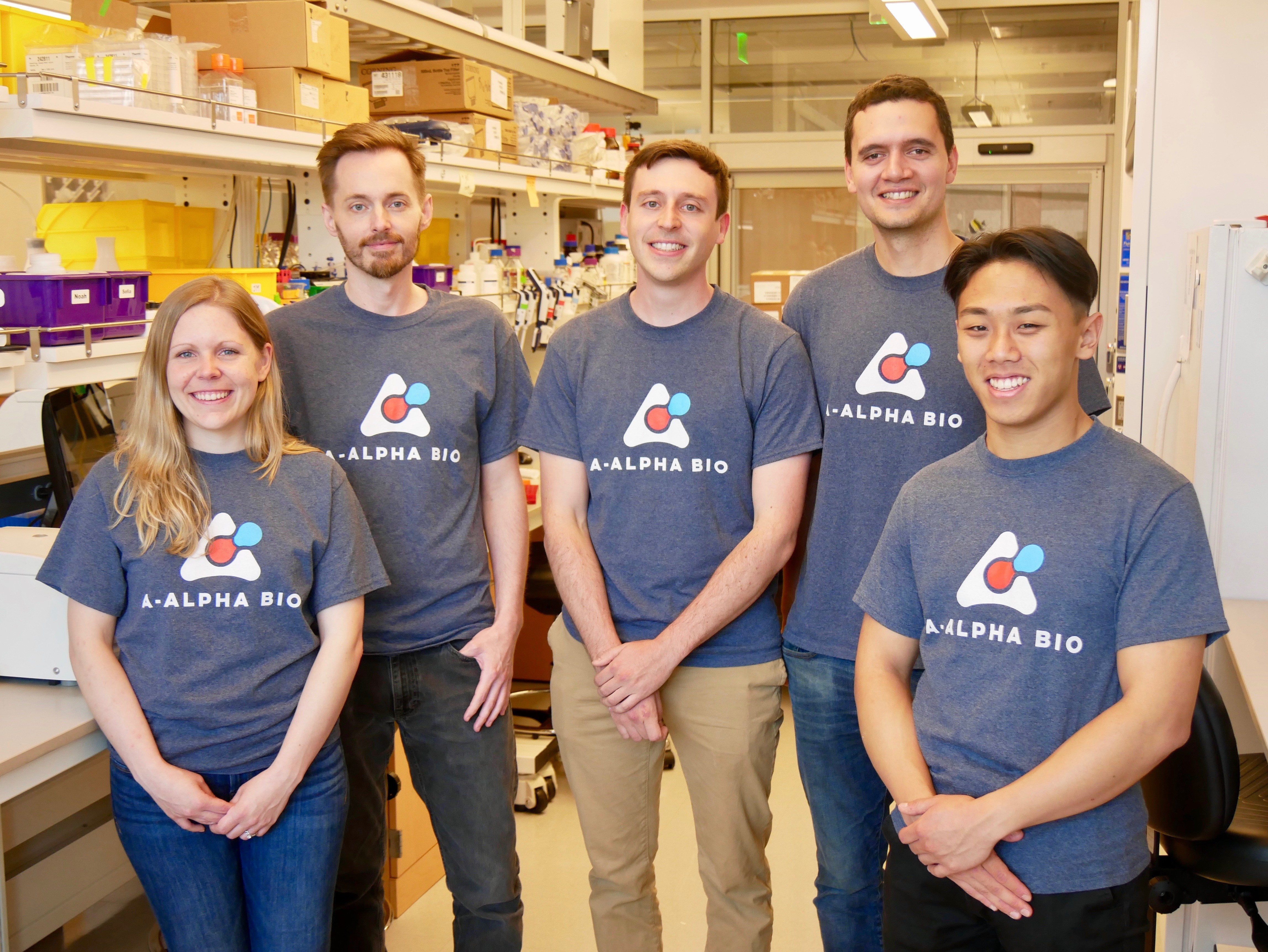
The A-Alpha Bio team includes scientist Emily Engelhart, principal scientist David Colby, co-founder and CEO David Younger, co-founder and chief technology officer Randolph Lopez and engineering associate Charles Lin. (A-Alpha Bio Photo)
A Seattle startup that took root at the University of Washington has closed a $2.8 million seed round for a drug discovery platform that can sort through millions of protein interactions at once.
“We expect that we can go considerably further than that,” said David Younger, the co-founder and CEO of A-Alpha Bio.
A-Alpha Bio’s genetically engineered protein analysis technology, known as AlphaSeq, has the potential to speed up the process of evaluating drug candidates. That’s what attracted interest from investors including OS Fund, which led the seed round, plus AME Cloud Ventures, Boom Capital, Madrona Venture Group, Sahsen Ventures, Washington Research Foundation and a number of angel investors.
The Allen Institute for Artificial Intelligence’s Supp.AI search engine combs through research focusing on interactions involving nutritional supplements as well as drugs. (GeekWire Photo / Alan Boyle
Physicians and regulators keep close tabs on how different drugs interact. But what about interactions involving dietary supplements?
“There’s just no way for anybody to keep up with the combinations of supplements and drugs,” said Deborah Rappaport, vice president of product at InHealth Medical Services. “It’s a huge number.”
Seattle’s Allen Institute for Artificial Intelligence, or AI2, is harnessing the power of its Semantic Scholar academic search engine to make the job easier. Today it unveiled Supp.AI, a searchable database that indexes 4,650 supplements and drugs from Abbokinase to Zytiga, and serves up research findings on more than 56,000 interactions involving those products.
The collaboration demonstrates how Pacific Northwest connections can pay off: Fujifilm SonoSite, a subsidiary of Japan’s Fujifilm that’s headquartered in Bothell, Wash., reached out to the startup incubator at the Seattle-based institute, known as AI2, for advice on improving their compact ultrasound imaging systems.
“The AI2 Incubator was a perfect place to look for help in creating breakthrough technology,” Rich Fabian, SonoSite’s president and chief operating officer, said in a news release. “They have the type of talent that is hard to recruit, combined with the hunger of a startup. We look forward to collaborating more.”
Ultrasound imaging is significantly more affordable and portable than X-ray imaging, CT scans or PET scans, with none of the downside associated with radiation exposure. “Ultrasound’s comparative disadvantage is its lower image quality, which we aim to address with the use of deep learning,” Vu Ha, technical director at the AI2 Incubator, told GeekWire in an email.