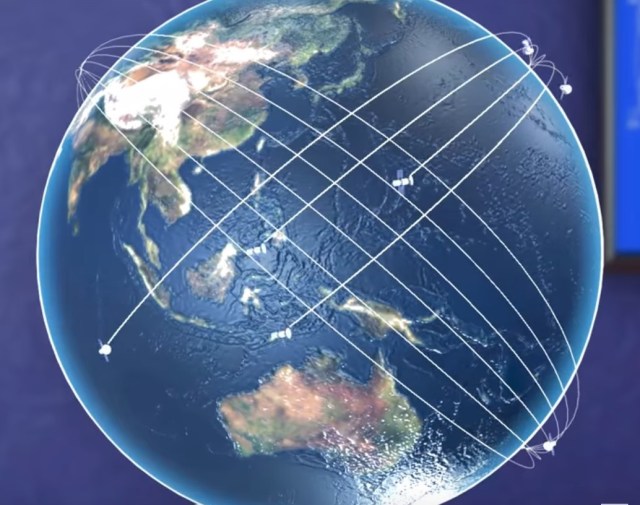
RBC Signals knits together a network of antennas at sites around the world. (GSA Illustration)
Seattle-based RBC Signals says it’s raised $1.5 million from investors around the world, providing a boost for its plans to knit together a network of ground stations for receiving satellite data.
The company didn’t provide details about its latest seed-round investors, other than to say they include venture capitalists from the United States, Singapore, the Middle East and China. Previously announced investors include Blacktop Capital and Entrenext Ventures.
SpaceX’s Falcon 9 rocket stands on its pad at Kennedy Space Center’s Launch Complex 39A in preparation for sending the EchoStar 23 satellite into orbit. (SpaceX Photo)
High winds have forced SpaceX to postpone its launch of the EchoStar 23 communications satellite, a mission requiring so much oomph that the company won’t even try landing the first-stage booster afterward.
The Falcon 9 rocket was due to lift off in the wee hours of March 15 from Launch Complex 39A at NASA’s Kennedy Space Center in Florida, but SpaceX decided to wait out the winds.
Paul Allen stands on the wing of the giant Stratolaunch plane during a tour of the hangar in Mojave, Calif., where the craft is being assembled. The plane’s tail is in the background. (Paul Allen via Twitter)
The world’s biggest airplane is staying on track to take to the air for the first time by the end of this year, according to Paul Allen, who made billions of dollars as Microsoft’s co-founder and is now spending millions of dollars on the Stratolaunch air-launch system.
Allen provided an update on Stratolaunch and dropped hints about future space endeavors today during an interview at the University of Washington’s Paul G. Allen Center for Computer Science & Engineering, where professors, students and VIPs celebrated Allen’s $40 million gift to UW’s 50-year-old computer science program,
Most of the interview was devoted to Allen’s reflections on how computer technology has changed since he and his high-school friends took advantage of the UW’s computer lab on the sly in 1971. But the billionaire entrepreneur and philanthropist also was clear about his commitment to the Stratolaunch project, which was unveiled back in 2011.
The satellite coverage scheme described in a patent application envisions two sets of satellites orbiting in different inclinations at different altitudes. (PatentYogi via YouTube)
When it comes to providing global broadband internet coverage, two satellite constellations in low Earth orbit are better than one. At least that’s the implication of a patent application filed by an inventor who used to work at Google and is now part of SpaceX’s Seattle-area satellite operation.
OneWeb executive chairman Greg Wyler and Blue Origin founder Jeff Bezos shake hands on a deal for satellite launches on Blue Origin’s New Glenn rocket. (Blue Origin Photo)
WASHINGTON, D.C. – A day after announcing the first launch customer for Blue Origin’s yet-to-be-built New Glenn rocket, Amazon billionaire Jeff Bezos introduced the second customer: OneWeb, a venture that aims to create a satellite network for global broadband access.
Over the next few years, OneWeb is planning to send hundreds, and then thousands of small satellites into low Earth orbit. In partnership with Airbus, OneWeb is due to build and launch the first satellites within the next year. It’s also planning a 100,000-square-foot manufacturing complex on Florida’s Space Coast – not far from where Blue Origin is building a 750,000-square-foot factory for New Glenn rockets.
OneWeb already has struck deals with Virgin Orbit and Arianespace for the initial launches. The deal that Bezos announced today provides for five additional launches on the New Glenn, starting in 2021.
Kymeta’s mTenna antenna system can bring turnkey satellite connectivity to buses, trains and remote sites where cellphones can’t get a signal. (Kymeta via YouTube)
WASHINGTON, D.C. – Five years after its founding, the Kymeta antenna venture backed by Microsoft co-founder Bill Gates is releasing its first commercial product – and partnering with satellite operator Intelsat on a new broadband data service dubbed Kalo.
Kalo (rhymes with “halo”) and Kymeta’s integrated antenna and data terminal system made their debut today at the Satellite 2017 conference in Washington, D.C.
“Anything you could do on a cellphone, you can now do with a satellite,” Bill Marks, chief commercial officer for Kymeta, headquartered in Redmond, Wash., told GeekWire.
Jeff Bezos, the founder of Amazon as well as the Blue Origin space venture, takes the stage with Eutelsat CEO Rodolphe Belmer. (GeekWire Photo / Alan Boyle)
WASHINGTON, D.C. — Amazon billionaire Jeff Bezos revealed satellite operator Eutelsat as the first paying customer for his Blue Origin space venture’s New Glenn orbital rocket, and showed off a new animation depicting the rocket taking off, delivering a satellite to orbit and landing on a barge at sea.
Bezos and the chairman of this week’s Satellite 2017 conference, Jeffrey Hill, brought the Paris-based satellite operator’s CEO, Rodolphe Belmer, on stage as a surprise guest during today’s keynote chat.
“We couldn’t hope for a better first partner,” Bezos said.
In a news release, Eutelsat said the first payload would be a geostationary satellite, to be launched in the 2021-2022 time frame.
Spaceflight’s SHERPA carrier is designed to deploy scores of satellites. (Credit: Spaceflight)
For more than a year, Seattle-based Spaceflight has been waiting to launch an array of 89 miniaturized satellites aboard a SpaceX Falcon 9 rocket and deploy them in orbit from its innovative SHERPA carrier.
Now the launch logistics company isn’t waiting any longer.
All 89 satellites have been rebooked due to schedule concerns, Spaceflight’s president, Curt Blake, reported today in a blog posting.
“We found each of our customers an alternative launch that was within the same time frame,” Blake wrote. “It took a huge effort, but within two weeks, the team hustled to have all customers who wanted to be rebooked confirmed on other launches!”
An artist’s conception shows a OneWeb satellite in orbit. (OneWeb Illustration)
Intelsat and OneWeb today laid out plans for a mega-merger aimed at bolstering their satellite internet services, with a $1.7 billion investment boost from SoftBank.
The arrangement is a head-turner, due to the complicated conditions of the deal as well as its ambitious objective. It comes just a couple of months after Japan-based SoftBank announced a $1 billion investment in OneWeb, which is gearing up to launch a constellation of satellites for global internet access.
“We believe that combining Intelsat with OneWeb will create an industry leader unique in its ability to provide affordable broadband anywhere in the world,” Intelsat CEO Stephen Spengler said in a news release.
India’s Polar Satellite Launch Vehicle lifts off from the Satish Dhawan Space Center on the coast of the Bay of Bengal, sending 104 satellites spaceward. (ISRO Photo)
A record-setting flock of 104 satellites was successfully deployed into orbit overnight after the launch of an Indian rocket. Seattle-based Spaceflight Industries played a part in getting nine of those satellites where they needed to go.
India’s Polar Satellite Launch Vehicle, or PSLV, lifted off from the Satish Dhawan Space Center at Sriharikota at 9:28 a.m. local time today (7:58 p.m. PT Feb. 14).
The mission’s main payload was the Indian Space Research Organization’s Cartosat 2D, a car-sized satellite designed for environmental mapping. Another 88 Dove nanosatellites, each about the size of a toaster oven, will become part of Planet’s Earth-observing constellation.
Eight more nanosatellites were launched for Spire Global, which is filling out a constellation to monitor weather as well as aviation and maritime traffic. This is the second Spire PSLV mission facilitated by Spaceflight Industries, which handles launch logistics.
Spaceflight also arranged to get Israel Aerospace Industries’ BGUSat nanosatellite on the flight. BGUSat is a research spacecraft built by students at Ben Gurion University to perform cloud imaging and measure atmospheric background radiation.
Six more research satellites rounded out the flock, which represented the highest number of satellites launched on a single rocket. ISRO said all 104 satellites were successfully deployed into pole-to-pole orbits within a half-hour after launch.