Kyle MacLachlan plays Thomas Edison in "Tesla." (Courtesy of IFC Films)
Can you picture Thomas Edison with a smartphone? Or poking a rival with an ice-cream cone? When you watch Kyle MacLachlan play one of America’s most famous inventors in the movie “Tesla,” you can.
And wait until you hear which 21st-century tech genius MacLachlan would love to portray next.
“The story of Elon Musk would be interesting, just because I think he’s a quirky fellow,” MacLachlan told me during an interview for the inaugural Fiction Science podcast. “That would be challenging, to understand who that his, and how he moves through the world, what he thinks, how he interacts with people.”
MacLachlan is pretty good at playing quirky roles. His best-known character is FBI Special Agent Dale Cooper, who delves into dark secrets, interdimensional weirdness and damn fine coffee in “Twin Peaks,” the classic TV series directed by David Lynch.
In a wide-ranging Q&A, MacLachlan and I talked about “Tesla” and “Twin Peaks,” as well as “Dune,” the science-fiction cult classic (or classic flop, depending on your perspective) from 1984 that marked his big-budget movie debut.
The saga had its genesis almost eight decades ago, and the action is set more than 10,000 years in the future. But the themes of the work — centering on the decline and fall of a high-tech empire, Machiavellian machinations and unintended consequences — are, if anything, more relevant than ever in the here and now.
That’s what makes the Foundation series the perfect literary work for the revival of the Cosmic Log Used Book Club.
The CLUB Club goes back to the foundation of Cosmic Log. In contrast to book clubs that promote pricey new publications, our aim is to highlight books with cosmic themes that should be available at used-book shops as well as local libraries.
Over the past 18 years, we’ve issued more than 60 CLUB Club selections — many of them suggested by Cosmic Log readers. And to celebrate the return of the CLUB Club, we’re giving you the full list at the end of this item.
We’re also presenting a book giveaway, so keep reading!
“Foundation” dates back to a series of short stories that were published in Astounding Magazine starting in 1942. In the 1950s, those stories were published as a book trilogy — and in the 1980s and 1990s, Asimov produced two sequels and two prequels.
The key concept is psychohistory, the idea that the mass behavior of billions of people can be predicted and shaped centuries in advance. The series’ foundational character, Hari Seldon, uses psychohistory to foresee the fall of a galactic empire. He also comes up with a plan to reduce the resulting dark age from 30,000 years to a mere millennium.
The latter half of the Foundation Trilogy highlights another concept: the potential for one individual with a talent for inspiring loyalty and fear to throw the course of history on a different track. That concept is as relevant today as it was in the midst of the Second World War.
To celebrate the revival of the CLUB Club, as well as the centennial year of Asimov’s birth, let’s have a trivial giveaway. This giveaway is “trivial” not only because it involves a trivia question, but also because there’s a relatively trivial sum at stake.
The prize is a $4 Amazon e-gift card that can be put toward the purchase of the Foundation Trilogy — or, frankly, any other purchase. I’ll send that amount to the first person answering the quiz question correctly in a comment below, based on submitted time stamp.
Here’s the question:
The Foundation series features a fictional reference work that has also popped up in books written by Carl Sagan and Douglas Adams. What is the two-word name of that reference work?
Update: We have a winner! Congrats to Kathy Coyle… The answer is “Encyclopedia Galactica.”
In case you’ve already gotten all the way through the Foundation series, here are 66 other CLUB Club selections you can check out using your e-gift card or your library card:
“The Sparrow” by Mary Doria Russell (June 2002 selection)
“Alice in Quantumland” by Robert Gilmore (July 2002)
“Mr. Tompkins” series by George Gamow (August 2002)
“Manifold: Time” by Stephen Baxter (September 2002)
“Dreamer” by Richard L. Miller (October 2002)
“Earth” by David Brin (November 2002)
“Roadside Picnic” by A. and B. Strugatsky (December 2002)
“Strange Matters” by Tom Siegfried (January 2003)
“Out of the Silent Planet” by C.S. Lewis (February 2003)
“Stranger in a Strange Land” by Robert A. Heinlein (March 2003)
“The Copper Crown” by Patricia Kennealy (April 2003)
“Dragon’s Egg” by Robert L. Forward (May 2003)
“The Elegant Universe” by Brian Greene (June 2003)
“Contact” by Carl Sagan (July 2003)
“A Skywatcher’s Year” by Jeff Kanipe (August 2003)
Mars Trilogy by Kim Stanley Robinson (September 2003)
“Book of the New Sun” series by Gene Wolfe (September 2003)
“The Best of AIR” by Marc Abrahams (October 2003)
“Flare” by R. Zelazny and Thomas T. Thomas (November 2003)
“Mother of Storms” by John Barnes (November 2003)
“Mars: Uncovering the Secrets of the Red Planet” by Paul Raeburn (December 2003)
Tripods Trilogy by John Christopher (January 2004)
“A Princess of Mars” by Edgar Rice Burroughs (February 2004)
“Bad Astronomy” by Phil Plait (March 2004)
“The Spirit of St. Louis” by Charles Lindbergh (April 2004)
“Angels and Demons” by Dan Brown (May 2004)
“The Man Who Sold the Moon” by Robert A. Heinlein (June 2004)
“Do Androids Dream of Electric Sheep?” by P.K. Dick (July 2004)
“Idlewild” by Nick Sagan (August 2004)
“The Right Stuff” by Tom Wolfe (October 2004)
“Science and Theology” by J.C. Polkinghorne (November 2004)
“Evolution” by Stephen Baxter (December 2004)
“Krakatoa” by Simon Winchester (January 2005)
“Killing Star” by C. Pellegrino and G. Zebrowski (February 2005)
“The Forge of God” by Greg Bear (March 2005)
“Short History of Nearly Everything” by B. Bryson (April 2005)
“The Red One” by Jack London (May 2005)
“N.Y. Times Book of Science Questions and Answers” (June 2005)
“Heavy Weather” by Bruce Sterling and “Forty Signs of Rain” by Kim Stanley Robinson (August 2005)
“Chaos” by James Gleick (October 2005)
“A Brief (or Briefer) History of Time” by Stephen Hawking (and Leonard Mlodinow) (November 2005)
“A Wrinkle in Time” by Madeleine L’Engle (December 2005)
“1491” by Charles C. Mann (January 2006)
“Ender’s Game” by Orson Scott Card (February 2006)
“The Gnostic Gospels” by Elaine Pagels (March 2006)
“Prey” by Michael Crichton (April 2006)
“Hellstrom’s Hive” by Frank Herbert (May 2006)
“Inferno” by Jerry Pournelle (August 2006)
“This Place Has No Atmosphere” by Paula Danziger and “Countdown for Cindy” by Eloise Engel (September 2006)
“Orbit” by John J. Nance (October 2006)
“Time and Again” by Jack Finney (November 2006)
“God in the Equation” by Corey Powell (December 2006)
“Conversations on Consciousness” by S. Blackmore (Jan. 2007)
“Everyday Life in New Testament Times” by Bouquet (April 2007)
“Supernova” by Roger Allen and Eric Kotani (May 2007)
“The Twilight of Briareus” by Richard Cowper (June 2007)
“The Traveler” by John Twelve Hawks (July 2007)
“Slaughterhouse-Five” by Kurt Vonnegut (August 2007)
“Flatland” by Edwin A. Abbott and “The Fourth Dimension” by Rudy Rucker (December 2007)
“The Year 1000” by D. Danziger and R. Lacey (November 2009)
“Creation” by Randal Keynes (January 2010)
“In Search of Time” by Dan Falk (February 2010)
“Space” by James Michener (September 2011)
What’s your favorite cosmic reading matter? Pass your suggestion along in a comment, and it just might be featured as a future CLUB Club selection.
Engineer Naomi Nagata (played by Dominique Tipper) watches a projectile whiz past her in an episode of “The Expanse.” Mavericks VFX was responsible for the whiz. (Mavericks VFX Photo)
It used to take a cast of thousands to create cinematic extravaganzas, but now the job can be done with a cast of dozens of artists and developers, plus thousands of cloud-connected computer servers.
The proof of that can be seen today in science-fiction epics ranging from “Star Wars” to “The Expanse.” And those shows merely hint at the beginning of a computer-generated revolution in visual effects, or VFX. Just wait until artificial intelligence hits its prime.
“That’s changing the game for all of us,” Brendan Taylor, president and visual effects supervisor for Mavericks VFX, told me. “That’s going to turn the VFX industry on its head in the next couple of years.”
Luke Skywalker’s home planet, Tatooine, and its two suns are a good example of science echoing Star Wars. Or is it the other way around? (Lucasfilm / 20th Century Fox Photo)
Over the past 42 years, filmgoers have seen exotic worlds come to life in a succession of Star Wars movies — a series that is now coming to a climax with “Star Wars: Episode IX, The Rise of Skywalker.” But are those exoplanets really all that exotic anymore?
Sure, we’ve seen two suns in the sky over the sands of Tatooine, Luke Skywalker’s home planet. We’ve been to an ice planet (Hoth) and a lava planet (Mustafar). We’ve even spent time on a habitable exomoon that’s in orbit around a gas giant (Endor).
Back in 1977, most of us might have thought those types of worlds to be science-fiction fantastical. Today, they’re seen as totally plausible categories in the study of thousands of planets beyond our solar system. And Rory Barnes, a University of Washington astronomer who focuses on astrobiology and the habitability of exoplanets, suspects Star Wars creator George Lucas knew this could happen.
If “The Expanse” ever decides to shoot episodes of the science-fiction series on a Blue Origin spaceship, Wes Chatham is ready to go.
“I do think it’d be an excellent marketing opportunity to be the first show that shoots a scene in space,” said Chatham, who plays the role of a space jockey with a gruff exterior but a soft heart on the Amazon Prime Video series.
His comments came to light in a video documenting the “Expanse” cast’s visit to Blue Origin’s headquarters in Kent, Wash. That visit took place in March, but back then, all we had to go on were tweets from Chatham’s fellow actors. Today, Prime Video posted highlights from the visit to publicize next week’s Season 4 premiere. This’ll be the first season to have its first-run airing on Amazon, thanks in part to CEO Jeff Bezos’ intervention.
Bezos also owns the Blue Origin space venture, so it was an obvious move to have the “Expanse” cast and crew stop by during March’s tour of Amazon’s home territory. In addition to the show’s stars, the entourage included showrunner Naren Shankar as well as Daniel Abraham and Ty Franck, who are co-authors of the “Expanse” book series under the pen name James S.A. Corey.
When the actor who plays the boss’ favorite Star Trek captain drops in at the office, it’s best to agree with the boss. Even though Amazon’s Alexa is just a computerized voice assistant, she clearly understands that much.
That’s basically how things went down today when Amazon CEO Jeff Bezos dropped in at the Seattle office where comedy writers come up with bon mots for Alexa … with Patrick Stewart, who plays Captain Jean-Luc Picard, at his side.
The killer robot in “Terminator: Dark Fate,” played by Gabriel Luna, can split into a human-looking ectoskeleton at left, and a metallic endoskeleton at right. (Paramount Pictures Photo)
He promised he’d be back — and 35 years after Arnold Schwarzenegger created what’s now a cliche for artificial intelligence gone wrong in the first “Terminator” movie, the cinematic nightmares about time-traveling killer robots have returned to the big screen.
“Terminator: Dark Fate” also marks the return of writer/producer James Cameron — who directed the first two movies in the franchise, but wasn’t involved in the three sequels that followed. Cameron skips over those films and reboots the saga with an alternate timeline for the robo-apocalypse.
Although monstrous machines have figured in movie plots since Fritz Lang’s “Metropolis” in 1927, Schwarzenegger’s performance in “The Terminator” set the stage for worries about out-of-control intelligent machines.
Billionaire techie Elon Musk is among the best-known doomsayers. “I keep sounding the alarm bell, but until people see robots going down the street, killing people, they don’t know how to react because it seems so ethereal,” Musk said in 2017.
On the other side of the debate, Oren Etzioni, the CEO of Seattle’s Allen Institute for Artificial Intelligence, or AI2, keeps telling people to calm down. “Even though AI is more and more being used, I want to reassure people that Skynet and Terminator are not around the corner for many, many reasons,” he told GeekWire in 2016.
Does the new “Terminator” movie update the saga with all the developments in AI, automation and robotics since 1984? How does “Dark Fate” stack up against the realities of our AI age? To get some informed perspectives, I invited two folks who work in the field to watch the movie with me — and share their thoughts afterward.
Brad Pitt, the star of the space movie “Ad Astra,” chats with NASA astronaut Nick Hague over a video hookup to the International Space Station. (NASA via YouTube)
Imagine the taglines in the movie ads: “Really good” portrayal of zero-gravity! “Absolutely” better than George Clooney!
There’d be some justification for Brad Pitt’s space movie, “Ad Astra,” to use those lines after today’s Earth-to-space video call between the A-list Hollywood star and NASA astronaut Nick Hague, who’s finishing up a six-month tour of duty on the International Space Station.
Pitt said the linkup, arranged through NASA, was a “real treat.” And he didn’t waste any time getting a film review from Hague, who watched an advance screening of “Ad Astra” with his crewmates on the station.
“Now that I have you all the way up at the space station, let’s talk about me,” Pitt said. “How’d we do? How was our zero-G?”
“I gotta tell you, it was really good,” Hague said as he floated amid the trappings of the station’s Destiny laboratory module. “The depictions, the settings, as you can tell, look very similar to the type of setting I’ve got around me.”
Science-fiction author Neal Stephenson discusses hsi latest book, “Fall; or, Dodge in Hell,” at Town Hall Seattle. (GeekWire Photo / Alan Boyle)
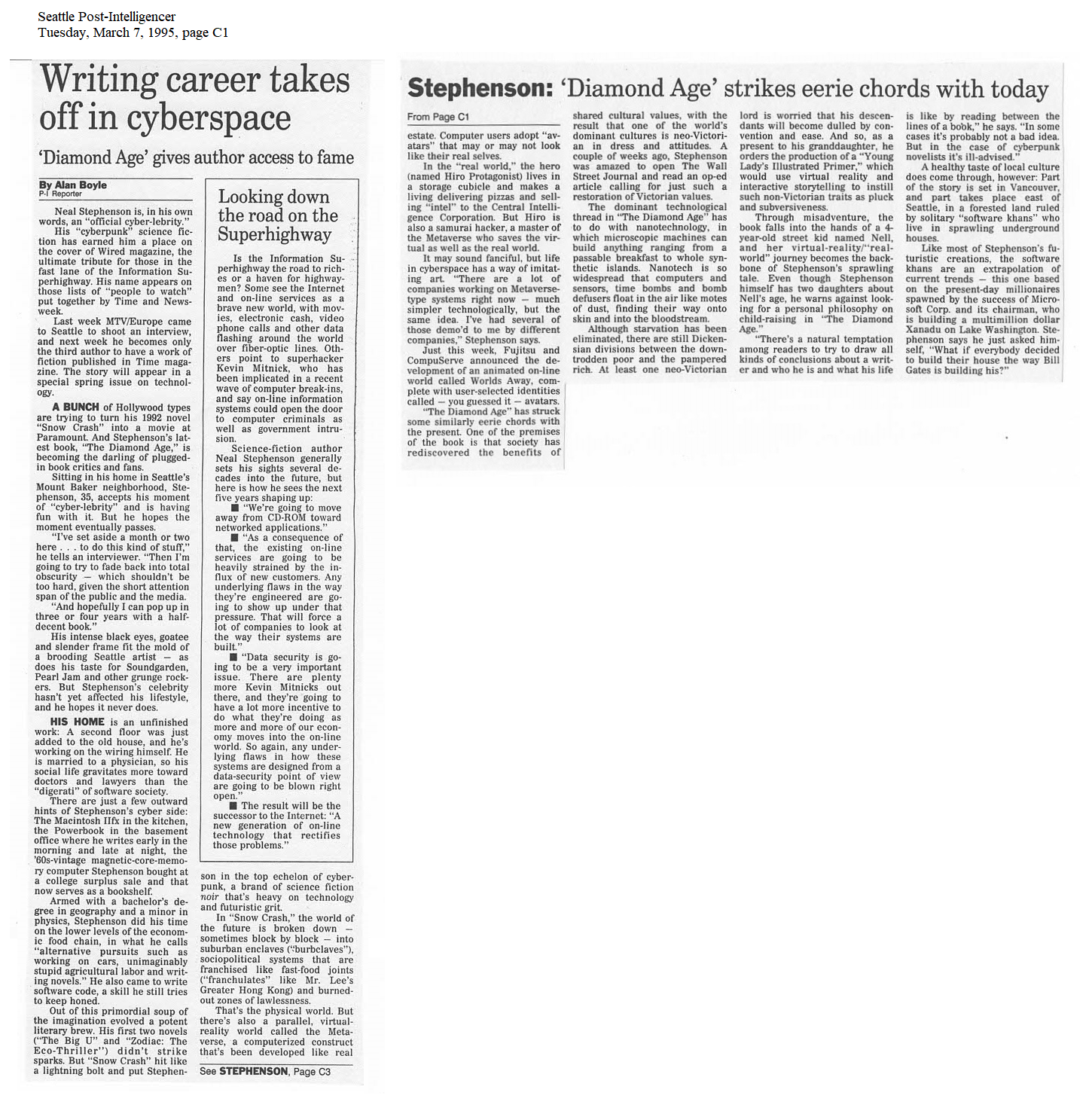
Seattle author Neal Stephenson’s works of fiction often play off the potential for future facts — for example, the virtual world described in “Snow Crash,” the nanotechnology at the heart of “The Diamond Age” and the millennium-scale thinking that’s embodied in “Anathem” (and in the real-life 10,000 Year Clock bankrolled by Amazon billionaire Jeff Bezos).
His latest novel, “Fall; or, Dodge in Hell,” kicks it up a notch with ruminations about what it would take to create an artificial afterlife, powered by computerized replicas of human consciousness.
Stephenson acknowledges that his vision in the afterlife in “Fall” plays loosely with the facts of neuroscience. But his books touch on other technological themes that are closer to reality, and he discussed several of those themes this week during a talk at Town Hall Seattle. Here’s a roundup of five ideas well worth thinking about — with recommendations for further reading.
Science-fiction author Neal Stephenson, shown here at a 2018 Town Hall event in Bellevue, Wash., uses Seattle as a setting in his latest novel, “Fall; or, Dodge in Hell.” (GeekWire Photo / Alan Boyle)
Are we living in a simulation? Is there an afterlife? And if not, what would it take to create one? Seattle science-fiction author Neal Stephenson knits together ideas as old as the Bible and as up to date as Elon Musk’s musings in an epic 880-page novel titled “Fall; or, Dodge in Hell.”
“Fall” takes its rightful place alongside Stephenson’s earlier works, including 1991’s “Snow Crash,” which anticipated the rise of virtual and augmented reality; 1995’s “The Diamond Age,” which celebrated nanotechnology and neo-Victorianism; and 2015’s “Seveneves,” a tale that started with the moon’s mysterious destruction.
Microsoft co-founder Bill Gates rated “Seveneves” among his favorite books, saying that it contained “so many cool ideas, memorable characters and good storylines that I can’t cover them all.” I can hardly wait to hear what he says about Stephenson’s latest.