Categories
GeekWire

SpaceX sets sights on lower Starlink satellite orbits

Satellite constellation
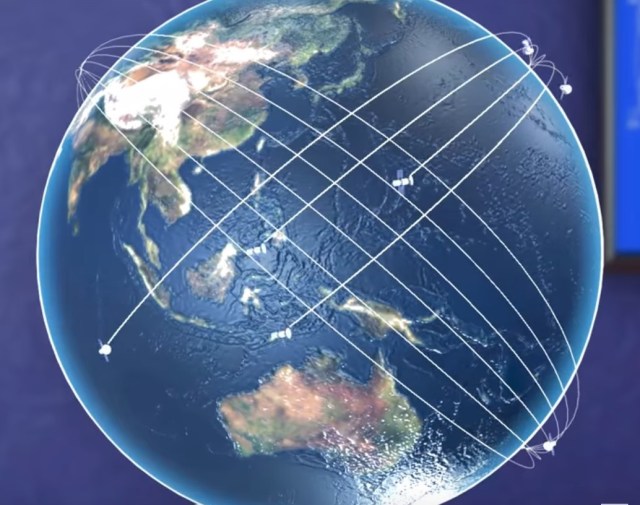
The satellite coverage scheme described in a patent application envisions two sets of satellites orbiting in different inclinations at different altitudes. (PatentYogi via YouTube)

SpaceX wants to lower the bar for its first batch of Starlink broadband satellites, with the aim of beginning deployment by the end of 2019.

The revised plan is laid out for regulators at the Federal Communications Commission in filings that seek a lower orbit for 1,584 of the more than 4,400 satellites it envisions launching. The new target orbit would be 550 kilometers (342 miles) in altitude, as opposed to the 1,150-kilometer (715-mile) orbit described in SpaceX’s initial round of filings.

The FCC signed off on SpaceX’s original plan in March, and would have to approve the revisions after putting them through a public comment period.

In its filings, SpaceX said it was changing the plan based on its experience with Tintin A and B, the two prototype satellites it put into orbit in February.

Those spacecraft, which were built at SpaceX’s satellite development facility in Redmond, Wash., have been undergoing testing for months. Some observers wondered why the Tintin satellites weren’t sent into a higher orbit as planned — and the revised constellation plan could provide an explanation.

Get the full story on GeekWire.

Categories
GeekWire

SpaceX reorganizes Starlink satellite operation

SpaceX Falcon 9 launch
A SpaceX Falcon 9 rocket blasts off from Vandenberg Air Force Base in California, sending the first two Starlink demonstration satellites into orbit. (SpaceX via YouTube)

SpaceX says it has reorganized its satellite development operation in Redmond, Wash., to accelerate design and testing of the elements for its planned satellite broadband constellation — and high-level departures were reportedly part of the shift.

Word of the reorg came in response to a Reuters report, quoting unnamed SpaceX employees as saying that CEO Elon Musk traveled to the Redmond facility in June to fire members of the satellite program’s senior management team.

Musk was reportedly unhappy with the pace of the testing program, which was highlighted by the launch of two demonstration satellites in February. The casualties were said to include the SpaceX vice president in charge of the satellite program, Rajeev Badyal, a veteran of Microsoft and Hewlett Packard; and satellite designer Mark Krebs, who led Google’s aircraft and spacecraft teams before coming to SpaceX.

Get the full story on GeekWire.

Categories
GeekWire

SpaceX is looking for a loan — and baristas

BFR illustration
An artist’s conception shows SpaceX’s BFR in flight. (SpaceX Illustration)

Bloomberg News is quoting unnamed sources as saying that SpaceX is seeking to borrow $500 million in the leveraged loan market with Goldman Sachs’ help.

Today’s report said that Goldman Sachs Group is leading the talks with potential investors this week. Neither Goldman Sachs nor SpaceX have publicly acknowledged the talks, however.

SpaceX has notched plenty of successes over the year to date, including 16 Falcon 9 rocket launches plus the first test launch of its Falcon Heavy rocket in February. Within the coming year, the California-based company is expected to execute its first crewed space launch, aimed at sending astronauts to the International Space Station.

Significantly more ambitious and capital-intensive projects are on SpaceX’s longer-range agenda: The company is working on a constellation of thousands of Starlink satellites that are designed to provide global internet access as well as a revenue stream that, over the long run, may be more substantial than the launch business. SpaceX’s team in Redmond, Wash., has been given the lead role in the Starlink project.

Then there’s the BFR, or Big Falcon Rocket: That super-heavy-lifter is designed to take on suborbital passenger flights between terrestrial destinations as well as trips to the moon and Mars. SpaceX has already signed up Japanese billionaire Yusaku Maezawa for a flight around the moon in the 2020s.

Starlink and BFR are each expected to require billions of dollars of investment.

Get the full story on GeekWire.

Categories
GeekWire

SpaceX’s satellites are good enough for gaming

Starlink satellites
A camera mounted on SpaceX’s Falcon 9 rocket shows the deployment of two prototype Starlink satellites in February. (Elon Musk via Twitter)

It’s been three months since SpaceX launched the first prototype satellites for its Starlink broadband internet network, and there’s been precious little information about what they’re up to. Until today.

Responding to a follower’s Twitter inquiry, SpaceX CEO Elon Musk assessed how the twin satellites, dubbed Tintin A and B, are doing:

Get the full story on GeekWire.

Categories
GeekWire

SpaceX president sees satellites as next frontier

Gwynne Shotwell
SpaceX’s president and chief operating officer, Gwynne Shotwell, talks about the company’s future financial frontier. (CNBC via YouTube)

SpaceX is taking a commanding role in the rocket business — but Gwynne Shotwell, the company’s president and chief operating officer, expects the satellite business to be more lucrative.

Shotwell sized up SpaceX’s road ahead in a CNBC interview that aired today in connection with the cable network’s latest Disruptor 50 list. For the second year in a row, the space venture founded by billionaire Elon Musk leads the list.

The 18 launches by SpaceX’s Falcon 9 rockets accounted for 20 percent of the world’s orbital liftoffs last year, and Shotwell said she expects the launch tally to rise to between 24 and 28 for this year.

Next year, however, could bring a “slight slowdown” to a level that’s more in line with 2017’s pace, Shotwell said. That’s due to a projected decline in demand for satellite launches.

The satellite launch service market has grown to an estimated $5.5 billion in 2016, according to the latest State of the Satellite Industry Report. But that pales in comparison with the $127.7 billion market for satellite services and the $113.4 billion market for satellite ground services.

That’s why SpaceX is putting its chips down on a plan to provide global broadband access through its own satellite constellation, known as Starlink.

Get the full story on GeekWire.

Categories
GeekWire

SpaceX’s Starlink satellite plan wins FCC’s approval

SpaceX Starlink satellites
SpaceX’s two prototype Starlink satellites are seen on either side of their carrier in advance of February’s launch. (SpaceX via YouTube)

The Federal Communications Commission says it has approved SpaceX’s application to provide broadband internet access via thousands of Starlink satellites — a new breed of spacecraft that’s currently under development at the company’s Seattle-area facilities.

SpaceX launched its first test prototype satellites, known as Tintin A and B, as secondary payloads last month. The California-based company plans to put 4,425 spacecraft into low Earth orbit for the first phase of what’s intended to be a low-cost satellite internet service.

“This is the first approval of a U.S.-licensed satellite constellation to provide broadband services using a new generation of low-Earth orbit satellite technologies,” the FCC said today in a statement.

SpaceX’s president and chief operating officer, Gwynne Shotwell, said she appreciated “the FCC’s thorough review and approval of SpaceX’s constellation license.”

Get the full story on GeekWire.

Categories
GeekWire

SpaceX launches first Starlink internet satellites

SpaceX Falcon 9 launch
SpaceX’s Falcon 9 rocket blasts off from Vandenberg Air Force Base in California. (SpaceX via YouTube)

SpaceX put its first two prototype Starlink broadband satellites into orbit along with a Spanish radar imaging satellite today.

The launch from Vandenberg Air Force Base in California came at 6:17 a.m. PT Thursday, 24 hours after strong upper-level winds forced a postponement of the first attempt.

No such issue arose during today’s trouble-free countdown, and the exhaust left behind by the rocket’s ascent made for an eerie, UFO-like picture in the skies above Southern California.

Get the full story on GeekWire.

Categories
GeekWire

SpaceX gets set to try out its first internet satellites

Image: SpaceX Redmond
SpaceX’s Redmond office is the center for its satellite operations. (GeekWire photo by Kevin Lisota)

The first test satellites for SpaceX’s global internet constellation are being prepped for launch as early as this week — three years after SpaceX CEO Elon Musk unveiled the project in Seattle.

The prototype spacecraft, known as Microsat 2a and 2b, are reportedly to be included as secondary payloads on a Falcon 9 rocket from Vandenberg Air Force Base in California, due for launch on Feb. 17. The primary payload is a 3,000-pound Spanish radar observation satellite called Paz.

SpaceX conducted a static-fire test of the Falcon 9, which makes use of a previously flown first-stage booster, at Vandenberg today. The test involved briefly firing up the booster’s rocket engines as a rehearsal for liftoff.

Get the full story on GeekWire.

Categories
GeekWire

SpaceX hints at ‘Starlink’ brand for satellite web

Satellite constellation
A SpaceX satellite coverage scheme described in a patent application envisions two sets of satellites orbiting in different inclinations at different altitudes. (PatentYogi via YouTube)

SpaceX has filed documents seeking to trademark the name “Starlink” for a satellite network that could provide global broadband access to data and video services as well as Earth imagery and remote sensing.

The California company’s satellite unit operates primarily out of facilities in Redmond, Wash., and is working stealthily to develop a constellation of thousands of satellites that would be launched into low Earth orbit.

When SpaceX’s billionaire founder, Elon Musk, announced the multibillion-dollar satellite project during a Seattle visit in 2015, he said it would open the way for low-cost broadband internet access around the world and potentially provide the revenue for the company’s Mars settlement program.

But the trademark application, filed in August, also leaves the door open for “satellite photography services” and “remote sensing services, namely, aerial surveying through the use of satellites.”

Get the full story on GeekWire.