This Hubble image of the merged galaxy known as AM 2026-424 was taken on June 19 in visible light by the Advanced Camera for Surveys. The system resides 704 million light-years from Earth. (NASA / ESA / UW / Dalcanton, Williams and Durbin)
Now here’s something really scary for Halloween: Imagine two galaxies slamming into each other and creating a monstrous wraith with ghostly glowing eyes.
It’s not that far of a stretch. The Hubble Space Telescope captured just such an image, for a team of astronomers based at the University of Washington.
The visible-light picture, taken in June by Hubble’s Advanced Camera for Surveys, shows a galactic smash-up that took place about 700 million light-years away in the constellation Microscopium. The cosmic collision is known as Arp-Madore 2026-424 or AM 2026-424, because it’s noted that way in the Arp-Madore Catalogue of Southern Peculiar Galaxies and Associations.
The mixture of bacteria shown in this photomicrograph contains five different species of the genus Bacteroides. (UW Medicine Photo / Mougous Lab / Kevin Cutler)
The balance of bacteria in your gut can make the difference between sickness and health — and now scientists report that different species of bacteria share immunity genes to protect themselves against each other’s toxins and maintain their balance of power.
In effect, closely related species of bacteria acquire each other’s defense systems to fend off threats from alien invaders.
Washington Gov. Jay Inslee checks out a mammoth skeleton at the Burke Museum of Natural History and Culture. (Jay Inslee via Twitter)
Washington Gov. Jay Inslee and other dignitaries got a helping hand from a troop of third-graders today when they cut a hand-woven cedar ribbon to mark this weekend’s opening of a spacious new home for the Burke Museum of Natural History and Culture.
The students from University Temple Children’s School, just across the street from the museum site on a corner of the University of Washington’s Seattle campus, represented the next generation at the ribbon-cutting ceremony — just as they did at the New Burke’s groundbreaking ceremony three years ago.
“One, two, three,” Inslee counted, and then he cut the ribbon with a giant scissors that was also held by UW President Ana Marie Cauce. The kids snipped their classroom scissors at the same time.
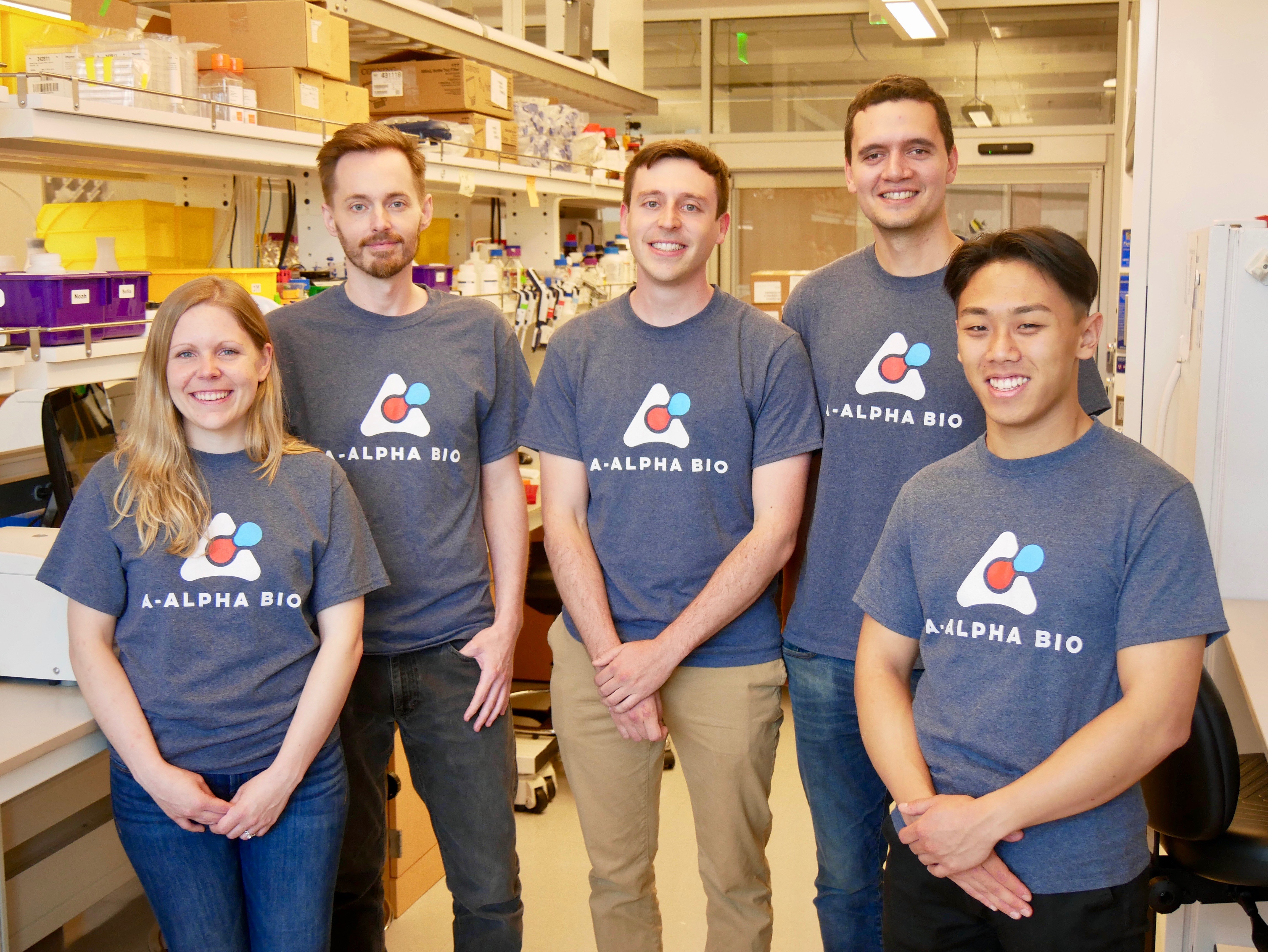
The A-Alpha Bio team includes scientist Emily Engelhart, principal scientist David Colby, co-founder and CEO David Younger, co-founder and chief technology officer Randolph Lopez and engineering associate Charles Lin. (A-Alpha Bio Photo)
A Seattle startup that took root at the University of Washington has closed a $2.8 million seed round for a drug discovery platform that can sort through millions of protein interactions at once.
“We expect that we can go considerably further than that,” said David Younger, the co-founder and CEO of A-Alpha Bio.
A-Alpha Bio’s genetically engineered protein analysis technology, known as AlphaSeq, has the potential to speed up the process of evaluating drug candidates. That’s what attracted interest from investors including OS Fund, which led the seed round, plus AME Cloud Ventures, Boom Capital, Madrona Venture Group, Sahsen Ventures, Washington Research Foundation and a number of angel investors.
The KATRIN neutrino experiment is located on the grounds of the Karlsruhe Institute of Technology in Germany. (KATRIN Photo)
Scientists from the University of Washington and other institutions around the world say they’ve reduced the upper limit for the mass of the neutrino by half.
Thanks to findings from the Karlsruhe Tritium Neutrino Experiment, or KATRIN, physicists now know to a 90% confidence level that the neutrino has a rest mass no greater than 1.1 electron volts, or 1.1 eV. The previous upper limit was 2 eV.
Nailing down the neutrino’s mass could solidify scientists’ grasp on the Standard Model, which describes the subatomic world in fine detail. It could also open a path to the mysterious realm beyond the Standard Model.
Teammates from the University of Washington’s Society for Advanced Rocket Propulsion carry hardware during the Spaceport America Cup competition in New Mexico. (UW-SARP via Facebook)
If at first you don’t succeed … try, try, try again. That’s the formula that the University of Washington’s Society for Advanced Rocket Propulsion followed to win the top prize at this year’s Spaceport America Cup competition, held over the weekend in New Mexico.
The SARP team took the Judge’s Choice and Overall Winner Award at the world’s largest collegiate rocket engineering contest, which is run by the Experimental Sounding Rocket Association and drew 120 teams from 14 countries. Each team is required to design, build and fly a rocket that can reach 10,000 feet or 30,000 feet, depending on the contest category.
SARP’s chief engineer, Jess Grant, said this year’s win comes after a string of three disappointments.
This composite image shows how plumes of water emanate from fissures in the surface ice of Enceladus, one of Saturn’s moons. (NASA / JPL Illustration)
The sea that lies beneath the icy surface of Enceladus, one of Saturn’s moons, could provide even more fuel for extraterrestrial organisms than previously thought.
That’s the upshot of a study to be presented at AbSciCon 2019, an astrobiology conference taking place next week in Bellevue, Wash. Hundreds of researchers will be sharing their findings about the prospects for life elsewhere in the solar system and the universe.
Photo Wake-Up can turn a photo of an Apollo moonwalker into an animation that has the astronaut walking out of the frame. (UW / NASA Image)
What would it be like to see pictures of moonwalkers, comic-book characters and painted portraits get up and walk right out of their frames? It’s an eerie thought – but Photo Wake-Up, a software application developed by computer scientists at the University of Washington and Facebook, gives you an idea how it would look.
And someday, the app could come to an augmented-reality headset near you.
Inspired by the paper folding art of origami, a University of Washington team — including Jinkyu Yang, an associate professor of aeronautics and astronautics — created a paper model of a metamaterial that uses folding creases to soften the force of an impact. (UW Photo / Kiyomi Taguchi)
Can origami protect football players and reusable rockets? Researchers have shown how the ancient art of paper-folding can soften the shock of an impact, whether it’s cracking into a helmet or touching down on a landing pad.
“If you were wearing a football helmet made of this material and something hit the helmet, you’d never feel that hit on your head. By the time the energy reaches you, it’s no longer pushing. It’s pulling,” senior author Jinkyu Yang, associate professor of aeronautics and astronautics at the University of Washington, said in a news release.
That’s not to say that future football helmets will be made of paper. But the engineering principles that Yang and his colleagues tested with paper models could well be translated into new types of shock-absorbing structures for rocket landing legs, automotive vehicles and other applications.
Washington Hyperloop team members show off their Husky spirit at an on-campus unveiling of this year’s pod racer. Veteran team member Mitchell Frimodt peeks out from within the pod’s carbon composite shell, while the guts of the racer are on display on a table at left. (Margo Cavis Photo)
Could this year be the year for Washington Hyperloop? For the fourth time, the students on University of Washington’s pod-racing team are taking aim at the top prize in tech titan Elon Musk’s competition, and this time they’ve got their racer down to fighting weight.
This year’s purple pod racer, which looks like a cross between a bobsled and a miniaturized bullet train, was unveiled May 10 at UW’s Husky Union Building.
“Our pod this year is about 60 percent of the weight of last year’s pod, with the same propulsion specs,” engineering senior Mitchell Frimodt, one of the veterans on the Hyperloop team, told GeekWire. “That’s our performance boost.”
Propulsive oomph per pound is a key factor in what’s become an annual tradition that plays out at SpaceX’s headquarters in Hawthorne, Calif. This year, Washington Hyperloop and a dozen other collegiate teams are due to compete on July 21. Competitors will show off the racers they’ve built, and the best of the pack will face off in time trials conducted in a mile-long tube that’s been built just across the street from SpaceX’s rocket factory.
The fastest team wins. And in the previous three competitions, the fastest team has been WARR Hyperloop from the Technical University of Munich in Germany. This year, Munich’s student engineers are racing under a different team name — TUM Hyperloop — but they’re expected to be every bit as formidable.