University of Washington biochemists David Baker and Neil King show off molecular models of proteins at UW’s Institute for Protein Design. (UW IPD Photo / Ian Haydon)
The era of engineering proteins for medical applications just got a lot closer, thanks to a five-year, $45 million grant from The Audacious Project at TED to the Institute for Protein Design at the University of Washington School of Medicine.
The institute, headed by UW biochemist David Baker, is among eight recipients of Audacious grants announced today at the annual TED conference in Vancouver, B.C.
“We’re really thinking of this as a protein design revolution, parallel to the digital revolution at Bell Labs. … If you can design proteins exactly to order from first principles, you can solve a lot of problems that are facing humans today — primarily in medicine, but also in materials and energy,” Baker told GeekWire.
Geophysicists Walter Alvarez (at left) and Mark Richards (in the background) examine a piece of impact ejecta at the North Dakota fossil site. (Jackson Leibach Photo via University of Kansas)
After days of puzzling over secondhand reports, anyone with an internet connection can now read a research paper about a fossil graveyard in North Dakota that appears to document the day nearly 66 million years ago when an asteroid pushed the dinosaurs and many other species into extinction.
“I am very much looking forward to the crowd-sourced opinions of everyone,” University of Edinburgh paleontologist Steve Brusatte said in a tweet. “There is a real thrill and a real mystery around this discovery, and it is EXCITING! Let’s see where the evidence leads.”
The study documents fossil evidence for a catastrophic fish kill that did in many other organisms as well. Intermixed with the fossilized remains were tiny beads of glass that had turned to clay. Some of those beads were found embedded in the gills of the fish.
The evidence led the research team, headed by paleontologist Robert DePalma, to conclude that the Cretaceous creatures were washed up onto a sandbar by a giant wave of water. Then they were pelted by hot droplets of molten rock, known as tektites, which were thrown up into the stratosphere by an asteroid impact thousands of miles away.
In the paper, the research team lays out a scenario suggesting that the impact produced a magnitude 10 to 11 earthquake, which sparked a standing wave in the body of water where the fish had lived. Such a wave, known more scientifically as a seiche (pronounced like “saysh”), could have done as much damage as a tsunami within an hour after the asteroid hit. That scenario would leave enough time for the tektites to deliver the coup de grace.
One of the study authors who came up with that scenario is Mark Richards, a geophysicist who left the University of California at Berkeley last July to become the University of Washington’s provost and executive vice president for academic affairs.
Today, Richards said the seiche scenario isn’t the only possibility for explaining what happened in North Dakota during what’s known as the Cretaceous-Paleogene or Cretaceous-Tertiary extinction.
“I think that the surge, unless it was some freak coincidence with something else, was likely seismically induced,” Richards told GeekWire. “Now, it could have been from a seiche. Also, for example, you could have had a local landslide that was triggered by seismic waves. We have to be pretty cautious.”
Scientists say a meteor impact 66 million years ago generated a tsunami-like wave in an inland sea that killed and buried fish, mammals, insects and a dinosaur. (Illustration courtesy of Robert DePalma)
First, there was a violent shock. Then, there was the roar of a 30-foot-high wave of water, throwing fish onto a sandbar in what is now North Dakota. Then there was a hail of molten rock, pelting dying fish and soon-to-be-dying land creatures. Then the fires began.
Microsoft and University of Washington researchers built an automated system that was fed by bottles of chemicals to encode date in custom-designed DNA molecules. (Microsoft / UW Image)
DNA data storage holds the promise of putting huge amounts of information into a test tube — but who wants to carry test tubes around a data center all day?
Researchers from Microsoft ahd the University of Washington are working on a better way: a completely automated system that can turn digital bits into coded DNA molecules for storage, and turn those molecules back into bits when needed.
They used their proof-of-concept system, described in a paper published today in Nature Scientific Reports, to encode the word “hello” in strands of DNA and then read it out. That may sound like a ridiculously simple task, but it served to show that the system works.
Sen. Maria Cantwell, D-Wash., and Microsoft President Brad Smith discuss the challenge of quantum computing during a fireside chat at the Northwest Quantum Nexus Summit at the University of Washington. (GeekWire Photo / Alan Boyle)
The Pacific Northwest may be known for tech icons like Microsoft and Amazon but when U.S. Sen. Maria Cantwell, D-Wash., was asked what advice she’d give to the researchers and executives who are trying to up their game when it comes to quantum computing, she invoked a slogan used by a totally different kind of industry leader.
“To borrow from another Northwest icon, ‘Just Do It,’ ” she said, referring to Nike, the Oregon-based sportswear powerhouse.
During today’s fireside chat with Microsoft President Brad Smith at the kickoff summit of a public-private consortium called the Northwest Quantum Nexus, Cantwell said quantum computing could become as much a part of the Pacific Northwest’s tech scene as Boeing and Microsoft, Amazon and Blue Origin.
Researchers at Pacific Northwest National Laboratory plan to employ quantum computing to develop new materials for chemical applications. (Microsoft Azure via YouTube)
Experts in the weird and woolly field of quantum computing tend to concentrate on one slice of the challenge, whether it’s developing hardware, algorithms or applications — but in the region that’s home to Microsoft and Amazon, the University of Washington and Pacific Northwest National Laboratory, a new consortium is going after the whole stack.
We’re not talking about pancakes or sandwiches here. We’re talking about the Northwest Quantum Nexus, which is aiming to widen a network of quantum connections for researchers, developers and business leaders. The group, led by Microsoft Quantum, PNNL and UW, was formally unveiled today in advance of its inaugural summit this week at the university.
This composite image of the Andromeda galaxy was made by combining images from the Zwicky Transient Facility in three bands of visible light. The image covers 2.9 square degrees, which is one-sixteenth of ZTF’s full field of view. (ZTF Photo / D. Goldstein / R. Hurt / Caltech)
A state-of-the-art astronomical camera system in California known as the Zwicky Transient Facility is rolling out an early batch of greatest hits with an assist from the University of Washington.
The wide-angle camera makes use of the 48-inch Samuel Oschin Telescope at Southern California’s Palomar Observatory, with Caltech playing the principal role in the $24 million project. But UW is one of the partners in the ZTF consortium, and UW’s DIRAC Institute plays a key role in the automated alert system that lets astronomers know when the instrument has picked up a hot one.
“It’s a cornucopia of results,” Caltech astronomer Shri Kulkarni, the ZTF project’s principal investigator, said in a news release. “We are up and running and delivering data to the astronomical community. Astronomers are energized.”
Tyrannosaurus rex may have reigned as “king of the tyrant lizards” 65 million years ago, but 185 million years before that, a reptile about the size of an iguana was the king of Antarctica.
At least that’s the message contained in the name of a fossil that’s described in a newly published research paper — and is now part of the permanent collection at Seattle’s Burke Museum of Natural History and Culture.
The fossil was collected during an expedition to the frozen continent led by Christian Sidor, who is the museum’s curator of vertebrate paleontology as well as a biology professor at the University of Washington. Sidor and two colleagues, the University of the Witwatersrand’s Roger Smith and Brandon Peecook of Chicago’s Field Museum, laid out the story behind the fossil in a paper published today by the Journal of Vertebrate Paleontology.
Antarctanax shackletoni takes its scientific name from the ancient Greek words for “Antarctic king” and from early-20th-century polar explorer Ernest Shackleton.
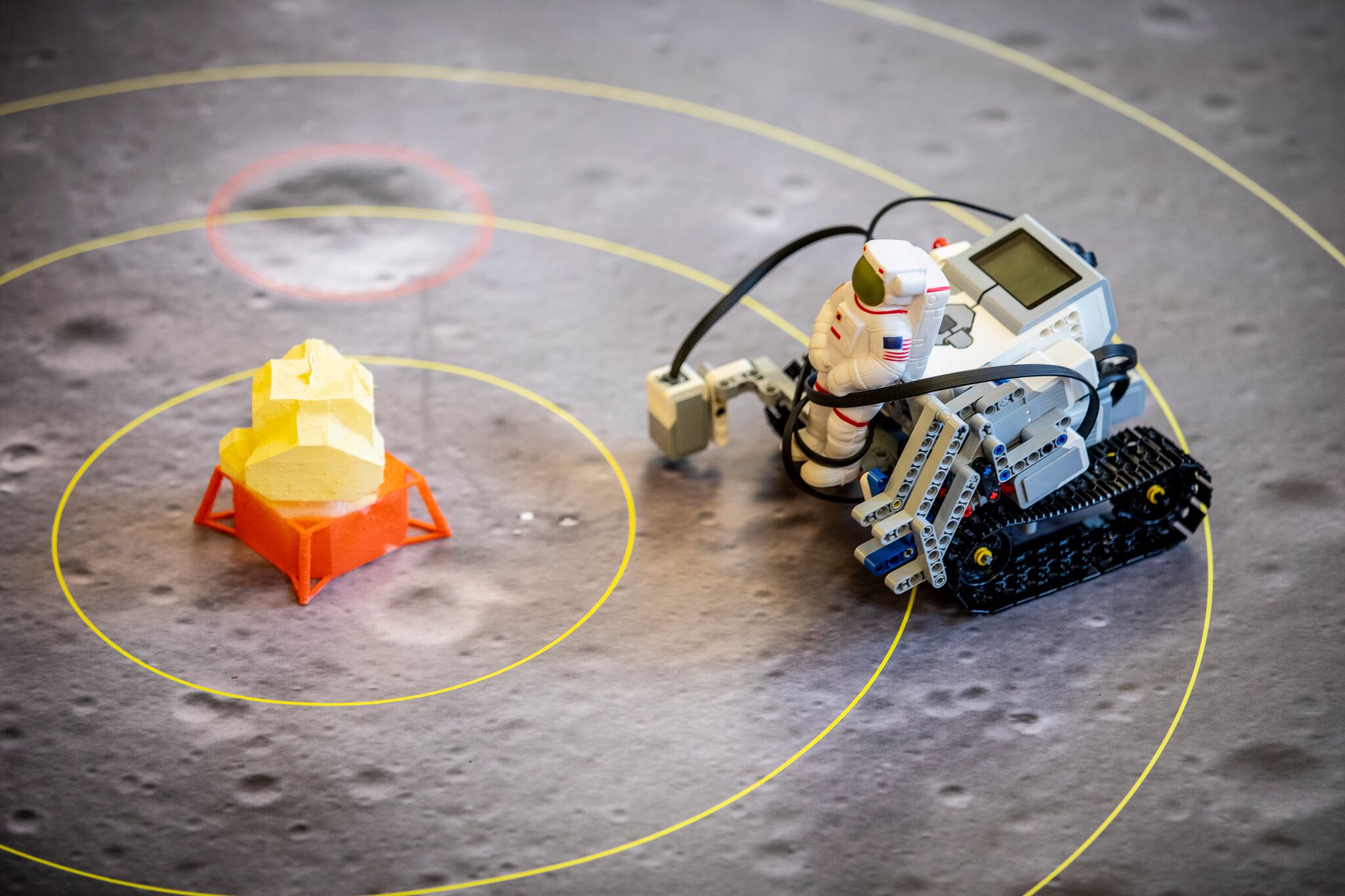
A Lego Mindstorms robot, with a plastic astronaut strapped to the front, approaches a toy lunar lander during an Apollo moon mission re-enactment. (University of Washington Photo / Dennis Wise)
Fifty years after the first Apollo moon landing, students from across the country will get a chance to re-enact the feat with drones and robots, thanks to an educational challenge orchestrated by NASA and the University of Washington’s Northwest Earth and Space Sciences Pipeline.
The event — known as the Apollo 50 Next Giant Leap Student Challenge, or ANGLeS Challenge for short — got its official kickoff today at Kent-Meridian High School in Kent, Wash.
“This is a truly interdisciplinary challenge, involving computer programming, robotics, remote sensing and design,” Robert Winglee, who’s the director of the Northwest Earth and Space Sciences Pipeline as well as a UW professor of Earth and space sciences, said in a news release.
Researchers deploy a Seaglider underwater drone from the South Korean icebreaker Araon in January 2018. (Paul G. Allen Philanthropies / UW APL / Columbia LDEO)
Except for one unfortunate battery-powered drone, that is.
“The one that hasn’t come back, it could be any number of things,” said Jason Gobat, a senior principal oceanographer at the University of Washington’s Applied Physics Laboratory. Maybe something broke, or maybe it got stuck in the silt at the bottom of the sea.
The good news is that two other Seaglider drones are continuing to transmit data via satellite. Four free-floating EM-APEX probes have been heard from as well.
The experiment, supported with nearly $2 million in funding from Seattle’s Paul G. Allen Philanthropies, has shown that the robots can use acoustic signals to navigate their way under the ice shelf, monitor the water that flows into and out of the ice shelf’s subsurface cavity, and keep operating for a whole year.