

“Disclosure Day” is nigh!
We’re not talking about end times for UFO believers, but about this week’s debut of Steven Spielberg’s latest movie about space aliens.
“Disclosure Day” is something of a second coming for the classic alien sci-fi movie — or perhaps a third coming, given that Spielberg is already famous for “Close Encounters of the Third Kind” (1977) and “E.T. the Extra-Terrestrial” (1982).
The second-coming analogy is apt for another reason: The movie’s title plays off the expectation that the world’s governments will disclose all their secrets about alien contact, but only when they determine that their citizens are ready to hear them. “UFO believers await the day of disclosure with the same burning eagerness as a religious believer expecting the Messiah,” Adam Kirsch, a senior editor at The Atlantic, writes in a forthcoming book titled “We Want to Believe.”
Kirsch says such believers might greet Spielberg’s movie as evidence that Disclosure Day is truly nigh. “For people who are very deeply committed to this idea of disclosure, they will take it as confirmation that disclosure is something that is really going to happen,” he says.
Even Meg Charlton, the author of a newly published alien-abduction novel titled “Voyagers,” felt a sense of anticipation as she was writing the manuscript. “I did spend a lot of the book nervous that I would be scooped by first contact somehow, or full disclosure,” she recalls.
In a double-stuffed episode of the Fiction Science podcast, Kirsch and Charlton explore what science and fiction reveal about our obsession with alien visitors.
Stories of otherworldly encounters go back millennia — for example, there are references in the Bible to angels ascending and descending on Jacob’s Ladder, or the prophet Elijah spotting wheels of fire in the sky. Kirsch argues that UFOs and space aliens address a psychic need that angels or fairies satisfied in the days before the space age.
“We do want to feel like we’re not alone in the universe, right?” Kirsch says. “Human beings have always wanted to feel that way, since long before people talked about UFOs, or knew that there was life on other planets, or knew what other planets really were. People thought the world is full of non-human intelligences. That’s a constant in human civilization going back to the very beginning. We’ve just had different languages for what those non-human intelligences are.”
The modern UFO era began in 1947, and waves of alien anticipation have advanced and retreated ever since. The current wave broke in 2017, when word started leaking out about the Pentagon’s efforts to investigate UFO sightings by military fliers.
That’s what piqued Kirsch’s interest.
“For a minute there, it started to seem like maybe there could be some threads to unravel to this story, and if you followed it, we would find something concrete,” he said. But a true Disclosure Day never came.
Looking back from the present day, Kirsch notes how the narrative has stalled. “I think that over the last nine years, as the story has been processed and followed up, what we found is that there isn’t really anything behind it,” he says.
Issues for science and religion

Adam Kirsch is the author of “We Want to Believe.” (Credits: Adam Kirsch Photo via LinkedIn; Cover Design by Kelly Winton)
Kirsch argues that eyewitness accounts of UFO sightings can’t serve as scientific evidence of their existence.
“Evidence in the scientific sense has to be testable and repeatable,” he says. “If someone has an experience that they can’t explain, that’s a personal experience that no one else is privy to and cannot be repeated, then you can testify to it. You can say this happened to me, but what you have at the end of that is a story that someone told. People have always told stories about unbelievable, miraculous, amazing things.”
“We Want to Believe” delves into how perspectives on UFOs have changed over the course of decades, why the subject came to be taken seriously, and how alien anticipation is connected to the scientific search for extraterrestrial life. The book also explores the philosophical implications of finding (or not finding) life beyond Earth.
What if we are alone in the universe after all? “The space age is the first time in human history that there’s good reason to think that only human minds exist,” Kirsch says. “What does it do to the way we think about ourselves and the future of our species and the future of our planet? I think those are huge questions with all kinds of interesting implications — not just scientific, but also religious and social.”
“Disclosure Day” capitalizes on the religious angle. In one scene, a character suggests that aliens may be “nearer to God” than humans. And in a later scene, a different character asks a nun who’s giving her shelter from the men in black, “Does God love us? Only us?”
Fiction focuses on the humans

Meg Charlton is the author of “Voyagers.” (Photo by Jessie Casey; Title Art by 3d_kot / Shutterstock / Harper)
Charlton looks at alien encounters through a different lens in “Voyagers,” her first published novel.
She weaves in references to the controversies currently surrounding the subject of UFOs — ranging from suspicions that an interstellar object known as ‘Oumuamua was actually an alien spaceship, to suspicions that UFOs (now known officially as unidentified anomalous phenomena, or UAPs) are actually powered by technologies developed in China or Russia. But the heart of her story is a decades-old mystery surrounding the 36-hour disappearance of two children in 1997. Were their missing memories caused by an alien abduction, or by a totally terrestrial type of trauma?
Charlton says she was inspired to write “Voyagers” by the stories she heard while covering the Roswell UFO Festival in New Mexico. The annual event is a magnet for “experiencers” — that is, people who turn to paranormal explanations for the anomalous experiences they’ve had.
“What really drew me to this as a novelist, and also as a human being, was the emotional resonance of the stories of people who had been through these experiences,” she says. “I was really thinking about how they spoke to these very universal questions about belief, about self-trust, about memory, about what happens when a private experience then gets turned into something public for other people to consume and dissect and analyze and question.”
In the course of researching the novel, Charlton learned about online support groups for experiencers — safe spaces where people can share stories about alien encounters without ridicule or cross-examination.
“I think that’s something that’s important for all of us, beyond just people who have had these kinds of anomalous experiences,” she says. “We all have experiences, I think, that don’t fit into the narrative we tell about ourselves or that we tell about our lives or the world. And having other people to talk about that with, to make you feel less alone, I think, is essential for all of us.”
Are we alone? “Voyagers,” “We Want to Believe” — and “Disclosure Day,” for that matter — all suggest it’s important to contemplate that question, even if we never find the answer.
Cosmic Log Used Book Club
Charlton hopes alien encounters will never go out of date as subjects for science fiction.
“I’ve been saving a lot of alien-abduction novels for after I finish promotion of this book,” she says. “I’ve been storing them all up. I just read Ilana Masad’s ‘Beings,’ which is absolutely wonderful.”
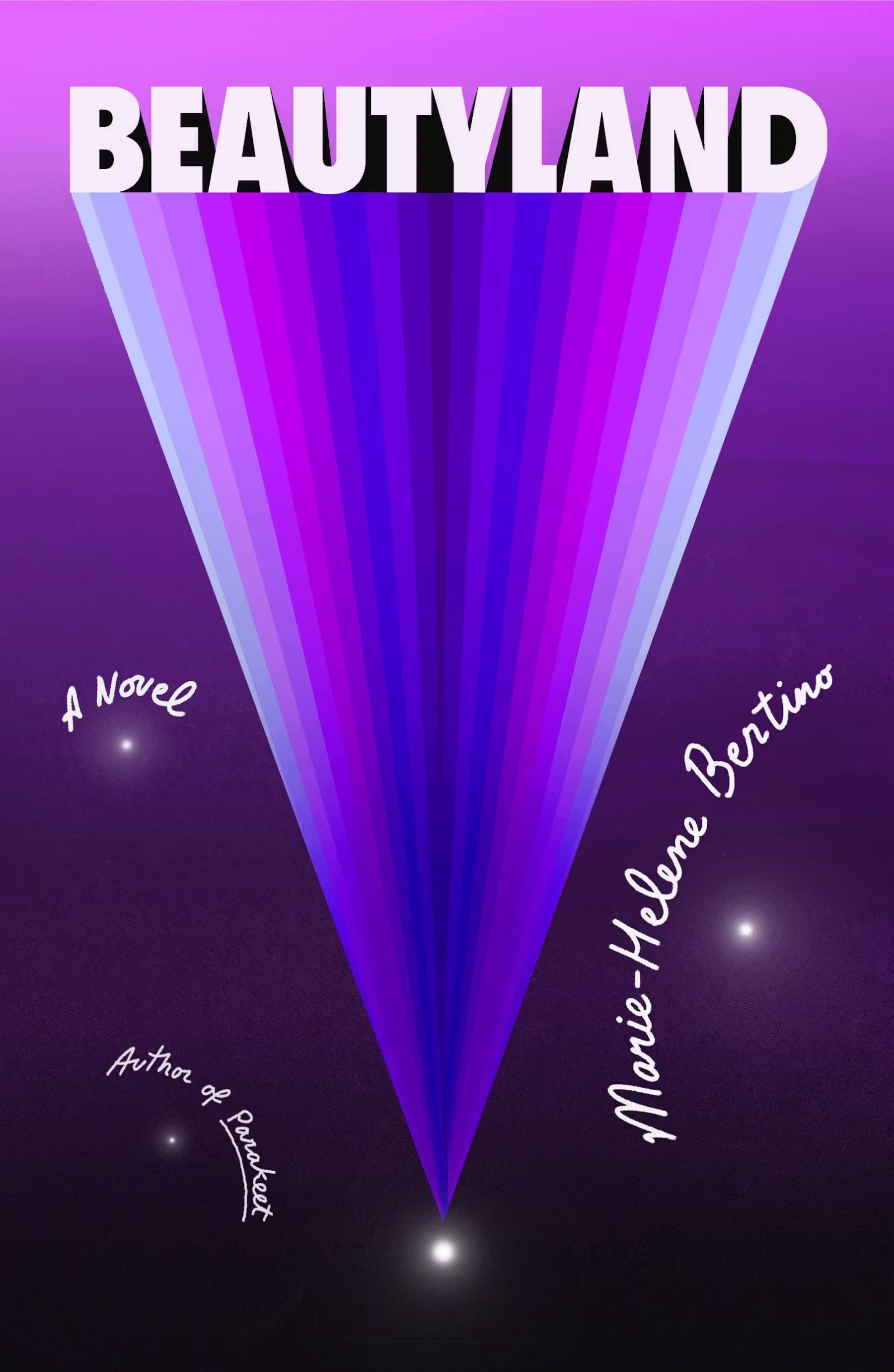
Charlton also recommends “Take Me With You” by Steven Rowley, and “Beautyland” by Marie-Helene Bertino.
“There are so many ways into this narrative that I don’t think it’s something we’ll ever exhaust, because it speaks to the most profound questions I think we can have, which is, are we alone, and what does it mean to be human, and what is our place in the universe?” she says. “I find alien-abduction stories to be really awe-inspiring, and wonderfully strange, and I hope that we have not seen the last of them.”
“Beautyland” was published in 2024, which qualifies it as the latest selection for the Cosmic Log Used Book Club. The CLUB Club highlights books with cosmic themes that have been around long enough to show up at your local library or secondhand book shop.
“Voyagers” is due for release on June 16, and “We Want to Believe” comes out on Aug. 25. While you’re waiting for “We Want to Believe,” you can check out Adam Kirsch’s article for The Atlantic on the buzz over UFOs. (Here’s an archived version of the article.) “Disclosure Day” is playing at a theater near you. There are a couple of other events coming up for UFO fans: The Men in Black Birthday Bash and Festival is scheduled in Des Moines, Wash., on June 20-21. This year’s Roswell UFO Festival takes place July 2-4 in New Mexico.
To get up to speed on the UFO beat, check out this Cosmic Log roundup. In a related development, an international committee of experts has updated its rules for evaluating and revealing the detection of extraterrestrial intelligence for the first time in more than 15 years.
Fiction Science is included in FeedSpot’s 100 Best Sci-Fi Podcasts. Stay tuned for future episodes of the Fiction Science podcast via Apple, Spotify, Player.fm, Pocket Casts and Podchaser. If you like Fiction Science, please rate the podcast and subscribe to get alerts for future episodes.
