SpaceX’s Falcon 9 rocket sends 64 satellites into space from California’s Vandenberg Air Force Base in December 2018 to kick off Spaceflight’s SSO-A satellite rideshare mission. (SpaceX Photo)
Seattle-based Spaceflight Industries has taken the spotlight in a research note from Morgan Stanley for disrupting the process of putting satellites in space — in a good way.
The note, sent to the investment firm’s clients last Friday by analyst Adam Jonas and his colleagues, pays tribute to Spaceflight Industries’ two business lines. One subsidiary, Spaceflight, arranges for payloads to share rides on other people’s rockets. The other subsidiary, BlackSky, offers satellite imagery from a range of spacecraft, soon to include its own Global constellation.
An artist’s conception shows one of EarthNow’s satellites in orbit, equipped with four telescopic cameras. (EarthNow Illustration)
BELLEVUE, Wash. — A satellite startup called EarthNow is laying out the details of its plan to blanket our planet with high-resolution, real-time, live-video coverage from a 500-satellite constellation in orbit, with support from Microsoft co-founder Bill Gates, Europe’s Airbus, Japan’s SoftBank Group and other high-profile backers.
The revelations come a year after Bellevue-based EarthNow raised $6.6 million in a seed investment round from those financial backers.
“The purpose of the seed phase was to make absolutely sure that we could do this,” founder and CEO Russell Hannigan told GeekWire.
If a follow-up Series A round comes together the way Hannigan and his team hope in the next couple of months, the venture could launch its first experimental “pathfinder” satellites by the end of 2020, setting the stage for a wave of operational satellites in 2022.
Hannigan discussed EarthNow’s roadmap last week during an interview at Intellectual Ventures’ Bellevue headquarters, which currently serves as the spin-out’s base of operations. He’ll be discussing the details with other satellite industry executives this week at the SmallSat Symposium in San Jose, Calif.
SpaceX CEO Elon Musk checks out the nozzle of a full-scale Raptor rocket engine in advance of its first test firing. (Elon Musk via Twitter)
SpaceX CEO celebrated the first test firing of a full-scale, built-for-flight Raptor engine for his Starship super-rocket in the usual way tonight: by tweeting about it.
“So proud of great work by @SpaceX team,” Musk wrote in a series of tweets from SpaceX’s test facility near McGregor, Texas.
Scaled-down versions of the methane-fueled Raptor rocket engine went through testing as far back as two and a half years ago, but Musk said this weekend’s test marked the “first firing of Starship Raptor flight engine.”
A Chinese Long March 4B rocket lifts off from Taiyuan Satellite Launch Center in October 2018. One of the payloads was a nanosatellite equipped with a SpaceChain blockchain node. (CCTV via SciNews / YouTube)
It’s been three months since Planetary Resources, the asteroid mining venture headquartered in Redmond, Wash., was acquired by the ConsenSys blockchain studio — and although the venture currently known as ConsenSys Space hasn’t yet take the wraps off its business plan, another space-centric blockchain venture just might provide some clues.
Singapore-based SpaceChain has been ramping up its activity over the past year, highlighted by the launch of two nanosatellite-based blockchain nodes into orbit aboard Chinese Long March rockets in February and October of 2018.
A video view from Fortem Technologies’ DroneHunter aircraft shows the targeting of an unauthorized drone. (Fortem / Today Show)
Fortem Technologies, a Utah-based venture that makes drones as well as radar detection systems, wants to be in on a drone-hunting test to be conducted during Sunday’s Super Bowl in Atlanta.
The test could turn into a high-tech matchup that parallels the football face-off between the New England Patriots and the Los Angeles Rams.
Tyrannosaurus rex may have reigned as “king of the tyrant lizards” 65 million years ago, but 185 million years before that, a reptile about the size of an iguana was the king of Antarctica.
At least that’s the message contained in the name of a fossil that’s described in a newly published research paper — and is now part of the permanent collection at Seattle’s Burke Museum of Natural History and Culture.
The fossil was collected during an expedition to the frozen continent led by Christian Sidor, who is the museum’s curator of vertebrate paleontology as well as a biology professor at the University of Washington. Sidor and two colleagues, the University of the Witwatersrand’s Roger Smith and Brandon Peecook of Chicago’s Field Museum, laid out the story behind the fossil in a paper published today by the Journal of Vertebrate Paleontology.
Antarctanax shackletoni takes its scientific name from the ancient Greek words for “Antarctic king” and from early-20th-century polar explorer Ernest Shackleton.
A schematic shows how storage compartments might fit on a bus. (Amazon Illustration via USPTO)
Amazon’s inventors have suggested using drone-dispensing trucks, rail cars and airships to deliver packages, but one of the company’s latest patents lays out a more mundane route for future customers: picking up their purchases from public buses.
As described in the patent, the system calls for installing storage compartments on buses or other vehicles, and letting riders with the authorized codes unlock a designated compartment and pick up their item. Customers can specify the time and the place for the pickup when they put in their online order.
Blue Origin founder Jeff Bezos and Blue Origin CEO Bob Smith flank Telesat CEO Dan Goldberg, who’s holding a model of Blue Origin’s New Glenn rocket. (Blue Origin via Twitter)
Canada’s biggest satellite operator, Telesat, has signed agreements with Amazon billionaire Jeff Bezos’ Blue Origin space venture and Alphabet’s Loon aerial telecommunications venture to support its future global broadband satellite constellation.
Blue Origin has agreed to provide multiple launches on its yet-to-be-built New Glenn rocket to get Telesat’s spacecraft into low Earth orbit, or LEO. Loon, meanwhile, will furnish a cloud-based data delivery platform that’s based on the system it currently uses to deliver mobile services via a fleet of high-altitude balloons.
Today’s announcements raise Telesat’s profile in a market battle that also involves California-based SpaceX and the international OneWeb consortium.
Tesla has teased the design of its Model Y car, but the big reveal is still ahead. (Tesla Image)
As big as the Model 3 electric car is for the future of Tesla, the sport utility vehicle known as the Model Y could be bigger, according to CEO Elon Musk.
“I would expect that the demand for the Model Y would be … maybe 50 percent higher than Model 3?” Musk said today during a teleconference reviewing the company’s fourth-quarter financial results. “Could be even double.”
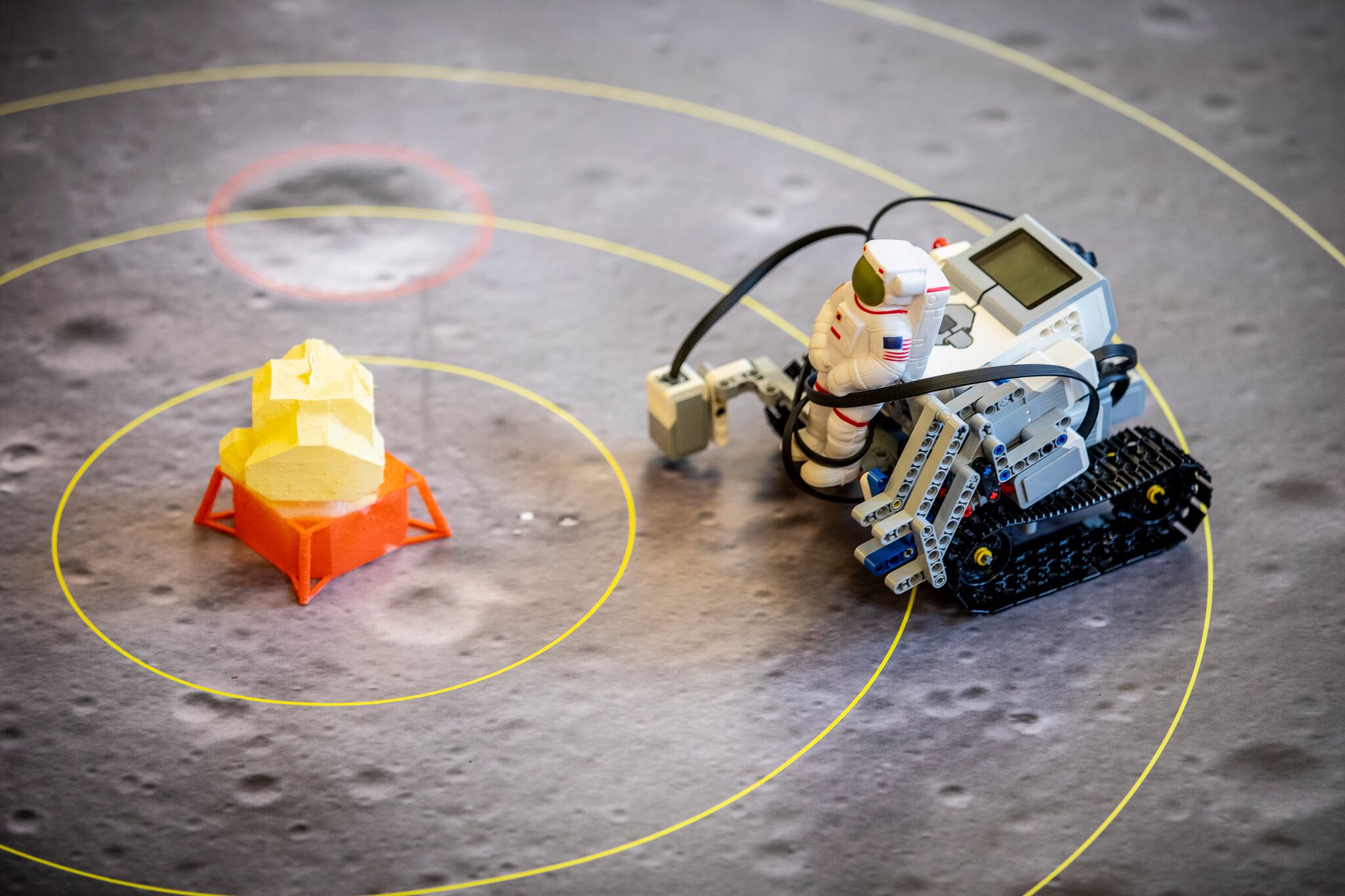
A Lego Mindstorms robot, with a plastic astronaut strapped to the front, approaches a toy lunar lander during an Apollo moon mission re-enactment. (University of Washington Photo / Dennis Wise)
Fifty years after the first Apollo moon landing, students from across the country will get a chance to re-enact the feat with drones and robots, thanks to an educational challenge orchestrated by NASA and the University of Washington’s Northwest Earth and Space Sciences Pipeline.
The event — known as the Apollo 50 Next Giant Leap Student Challenge, or ANGLeS Challenge for short — got its official kickoff today at Kent-Meridian High School in Kent, Wash.
“This is a truly interdisciplinary challenge, involving computer programming, robotics, remote sensing and design,” Robert Winglee, who’s the director of the Northwest Earth and Space Sciences Pipeline as well as a UW professor of Earth and space sciences, said in a news release.