Categories
GeekWire

Supernova leftovers point to a messy blowup

White dwarf and red giant
This artist’s view shows a white dwarf star accumulating material from a nearby red giant star. Ultimately, the white dwarf erupts into a supernova. (Instituto de Astrofísica de Canaria Illustration / Romano Corradi)

In what sounds like a cosmic episode of “CSI,” sleuthing astronomers have figured out what touched off a stellar explosion 545 million light-years away, based on evidence left behind at the scene of the crime.

An international team of astronomers used the Hubble Space Telescope and other observatories to sift through the chemical fingerprints left behind in the remnants of a Type Ia supernova known as SN 2015cp. The astronomers knew the type of star that blew up: It was a carbon-oxygen white dwarf. But they wanted to find out whether a different kind of star had a hand in the blast.

Today the astronomers reported the detection of hydrogen-rich debris in the vicinity of the supernova site — which cracks the case wide open.

Get the full story on GeekWire.

Categories
GeekWire

Air Force accepts first Boeing KC-46 tanker

KC-46 tanker
Air Force Maj. Nick Cenci and Maj. Anthony Mariapain stand in front of a KC-46A Pegasus tanker aircraft at Seattle’s Boeing Field in advance of its acceptance for delivery. Cenci and Mariapain led flight acceptance testing on the jet. (Boeing Photo)

After struggling through years of delay and absorbing billions of dollars of cost overruns, Boeing says the U.S. Air Force has accepted the first of what’s expected to be hundreds of KC-46 tanker aircraft.

The Air Force says the plane still has problems relating to a remote camera system that’s supposed to show the flight crew how the refueling process is going. But it struck a deal to have Boeing fix those problems after delivery.

Boeing and the Air Force say the milestone delivery to McConnell Air Force Base in Wichita, Kan., could be made by the end of January.

Get the full story on GeekWire.

Categories
GeekWire

Scientists seek new ways to track technosignatures

Image: Alien megastructure
An artist’s conception shows a crumbling megastructure known as a Dyson sphere orbiting a distant star. Could such structures produce detectable technosignatures? (Danielle Futselaar Illustration)

Could extraterrestrial civilizations leave their fingerprints as chlorofluorocarbons in planetary atmospheres, or the waste heat generated by industrial processes, or artificial bursts of neutrinos or gravitational waves?

That’s what a vanguard of astronomers would like to find out, and they’re hoping to win more support for an approach that widens the nearly 60-year-old search for alien radio signals to include other alien indicators.

Those indicators — which could include anomalous chemicals in exoplanet atmospheres or readings that hint at the presence of alien megastructures — have come to be known collectively as technosignatures. It’s a term that originated with Jill Tarter, one of the pioneers in the search for extraterrestrial intelligence, or SETI.

“When the astrobiology people started talking about ‘biosignatures,’ it just seemed obvious,” Tarter told GeekWire this week at the American Astronomical Society’s winter meeting in Seattle.

Tarter said the term crystallizes the idea that scientists should look for a variety of technological traces potentially pointing to intelligent life beyond Earth.

“We’re really talking about more than just searching for radio signals or optical signals,” she said. “What is it that technology does to modify its environment in a way that we can detect over interstellar distances, and distinguish from what life does?”

Get the full story on GeekWire.

Categories
GeekWire

Search for fast radio bursts enters a new era

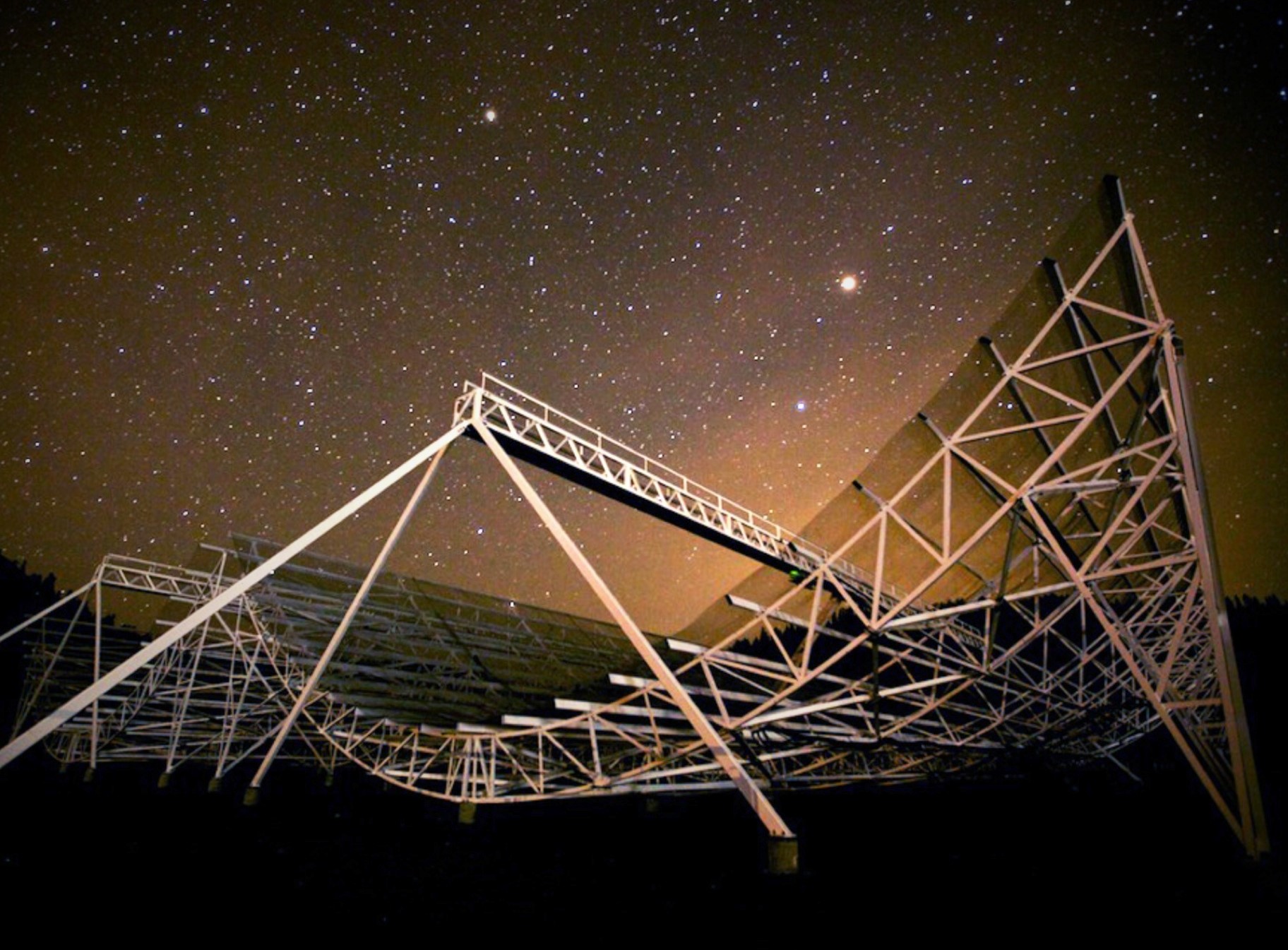
CHIME antenna
One of the radio antennas of the Canadian Hydrogen Intensity Mapping Experiment, or CHIME, spreads out beneath the night sky near Penticton, B.C. (CHIME Photo)

A new radio telescope in British Columbia’s Okanagan Valley has detected 13 new sources of mysterious extragalactic phenomena known as fast radio bursts, including the second known source of repeated bursts.

And the experiment is just barely getting started.

The Canadian Hydrogen Intensity Mapping Experiment, or CHIME, picked up the radio signatures of the bursts over the course of three weeks in July and August, while the telescope was in its pre-commissioning phase and running at only a fraction of its design capacity.

Fast radio bursts, also known as FRBs, are powerful spikes of radio emissions that emanate from galaxies beyond our own Milky Way and last for mere milliseconds. Only 60 FRB sources have been detected, including the 13 announced today.

“Their origin is still unknown,” said the University of British Columbia astronomer Deborah Good, one of the co-authors of two papers about the detections published today by the journal Nature.

Get the full story on GeekWire.

Categories
GeekWire

Test gets Stratolaunch super-plane set for takeoff

Stratolaunch plane
A photo taken during a high-speed taxi test shows the nose gear on Stratolaunch’s twin-fuselage airplane rising from the runway at California’s Mojave Air and Space Port. (Stratolaunch Photo)

Stratolaunch, the aerospace venture created by Microsoft co-founder Paul Allen, says its twin-fuselage, six-engine aircraft raced as fast as 136 mph down the runway at California’s Mojave Air and Space Port today during its latest taxi test.

That’s almost takeoff speed for the world’s largest airplane, which is designed to serve as a flying launch platform for orbital-class rockets.

One of the pictures released in the wake of today’s test run shows the plane’s nose gear rising from the runway, and Stratolaunch used the hashtag #wheelie in its celebratory tweet. It’s been said that one of the challenges during these high-speed tests is to keep the 385-foot-wide plane on the ground.

Get the full story on GeekWire.

Categories
GeekWire

Hubble team works to revive camera amid shutdown

Hubble Space Telescope
NASA astronaut Andrew Feustel, perched on the end of the shuttle Atlantis’ robotic arm, helps to install the Wide Field Camera 3 during 2009 spacewalk to perform work on the Hubble Space Telescope. (NASA Photo)

Engineers are working to bring the Hubble Space Telescope’s wide-angle camera back into operation after a hardware problem knocked it offline.

In a status update, NASA said the problem cropped up on Jan. 8 and forced a suspension of operations for the Wide Field Camera 3.

WFC3 was installed on the telescope nearly a decade ago during the space shuttle fleet’s final servicing mission. It’s designed to capture high-resolution images in visible, ultraviolet and near-infrared wavelengths.

“Hubble will continue to perform science observations with its other three active instruments, while the Wide Field Camera 3 anomaly is investigated,” NASA said. Those instruments include the Advanced Camera for Surveys, the Cosmic Origins Spectrograph and the Space Telescope Imaging Spectrograph.

NASA said that WFC3 is “equipped with redundant electronics should they be needed to recover the instrument.”

Operations at NASA have been reduced agency-wide due to a partial government shutdown that’s lasted 19 days so far. However, Christine Pulliam, news director for the Baltimore-based Space Telescope Science Institute, said the shutdown “is not affecting the response to the anomaly.”

Get the full story on GeekWire.

Categories
GeekWire

Space billionaires honored as ‘Legends of Aviation’

Jeff Bezos and Paul Allen
Two Seattle billionaires, Jeff Bezos (left) and the late Paul Allen (right), will be honored for their contributions to aviation and space next week at a Beverly Hills awards ceremony. (GeekWire Photos)

Amazon billionaire Jeff Bezos has racked up another round of recognition for his role on the space frontier: Next week he’ll be inducted into the Living Legends of Aviation, alongside aerospace executives, pioneering skydiver Joe Kittinger and musician Kenny G.

Microsoft co-founder Paul Allen, who passed away in October, will receive a posthumous tribute as a “Flown West Legend” during the Living Legends of Aviation Awards ceremony, scheduled for Jan. 18 at the Beverly Hilton Hotel in Beverly Hills, Calif.

The star-studded event, produced as a fundraiser for the Kiddie Hawk Air Academy, honors those who have made significant contributions to aviation. Bezos is among this year’s inductees by virtue of his role in founding the Blue Origin space venture and supporting it to the tune of $1 billion a year.

Get the full story on GeekWire.

Categories
GeekWire

Red dwarfs seem to wipe out life’s necessities

AU Microscopii with planet
An artist’s conception shows the red dwarf star AU Microscopii with a hypothetical planet and moon in the foreground. (NASA / ESA Illustration / G. Bacon)

Red dwarf stars have been seen as the biggest potential frontier for alien life, in part because they’re the most common stars in our galaxy. But observations made using the Hubble Space Telescope suggest that the frontier might turn out to be a desert.

“We may have found the limit to habitable planets,” said Carol Grady, a co-investigator on the Hubble observations from Eureka Scientific in Oakland, Calif. She laid out the research team’s findings today at the American Astronomical Society’s winter meeting in Seattle.

Get the full story on GeekWire.

Categories
GeekWire

Boeing reports record airplane deliveries for 2018

Boeing 737 jets
Boeing’s 737 jets accounted for well more than half of a record-high 806 deliveries during 2018. (Boeing Illustration)

Boeing says it delivered a record-high 806 airplanes in 2018, with single-aisle 737 jets accounting for well more than half of those deliveries.

The record pace comes despite a 737 delivery backup that hit the planemaker’s plant in Renton, Wash., last summer due to problems with suppliers such as Spirit AeroSystems and CFM International. The company said 69 planes were delivered in December.

Last year’s tally bests the previous record of 763 deliveries in 2017, but falls just short of Boeing’s target of 810 to 815 deliveries.

Boeing’s order backlog grew as well. The company said 893 net orders came in, with a list-price value of $143.7 billion. That’s just slightly below 2017’s tally of 912 net orders. Boeing recorded 203 airplane sales in December alone, contributing to what’s now a seven-year backlog.

Wall Street greeted today’s news positively, boosting Boeing’s share price by more than 3 percent in midday trading.

Get the full story on GeekWire.

Categories
GeekWire

For UFO fans, ‘Project Blue Book’ rings all too true

“Project Blue Book” turns some of the best-known UFO tales into a TV series, starring Aidan Gillen as investigator J. Allen Hynek. (History Channel Illustration)

“Project Blue Book,” the History Channel TV series making its debut tonight, takes its inspiration from classic UFO cases of the 1940s and 1950s — but for UFO fans who gathered to watch a Seattle preview of the first episode, the show hints at the shape of things to come as well.

“You won’t believe how many productions are coming down the pike right now to basically red-pill the public,” Michael W. Hall, the founder of a Seattle-area group called UFOiTeam, said at the screening. “The truth is out there, and guess what? We’re going to have to ‘fess up to it right away.”

“Project Blue Book” fictionalizes the real-life X-files of pioneer UFO investigator J. Allen Hynek. So it was natural for.Hall — an attorney based in Edmonds, Wash., who styles himself as the “Paranormal Lawyer” — to put out the word to the more than two dozen UFOiTeam members to attend November’s movie-theater preview.

Get the full story on GeekWire.