Categories
GeekWire

What’s cooking inside Nvidia’s robotics research lab

Nvidia robot open house
Nvidia CEO Jensen Huang and Susan Gaither tickle a robotic hand at Nvidia’s robotics research lab in Seattle. (Nvidia Photo)

When Nvidia CEO Jensen Huang interacted with a sensitive robotic hand at today’s open house for his company’s robotics research lab in Seattle, it was love at first touch.

“It almost feels like a pet!” Huang said as he tickled the hand’s fingers, causing them to retreat gently.

“It’s surprisingly therapeutic,” he told the crowd around him. “Can I have one?”

The robotic hand, which is programmed to avoid poking humans when they come too close, was just one of the machines on display at the 13,000-square-foot lab in Seattle’s University District.

Nvidia is based in California’s Silicon Valley and has nearly 200 employees working at an engineering center in Redmond, Wash.

But when the chipmaker laid plans to open a lab focusing on research in robotics and artificial intelligence, it set up shop in the same building that houses the University of Washington’s CoMotion Lab. It also put Dieter Fox, a longtime computer science professor at UW, in charge of the operation as senior director of robotics research.

Get the full story on GeekWire.

Categories
GeekWire

SpaceX is reducing its workforce by 10 percent

SpaceX employees
SpaceX employees cheer a Falcon 9 liftoff at the company’s headquarters in Hawthorne, Calif. (SpaceX Photo)

SpaceX says it’s reducing its workforce by about 10 percent as part of a strategic realignment to focus the California-based company on providings its global Starlink satellite broadband service and furthering CEO Elon Musk’s drive to make humanity a multiplanet species.

Word of the reductions came just hours after SpaceX executed its first Falcon 9 rocket launch of the year, putting 10 Iridium NEXT satellites into low Earth orbit, and a day after Musk hailed the assembly of a subscale test prototype for SpaceX’s interplanetary Starship spacecraft.

Assuming that the company currently employs more than 6,000 people, a 10 percent cut would amount to 600 jobs.

Get the full story on GeekWire.

Categories
GeekWire

SpaceX launches last batch of Iridium satellites

SpaceX launch
SpaceX’s Falcon 9 rocket lifts off from California’s Vandenberg Air Force Base, carrying 10 Iridium NEXT satellites into space. (SpaceX via YouTube)

SpaceX’s Falcon 9 rocket deployed the eighth and final set of next-generation Iridium satellites into orbit today, closing off a two-year launch campaign.

The rocket rose into partly cloudy skies from California’s Vandenberg Air Force Base at 7:31 a.m. PT after a trouble-free countdown. Iridium CEO Matt Desch counted down the final seconds.

Minutes after liftoff, the first-stage booster separated and made an at-sea touchdown on a drone landing ship called “Just Read the Instructions,” hundreds of miles out in the Pacific Ocean.

Get the full story on GeekWire.

Categories
GeekWire

Elon Musk’s SpaceX assembles a shiny Starship

Starship Hopper
Which is the illustration, and which is the actual Starship Hopper test rocket? The real rocket is on the left — and take note of the Starman standing by one of the fins. (Elon Musk via Twitter)

For weeks, photographers have been snapping pictures of a retro-looking, shiny stainless-steel rocket that’s been taking shape at SpaceX’s launch site in South Texas — and tonight, SpaceX CEO Elon Musk declared that assembly of the first Starship short-hop test rocket is complete.

Musk tweeted a picture of what looks to be a roughly 120-foot-tall “Starship Hopper,” composed of three sections that were put together at SpaceX’s Boca Chica facility.

“This is an actual picture, not a rendering,” Musk wrote. But the rocket does look eerily like the illustration that Musk shared several days earlier — or, for that matter, the pointy-topped rockets that were all the rage in the 1940s.

Get the full story on GeekWire.

Categories
GeekWire

Could Barnard’s Star harbor an icy home for life?

Red dwarf and planets
An artist’s conception shows three planets around a red dwarf star. (NASA / JPL-Caltech Illustration)

Where’s the nearest exoplanet with conditions that are right for life? Over the past couple of years, astrobiologists have talked up Proxima Centauri b, which is sitting just 4.2 light-years away.

But Villanova University astrophysicist Edward Guinan favors a world that’s just a bit farther out, at least in astronomical terms. It’s Barnard’s Star b, a super-Earth that orbits Barnard’s Star, 6 light-years from our solar system.

Get the full story on GeekWire.

Categories
GeekWire

Brazil OKs Boeing-Embraer joint jet venture

Boeing and Embraer jets
The Boeing-Embraer deal would add regional jets such as Embraer’s E190-E2 to a lineup that also includes Boeing’s 737 MAX 7 and larger jets. (Embraer Illustration)

The Brazilian government today approved the creation of a joint venture that would give Boeing control over Embraer’s commercial airplane operation.

That approval is crucial to the $4.2 billion deal, because the government holds a “golden share” in Embraer that could have been used to veto the arrangement. Some observers wondered whether the country’s newly inaugurated president, Jair Bolsonaro, would give the OK.

Today the government said that the agreement “preserves sovereignty and national interests,” and that the “golden share would not be exercised.”

The arrangement calls for Boeing to acquire an 80 percent ownership stake in a joint venture that would take in Embraer’s commercial aircraft and services operations.

Get the full story on GeekWire.

Categories
GeekWire

Supernova leftovers point to a messy blowup

White dwarf and red giant
This artist’s view shows a white dwarf star accumulating material from a nearby red giant star. Ultimately, the white dwarf erupts into a supernova. (Instituto de Astrofísica de Canaria Illustration / Romano Corradi)

In what sounds like a cosmic episode of “CSI,” sleuthing astronomers have figured out what touched off a stellar explosion 545 million light-years away, based on evidence left behind at the scene of the crime.

An international team of astronomers used the Hubble Space Telescope and other observatories to sift through the chemical fingerprints left behind in the remnants of a Type Ia supernova known as SN 2015cp. The astronomers knew the type of star that blew up: It was a carbon-oxygen white dwarf. But they wanted to find out whether a different kind of star had a hand in the blast.

Today the astronomers reported the detection of hydrogen-rich debris in the vicinity of the supernova site — which cracks the case wide open.

Get the full story on GeekWire.

Categories
GeekWire

Air Force accepts first Boeing KC-46 tanker

KC-46 tanker
Air Force Maj. Nick Cenci and Maj. Anthony Mariapain stand in front of a KC-46A Pegasus tanker aircraft at Seattle’s Boeing Field in advance of its acceptance for delivery. Cenci and Mariapain led flight acceptance testing on the jet. (Boeing Photo)

After struggling through years of delay and absorbing billions of dollars of cost overruns, Boeing says the U.S. Air Force has accepted the first of what’s expected to be hundreds of KC-46 tanker aircraft.

The Air Force says the plane still has problems relating to a remote camera system that’s supposed to show the flight crew how the refueling process is going. But it struck a deal to have Boeing fix those problems after delivery.

Boeing and the Air Force say the milestone delivery to McConnell Air Force Base in Wichita, Kan., could be made by the end of January.

Get the full story on GeekWire.

Categories
GeekWire

Scientists seek new ways to track technosignatures

Image: Alien megastructure
An artist’s conception shows a crumbling megastructure known as a Dyson sphere orbiting a distant star. Could such structures produce detectable technosignatures? (Danielle Futselaar Illustration)

Could extraterrestrial civilizations leave their fingerprints as chlorofluorocarbons in planetary atmospheres, or the waste heat generated by industrial processes, or artificial bursts of neutrinos or gravitational waves?

That’s what a vanguard of astronomers would like to find out, and they’re hoping to win more support for an approach that widens the nearly 60-year-old search for alien radio signals to include other alien indicators.

Those indicators — which could include anomalous chemicals in exoplanet atmospheres or readings that hint at the presence of alien megastructures — have come to be known collectively as technosignatures. It’s a term that originated with Jill Tarter, one of the pioneers in the search for extraterrestrial intelligence, or SETI.

“When the astrobiology people started talking about ‘biosignatures,’ it just seemed obvious,” Tarter told GeekWire this week at the American Astronomical Society’s winter meeting in Seattle.

Tarter said the term crystallizes the idea that scientists should look for a variety of technological traces potentially pointing to intelligent life beyond Earth.

“We’re really talking about more than just searching for radio signals or optical signals,” she said. “What is it that technology does to modify its environment in a way that we can detect over interstellar distances, and distinguish from what life does?”

Get the full story on GeekWire.

Categories
GeekWire

Search for fast radio bursts enters a new era

CHIME antenna
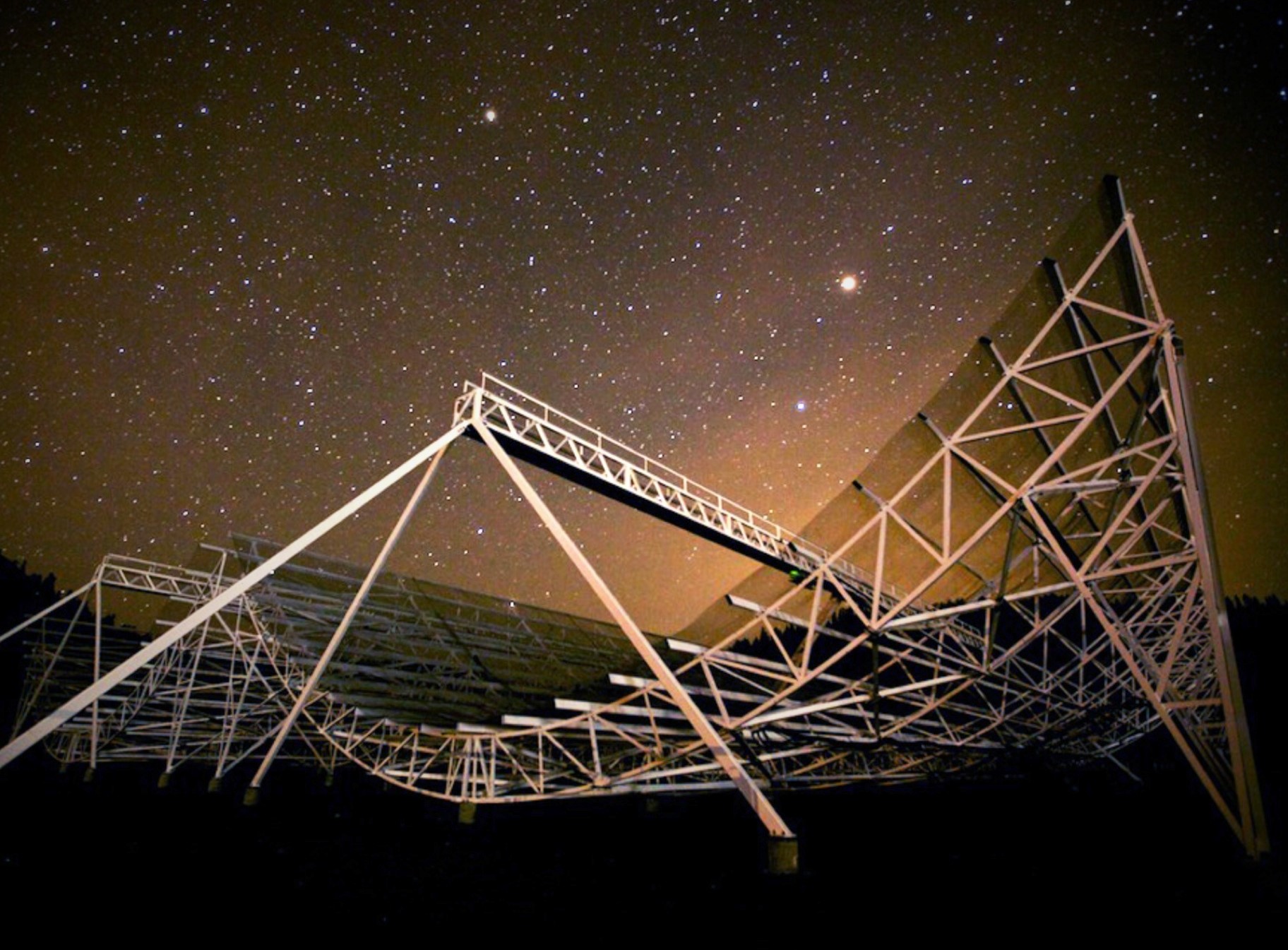
One of the radio antennas of the Canadian Hydrogen Intensity Mapping Experiment, or CHIME, spreads out beneath the night sky near Penticton, B.C. (CHIME Photo)

A new radio telescope in British Columbia’s Okanagan Valley has detected 13 new sources of mysterious extragalactic phenomena known as fast radio bursts, including the second known source of repeated bursts.

And the experiment is just barely getting started.

The Canadian Hydrogen Intensity Mapping Experiment, or CHIME, picked up the radio signatures of the bursts over the course of three weeks in July and August, while the telescope was in its pre-commissioning phase and running at only a fraction of its design capacity.

Fast radio bursts, also known as FRBs, are powerful spikes of radio emissions that emanate from galaxies beyond our own Milky Way and last for mere milliseconds. Only 60 FRB sources have been detected, including the 13 announced today.

“Their origin is still unknown,” said the University of British Columbia astronomer Deborah Good, one of the co-authors of two papers about the detections published today by the journal Nature.

Get the full story on GeekWire.