An employee works on the BE-4 Ox Boost Pump prior to engine installation. (Blue Origin Photo)
And now for something completely different from Amazon billionaire Jeff Bezos: His latest mass email isn’t about jobs, or Donald Trump, or his new D.C. digs. It’s about a rocket engine boost pump.
Bezos’ Blue Origin space venture, which he founded more than 16 years ago, is in the midst of building a next-generation rocket engine fueled by liquefied natural gas, known as the BE-4. Today, Bezos lifted the curtain on one of the engine’s subassemblies and highlighted how Blue Origin is using 3-D printing.
Blue Origin’s Jeff Bezos chats with GeekWire’s Alan Boyle at the 2016 Space Symposium in Colorado, with a picture of Blue Origin’s New Shepard passenger capsule displayed in the background. (Tom Kimmell Photography / Courtesy of the Space Foundation)
What should Donald Trump have NASA do? Today Amazon billionaire Jeff Bezos voiced his support for the idea that the space agency should help build a “highway in the sky” analogous to the interstate highway system that President Dwight Eisenhower ramped up in the 1950s.
Blue Origin employees and their families got their pictures taken with the scorched New Shepard rocket booster and crew capsule during this year’s holiday party at the company’s production facility in Kent, Wash. (Photo courtesy of @Megsylhydrazine via Twitter)
The shindig gave employees and their families the chance to get up close and personal with the New Shepard booster and capsule, which are undergoing analysis in Kent after more than a year’s worth of flight tests.
Once the engineers at Amazon billionaire Jeff Bezos’ space venture learn as much as they can about the craft and how it performed, the hardware will be handed over to a museum for display. A new New Shepard will go into service for the next suborbital flight test at Blue Origin’s West Texas launch site.
Pictures from the holiday party showed up over the weekend on Twitter and Reddit. “Can I be your +1 next year then?” one Redditor asked.
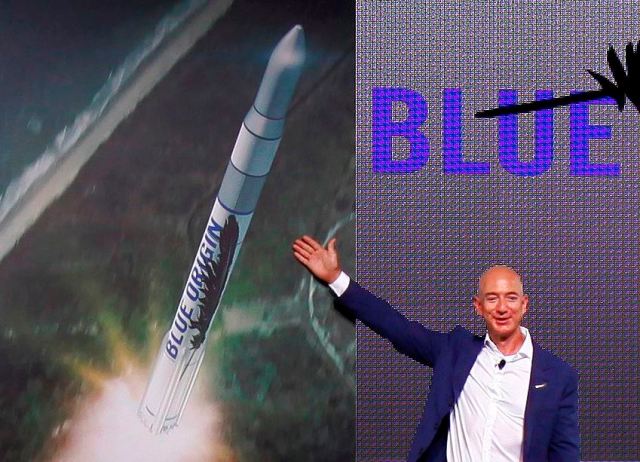
Jeff Bezos shows off the concept for Blue Origin’s launch system during a 2015 news conference in Florida. Bezos’ Blue Origin space venture is headquartered in Kent, Wash. (Blue Origin photo)
Amazon billionaire Jeff Bezos accepted yet another award tonight for his Blue Originspace effort, but the prize he treasured the most is no doubt an accompanying letter from space hero John Glenn, who passed away 10 days after writing it.
The letter, dated Nov. 28, was made public as Bezos received a Smithsonian American Ingenuity Award tonight in Washington, D.C. The first African-American woman to fly in space, Mae Jemison, read Glenn’s tribute to Bezos at the ceremony – only hours after Glenn died in an Ohio hospital.
Blue Origin has successfully sent its New Shepard suborbital rocket ship to outer space and back five times, duplicating Mercury astronaut Alan Shepard’s ride. And it’s gearing up to build New Glenn rockets that will send spacecraft into orbit, just as Glenn went into orbit in 1962.
Glenn wrote that he was “deeply touched” to have a rocket named after him.
The steel structure for Blue Origin’s factory rises from a Florida site. (Blue Origin Photo via Jeff Bezos)
Amazon billionaire Jeff Bezos is showing off the “extraordinary progress” being made on the Florida factory where Blue Origin’s New Glenn orbital launch vehicle will be built.
“As you can see here, the first steel is now going up,” he wrote today in an email update, accompanied by a picture showing a lattice of girders rising from the construction site near NASA’s Kennedy Space Center.
The 750,000-square-foot facility is due to open by the end of 2017 and produce New Glenn rockets for Blue Origin’s orbital missions. Test flights are expected to begin by the end of the decade, lifting off from Launch Complex 36 under the terms of a lease from Space Florida.
Meanwhile, Bezos’ Blue Origin venture is also proceeding with its New Shepard suborbital space program. The first full-fledged New Shepard rocket ship was retired after making five successful test flights to the edge of outer space and back.
Blue Origin’s EDM drilling machine works on a nozzle for the BE-4 rocket engine, currently under development at the company’s production facility in Kent, Wash. “Only 1,000 holes to go,” Blue Origin founder Jeff Bezos writes. (Blue Origin Photo)
Building a rocket ship may sound romantic, but there are a lot of nitty-gritty details behind the work – and that’s what Amazon billionaire Jeff Bezos is celebrating in his latest email about Blue Origin’s BE-4 rocket engine.
Blue Origin, the space venture that Bezos founded back in 2000, is building the engine for use on United Launch Alliance’s next-generation Vulcan rocket as well as Blue Origin’s own New Glenn rocket. The plan is to start testing the engine early next year, and start flying the rockets by 2019.
There’s a bit of competitive pressure involved: United Launch Alliance has Aerojet Rocketdyne’s AR-1 engine waiting in the wings, just in case Blue Origin and the BE-4 don’t hit their marks.
The BE-4 engine will be fueled by liquid natural gas, unlike the hydrogen-fueled BE-3 engine that Blue Origin is using on the suborbital New Shepard rocket ship that it’s testing in West Texas. It’s designed to produce 550,000 pounds of thrust, as opposed to 110,000 pounds of thrust for the BE-3.
That means new technologies have to be employed to build the BE-4 – and today, Bezos called attention to one of those technologies: the automated electrical discharge machining drill, or EDM.
His long-range vision focuses on a decades-old concept for huge artificial habitats that are best known today as O’Neill cylinders.
The concept was laid out in 1976 in a classic book by physicist Gerard O’Neill, titled “The High Frontier.” The idea is to create cylinder-shaped structures in outer space, and give them enough of a spin that residents on the inner surface of the cylinder could live their lives in Earth-style gravity. The habitat’s interior would be illuminated either by reflected sunlight or sunlike artificial light.
Blue Origin’s coat of arms is packed with symbolism. (Credit: Blue Origin)
You can’t buy stuff from billionaire Jeff Bezos’ Blue Origin space venture on Amazon just yet, but just wait: Sixteen years after its founding, Blue Origin offers enough symbols, mottos and mascots to keep the folks who make caps, shirts, coffee mugs – and yes, even cowboy boots – busy for years.
The symbolism adds a sense of tradition to Blue Origin’s 21st-century mission of getting millions of people living and working in space.
During last weekend’s Pathfinder Awards banquet at Seattle’s Museum of Flight, Bezos provided a guide to Blue Origin symbology, which we’re supplementing here with some extra bits of background. Before you know it, you’ll be shouting “Gradatim Ferociter” like a pro (preferably as you brandish a Lady Vivamus sword).
Amazon billionaire Jeff Bezos shows off a tortoise cufflink during the Pathfinder Awards banquet at Seattle’s Museum of Flight. The tortoise symbolizes the approach Bezos takes with his Blue Origin space venture. “We believe slow is smooth, and smooth is fast,” he says. (Credit: Tania Shepard / Azzura Photography)
Someday, you’ll be printing out a landing pad to guide an Amazon drone to its delivery, or maybe taking a suborbital space trip on a Blue Origin rocket ship, or marveling over the mechanism of a clock designed to run for 10,000 years.
Such were the visions laid out by Amazon’s billionaire founder, Jeff Bezos, on Oct. 22 as he received one of this year’s Pathfinder Awards from the Museum of Flight.
Jeff Bezos says he plans to spend his “Amazon winnings” on Blue Origin’s effort to build the heavy lifting infrastructure for space ventures. (Credit: Blue Origin)
Amazon founder Jeff Bezos says he’s trying to do for outer-space ventures what delivery services and the internet did for him: provide the “heavy lifting infrastructure” that will make it possible for entrepreneurs to thrive.
And he’s willing to commit billions of dollars of his “Amazon winnings” to make it so.
Bezos has talked about the parallels between the internet and space commercialization several times before. In April, for example, the subject came up during our fireside chat at the Space Symposium in Colorado.
But at this week’s Vanity Fair New Establishment Summit in San Francisco, Bezos made a strong linkage between the work being done at Amazon and the work being done at Blue Origin, the space venture he founded 16 years ago.