Blue Origin’s New Shepard prototype spaceship blasts off in January. (Credit: Blue Origin)
Blue Origin, the space venture founded by Amazon billionaire Jeff Bezos, is lifting the curtain just a bit on its future plans for rocket engines and spaceflights.
One of the revelations relates to progress on its methane-fueled BE-4 rocket engine, which is on track to provide propulsion for United Launch Alliance’s next-generation Vulcan rocket. Blue Origin tweeted out a picture of the engine’s bell, most likely taken at the company’s production facility in Kent, Wash.:
Blue Origin’s New Shepard propulsion module fires its rocket engines for a soft landing. It marked the second trip to space and touchdown for the same prototype vehicle. (Credit: Blue Origin)
Amazon founder Jeff Bezos’ Blue Origin space venture sent up its New Shepard suborbital spaceship on another flight test to outer-space altitudes today, and brought it back to a safe landing.
The uncrewed flight at Bezos’ West Texas test facility arguably marks the first time that a reusable rocket designed for a vertical landing proved to be actually reusable for space missions.
There are caveats to that claim, to be sure: The SpaceShipOne rocket plane, the X-15 and NASA’s space shuttles have all demonstrated reusability after going into space. Those craft landed horizontally, like an airplane, rather than vertically. In addition, test rockets flown by the DC-X program as well as Masten Space Systems, Armadillo Aerospace and SpaceX have been reused after taking vertical hops. However, those rockets stuck to altltudes below 100 kilometers (62 miles), the internationally accepted boundary of outer space.
Despite all the caveats, Blue Origin’s feat marks a significant step toward flying reusable rocket ships on suborbital space trips on a commercial basis, for tourism as well as for research.
Richard Branson is in a friendly rivalry with Jeff Bezos and Elon Musk. (Credit: Virgin Galactic)
Amazon founder Jeff Bezos’ Blue Origin space venture may have done another flight test, and Elon Musk’s SpaceX is making waves with its rocket progress – but don’t forget about Richard Branson.
“Our spaceship comes back and lands on wheels. Theirs don’t,” the billionaire founder of Virgin Galactic said during a CNBC interview at the World Economic Forum in Davos, Switzerland. “There’ll be banter like this which will take place, and that’s good. People will have a choice of which spaceships they want to use to go to space.”
Today there was a torrent of tweets about a possible Blue Origin flight test. First, the Federal Aviation Administration alerted aviators to stay away from the airspace over the company’s test range in West Texas. Then, around midday today, the restrictions were lifted. One Twitter user, Patrick Brown, went so far as to post a picture of what appears to be a rocket trail leading up from the company’s test range in West Texas.
Blue Origin kept mum. “Unfortunately, Blue Origin doesn’t have anything to contribute at this time,” the company said in a statement emailed to GeekWire.
SpaceX’s Falcon 9 first-stage booster descends toward a landing on a ship in the Pacific Ocean after the Jason 3 launch. SpaceX says the booster tipped over due to a landing-leg failure. (Credit: SpaceX)
Rocket launches can sometimes turn into flame wars, as shown by last year’s Twitter tug of war between space-minded billionaires Jeff Bezos and Elon Musk.
That rivalry crossed over into the Twittersphere in November, when the Amazon founder used his first tweet to tout the landing of Blue Origin’s New Shepard suborbital spacecraft after its first test flight to an outer-space altitude.
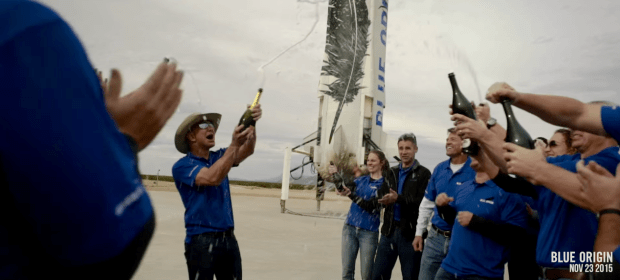
Amazon founder Jeff Bezos (in hat and sunglasses) pops open a bottle of champagne after Blue Origin’s New Shepard rocket landing in November. (Credit: Blue Origin)
When Jeff Bezos welcomed SpaceX to the rocket landing “club” last week, it set off a round of twittering over whether Bezos’ Blue Origin space venture and fellow billionaire Elon Musk’s SpaceX were really in the same league. What kind of club was Bezos talking about?
The club that Bezos had in mind was precisely defined: It consists of ventures that can launch a rocket booster from the ground into space, and then bring that booster back intact for a vertical landing.
Blue Origin was the first to become a member, during a November test flight of its suborbital New Shepard spaceship in Texas. SpaceX followed in December, with the successful landing of its Falcon 9’s first-stage booster after the launch of 11 Orbcomm telecommunication satellites.
Lots of folks have pointed out how much more difficult it is to bring back a booster after an orbital launch, as opposed to New Shepard’s up-and-down suborbital trip. The Falcon 9 stage is more than 10 times as powerful and rose twice as high as New Shepard. The implications are greater, as well: Musk says total rocket reusability could lower the cost of delivering satellites and other payloads to orbit by a factor of 100, and eventually open the way for building a city on Mars.
Based on Bezos’ narrow definition of the club, Blue Origin may have been the first member, but this month SpaceX took the lead.
Employees at Blue Origin’s headquarters in Kent, Wash., cheer as they watch the landing of the company’s New Shepard test spaceship on Nov. 23. “How do we steal that video?” Lt. Gov. Brad Owen joked after watching a clip showing the celebration. (Credit: Blue Origin)
Washington state legislators got an introduction to the state’s space industry today at Seattle’s Museum of Flight – and voiced amazement at how much is going on.
“I feel so illiterate in this field, it’s unbelievable,” state Sen. Mike Hewitt, R-Walla Walla, remarked at one point during today’s meeting of the Legislative Committee on Economic Development and International Relations. Afterward, Hewitt said he knew “100 percent” more about the field than he did at the start of the hearing.
State Sen. Maralyn Chase, D-Shoreline, marveled when she heard Aerojet Rocketdyne executive Roger Myers list all the missions his company in which his company has played a part, ranging from the Apollo missions to the moon, to the space shuttle program, to robotic missions that have visited every planet (yes, including Pluto).
“I would wager that most of the people in this state do not know what you’re doing in Redmond,” Chase told Myers.
That was the point of today’s hearing, presided over by Lt. Gov. Brad Owen: to let legislators know that there’s much more than Boeing to the state’s profile in the aerospace industry.
“Touchdown” means something different to rocket scientists and to football fans, but the cheering, hugs and high fives are the same – as revealed today in a Blue Origin video.
The video shows how the Nov. 23 landing of Blue Origin’s New Shepard suborbital spacecraft played out, as seen from four perspectives. Two views showed how the autonomous landing went down at the company’s test range in West Texas. The other two views showed the reaction of Blue Origin employees who gathered at the company’s headquarters in Kent, Wash.
Jeff Bezos, the billionaire founder of Blue Origin as well as the better-known Amazon online commerce venture, touted the video in the third tweet he’s ever posted.
Jeff Bezos, the founder of Amazon and Blue Origin, sprays champagne from a bottle after the successful landing of the New Shepard rocket booster on Monday. (Credit: Blue Origin via YouTube)
Amazon’s billionaire founder, Jeff Bezos, says watching his Blue Origin rocket make a safe landing after flying into space rates as one of the greatest moments of his life, and he can’t wait to take a ride himself.
In an exclusive GeekWire interview, conducted on the morning after the New Shepard test mission, Bezos answered questions about what the flight means for Blue Origin, the space venture he founded … why he waited so long to start tweeting … and when the rest of us will get a suborbital space ride. He also stirred the pot in his rivalry with that other billionaire space geek, SpaceX founder Elon Musk.
The flight of Blue Origin’s New Shepard rocket ship on an uncrewed trip to space and back may be history-making, but here’s a first that’s almost as big for social media: Jeff Bezos’ maiden tweet.
The rarest of beasts – a used rocket. Controlled landing not easy, but done right, can look easy. Check out video: https://t.co/9OypFoxZk3
One of Bezos’ biggest rivals in the space game is SpaceX’s billionaire founder, Elon Musk, who weighed in with an artful series of tweets that started out praising Blue Origin’s test flight but ended up downplaying it.
Blue Origin’s New Shepard rocket ship rises from its launch pad. (Credit: Blue Origin)
Blue Origin, the space venture founded by Amazon billionaire Jeff Bezos, successfully sent its New Shepard rocket ship to outer space for the first time on Monday – and even more amazingly, brought every piece back down to Earth for a soft landing.
“Now safely tucked away at our launch site in West Texas is the rarest of beasts, a used rocket,” Bezos wrote in a blog posting that spread the news and shared a video.
Bezos makes a couple of cameo appearances in the video – including a shot showing him taking a seat in the control room before launch, and a post-landing scene in which he pops open a champagne bottle. (He’s the guy wearing the hat and sunglasses.)
The achievement arguably qualifies New Shepard as the “first fully reusable rocket” to go into space, said Jessica Pieczonka, a spokeswoman for Blue Origin. The flight comes after more than a decade of effort and several test flights at Blue Origin’s launch facility near Van Horn, Texas. The company is headquartered in Kent, Wash., and recently struck a deal for a $200 million launch and manufacturing complex in Florida.
Blue Origin’s aim is to reduce the cost of sending people and payloads to the final frontier – first, on suborbital up-and-down trajectories, and eventually into orbit and back. The venture follows through on Bezos’ childhood dream of spaceflight.