Categories
GeekWire

‘Ultimate global crisis’ tests US-China relations

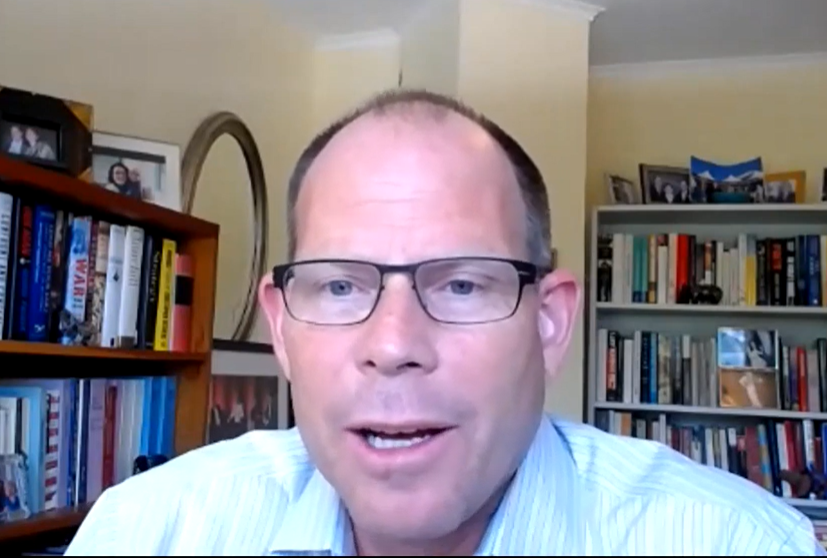
Gates Foundation CEO Mark Suzman
Gates Foundation CEO Mark Suzman discusses the coronavirus pandemic from his home study during a virtual event for GeekWire members. (GeekWire via Zoom)

The CEO of the Bill & Melinda Gates Foundation is disappointed that the United States isn’t on the same page with other nations when it comes to fighting the coronavirus pandemic, but he says it’s still possible to present a united front in dealing with what he calls “the ultimate global crisis.”

Mark Suzman, who stepped into the foundation’s top executive role in February just as the pandemic was ramping up, points to a high-profile conference held this week as an example. Leaders and luminaries from Europe, Canada, Japan, Saudi Arabia and other parts of the world pledged $8 billion to help the World Health Organization fight COVID-19.

“Unfortunately, the United States did not participate in that event,” Suzman said today during a live virtual event for GeekWire members. “But the United States is putting a lot of resources, obviously, into the COVID vaccine. Our hope is, at a minimum, can we make these investments complementary to each other, so you don’t have any duplicative races that are wasting resources.”

Get the full story on GeekWire.

Categories
GeekWire

Scientists debate coronavirus evolution

Coronavirus transmission map
A graphic generated by Nextstrain shows how different variants of the SARS-CoV-2 coronavirus have spread around the world. Purple streaks show where the virus was transmitted from China, green and yellow-green streaks show transmission from Europe, and red streaks show transmission from the United States. (Nextstrain.org Graphic)

Is the coronavirus behind COVID-19 turning into a more insidious pathogen? Or are such claims overblown?

A fast-moving debate over virus evolution illustrates how not-yet-vetted reports about the course of the coronavirus outbreak can go, um, viral — and how important social media channels have become in the global discussion of the science behind the pandemic.

The nature of SARS-CoV-2, the virus that causes COVID-19, is of such great interest because the disease is so deadly and disruptive: As of today, Johns Hopkins University reports nearly 3.7 million confirmed cases around the world, with a global death toll of more than 250,000. The United States accounts for 1.2 million cases and 71,000 deaths so far, and that toll could double before the worst is over.

Every day, several hundred new studies about SARS-CoV-2 and COVID-19 — most of which haven’t yet gone through the traditional peer-review process — go online, to face scrutiny by researchers and a wide swath of the general public.

One study got more than the usual traction today: The research project, led by scientists at Los Alamos National Laboratory and the University of Sheffield, looked at the way 14 variants of the virus have spread across the world.

The resulting paper was filed to the BioRxiv preprint server last week but has not yet been peer-reviewed. It concluded that one particular variant known as D614G is “of urgent concern.” That variant, a descendant of a form of the virus that started out in China, began spreading in Europe in early February and eventually made the leap to other parts of the world.

Get the full story on GeekWire.

Categories
GeekWire

New pandemic projection: 135,000 U.S. deaths

This chart shows the actual and projected daily U.S. death toll for COVID-19 from mid-March to Aug. 4, issued by the Institute for Health Metrics and Evaluation. The pink shaded area represents the uncertainty interval for the projection to the 95% confidence level. (IHME Graphic)

The latest projection from the University of Washington’s Institute for Health Modeling and Evaluation says the coronavirus pandemic will claim nearly 135,000 lives in the U.S. by August, in part because many states are easing their social distancing restrictions.

Other projections also foresee a deadlier spring: A presentation purportedly prepared for the Trump administration and leaked to The New York Times and The Washington Post projects that there’ll be as many as 3,000 deaths per day in the U.S. by June 1, with a sharp increase coming around May 14. That’s significantly higher than the current pace of roughly 1,500 daily deaths, and close to the previous peak rate reported in mid-April.

The White House and the Centers for Disease Control disavowed the slide presentation, which carried the CDC’s logo. The Post quoted one of the researchers providing the data for the presentation, Justin Lasser of the Johns Hopkins Bloomberg School of Public Health, as saying that the modeling work was not complete and that the projection was only one of a range of forecasts.

The Institute for Health Modeling and Evaluation’s projections have been closely watched by the White House and other policymakers — in part because they’ve provided specific albeit variable estimates of total deaths. But the IHME’s projections also have come in for significant criticism from other quarters — in part because the models are based on tracking the course of the pandemic in various regions of the world, rather than the epidemiological characteristics of the virus.

Get the full story on GeekWire.

Categories
GeekWire

NASA wants no crowds at historic crewed flight

NASA crew for Crew Dragon
NASA astronauts Bob Behnken and Doug Hurley participate in an integrated SpaceX test of critical crew flight hardware in March, in preparation for this month’s scheduled launch to the International Space Station in a Crew Dragon capsule. (SpaceX Photo)

Everything is in readiness for the first mission to send humans into orbit from U.S. soil since NASA retired the space shuttle fleet in 2011 – from the SpaceX Crew Dragon capsule that will take two astronauts to the International Space Station, to the parachutes that will bring them back down gently to an Atlantic Ocean splashdown, to the masks that NASA’s ground team will wear in Mission Control.

The fact that the launch is coming in the midst of the coronavirus pandemic has added a weird and somewhat wistful twist to the history-making event.

“That certainly is disappointing,” NASA astronaut Doug Hurley, who’ll be spacecraft commander for the Crew Dragon demonstration mission, told reporters today during a mission preview. “An aspect of this pandemic is the fact that we won’t have the luxury of our family and friends being there at Kennedy to watch the launch. But it’s obviously the right thing to do.”

NASA is asking people not to show up in person to watch the liftoff, currently scheduled for 4:32 p.m. ET (1:32 p.m. PT) May 27 at Kennedy Space Center in Florida.

Get the full story on GeekWire.

Categories
GeekWire

Remdesivir OK’d for wider use to treat COVID-19

The Food and Drug Administration today authorized emergency use of the experimental antiviral drug remdesivir for treating COVID-19 in the wake of encouraging results from a federally backed clinical trial.

Get the news brief on GeekWire.

Categories
GeekWire

Bill Gates: We’ll need 7 billion doses of vaccine

Bill Gates has been big on vaccines since before the start of the coronavirus pandemic, but in a new blog posting, the Microsoft co-founder and billionaire philanthropist says the only way to end the pandemic for good is to offer a vaccine to almost all of the planet’s 7 billion inhabitants.

That’s big.

“We’ve never delivered something to every corner of the world before,” Gates notes.

It’s especially big considering that a vaccine hasn’t yet been approved for widespread use, and that it may take as long as a year to 18 months to win approval and start distribution.

Some companies are aiming for a faster pace: Oxford University says its vaccine candidate has shown encouraging results in trials with rhesus macaque monkeys, and if it clears accelerated human trials, a few million doses could be available by September.

Meanwhile, the White House is pressing an initiative called Operation Warp Speed that Anthony Fauci, the director of the National Institute of Allergy and Infectious Disease, could result in hundreds of millions of vaccine doses being manufactured by January.

Get the full story on GeekWire.

Categories
GeekWire

Remdesivir wins a vote of COVID-19 confidence

An antiviral drug called remdesivir got a strong vote of confidence today from one of the most prominent figures in the battle against the coronavirus outbreak.

“The data shows that remdesivir has a clear-cut, significant positive effect in diminishing the time to recovery,” Anthony Fauci, director of the National Institute of Allergy and Infectious Diseases, told reporters during a White House photo op.

Also today, The New York Times quoted an unnamed administration official as saying that the Food and Drug Administration is likely to clear remdesivir to be employed more widely as a treatment for COVID-19 under the terms of an Emergency Use Authorization.

The FDA acknowledged that it’s “engaged in sustained and ongoing discussions” with remdesivir’s manufacturer, California-based Gilead Sciences, to make the drug available to patients as quickly as possible where appropriate.

Fauci said his optimism is based on a randomized, placebo-controlled trial involving more than 1,000 COVID-19 patients at medical clinics around the world, including four clinics in Washington state.

Get the full story on GeekWire.

Categories
GeekWire

Boeing plans cutbacks amid coronavirus losses

Boeing 777
A Boeing 777 jet is assembled at the company’s plant in Everett. (Boeing Photo)

Boeing says it’s planning to reduce its workforce by 10% and cut back on production of wide-body jets in response to the coronavirus pandemic’s dramatic effect on the aviation industry.

“We will be a smaller company for a while,” David Calhoun, Boeing’s CEO and president, told investors today during a conference call.

The moves came as the company reported an adjusted loss of $1.7 billion and a negative cash flow of $4.7 billion for the first quarter of the year. It was the second quarterly loss in a row, but it wasn’t as bad as analysts feared. As a result, Boeing’s shares finished today’s trading session up nearly 6%, at a closing price of $139.

In a letter to employees, Calhoun said that the pandemic has delivered a “body blow to our business.”

“The aviation industry will take years to return to the levels of traffic we saw just a few months ago,” he wrote.

In response, the company has started executing a plan for a 10% reduction in total workforce through a combination of voluntary layoffs, natural turnover and involuntary layoffs as necessary.

Get the full story on GeekWire.

Categories
GeekWire

Coronavirus modelers raise projected death toll

COVID-19 death projection
A chart created by the University of Washington’s Institute for Health Metrics and Evaluation traces the actual and projected trend line for daily COVID-19 deaths in the United States between March 1 and July 1, as solid and dotted lines respectively. The pink shaded area indicates a wide uncertainty interval for future death rates. (IHME Graphic)

The timeline has slipped to the right and the projected death toll has trended upward in a new projection from the creators of a closely watched computer model for the course of the U.S. coronavirus outbreak.

Tonight’s update from the University of Washington’s Institute for Health Metrics and Evaluation raises the outlook for the cumulative U.S. death toll through Aug. 4 from the 67,641 fatalities projected on April 22 to a new figure of 74,073.

That’s creeping closer to the death toll of 81,114 that IHME laid out in its first projection, way back in late March. Since then, the figures have gone as high as 93,000 and as low as 60,000.

Get the full story on GeekWire.

Categories
GeekWire

Social distancing needs to be more stringent

South Lake Union
Amazon’s banana stand in Seattle’s South Lake Union district was an early victim of social distancing policies enacted to counter the coronavirus outbreak. (GeekWire Photo / Kurt Schlosser)

Although many states are starting to relax restrictions on business activity and contacts, Seattle-area epidemiologists say such restrictions will need to be tightened up to reduce the spread of coronavirus much further.

The only alternative to clamping down harder would be to create a robust system of testing and contact tracing, experts at the Bellevue, Wash.-based Institute for Disease Modeling say in their latest report.

Their conclusions are based on an updated analysis of viral transmission patterns in Seattle and the rest of King County. The numbers suggest that the extent of the pandemic in the county is declining very slowly, if at all.

Get the full story on GeekWire.