Categories
GeekWire

Metamaterials harnessed for beaming power

Russell Hannigan
Intellectual Ventures’ Russell Hannigan explains how a metamaterials-based reflector array antenna can focus a microwave beam on a power receiver. (GeekWire Photo / Alan Boyle)

BELLEVUE, Wash. – Wireless power transmission has been a dream since the days of Nikola Tesla, but Intellectual Ventures is adding a twist to make it so, and make it profitable.

The twist is a little something called metamaterials, a technology that has already spawned several spin-outs from the Bellevue-based company. Russell Hannigan, senior director of business development for Intellectual Ventures’ Invention Science Fund, says a decision on how to commercialize the technology is just “a few months away.”

Right now, the company is working with a proof-of-concept setup that beams about 8 watts’ worth of microwaves across a lab space to light up an array of LED lights. But researchers expect to scale up the system to power devices at distances of 160 feet (50 meters) or more.

“Our driving application – the one that’s the most lucrative – is drones,” Hannigan said.

Get the full story on GeekWire.

Categories
GeekWire

Amazon patents drone with foldable wings

Foldable drone
A diagram shows Amazon’s foldable-wing drone in its configuration for takeoff and landing. (Amazon Illustration via USPTO)

Amazon has sought patents for hitchhiking drones, mini-drones that can sit on shoulders, drones that assemble themselves like Lego toys – and now drones that flip their wings to go from vertical to horizontal flight.

The hybrid foldable-wing design is covered in a patent that was published Jan. 24, following up on an application filed back in 2014.

When the drone takes off, the robo-plane’s jointed wings would be folded around to provide a stable base for a vertical takeoff, with the rotors spinning in a horizontal plane.

But once the drone gets up in the air, the wings and tail would stretch out to create an airplane-style configuration. The rotors would then be spinning in a vertical plane, like a traditional airplane’s propellers, to push the drone forward.

When it’s time to land, the drone’s wings and tail would fold up again for a vertical landing.

Get the full story on GeekWire.

Categories
GeekWire

Amazon exec worries about state laws on drones

Paul Misener
Paul Misener, Amazon’s vice president of global innovation policy and communications, speaks at the CES show in Las Vegas. (GeekWire Photo / Monica Nickelsburg)

By Alan Boyle and Monica Nickelsburg

A patchwork of state laws governing drone operations would pose a “real problem” for aerial delivery systems like the one that Amazon is developing, one of the executives in charge of the company’s drone program says.

Paul Misener, Amazon’s vice president of global innovation policy and communications, discussed the regulatory issues facing delivery drones today during a panel at the Consumer Electronics Show in Las Vegas.

Amazon began using drones to make deliveries to a handful of customers in England last month, and the Seattle-based company is expected to ramp up U.S. drone operations in the next couple of years.

Get the full story on GeekWire.

Categories
GeekWire

FAA tests systems to counter dastardly drones

Drones
Drones were visible in abundance at CES. (FAA Photo)

Drone sightings by commercial pilots are on the rise, and so is the Federal Aviation Administration’s research into systems that detect and defend against unmanned aerial vehicles.

In cooperation with other government agencies and industry partners, the FAA has been testing technologies designed to detect unauthorized drone operations near airports and other critical infrastructure, FAA Administrator Michael Huerta told a packed audience today at the CES show in Las Vegas.

“We’ve evaluated some of these technologies in some pretty complicated places, airports like New York, and Denver, and smaller places like Atlantic City,” he said.

Huerta said further tests will be conducted later this year around Dallas-Fort Worth International Airport.

Get the full story on GeekWire.

Categories
GeekWire

Amazon designs the Borg of delivery drones

Collective UAV
One concept for a collective UAV looks like the Borg Cube from “Star Trek.” (Amazon Illustration via USPTO)

Right now, Amazon’s delivery drones are designed to drop off packages weighing no more than 5 pounds. But what if you could link up lots of drones? Then your bigger packages could be assimilated.

That’s the idea behind a patent application from the Seattle-based online retail giant that focuses on Lego-like assemblies known as “collective UAVs,” or unmanned aerial vehicles.

“A collective UAV may be used to aerially transport virtually any size, weight, or quantity of items, travel longer distances, etc.,” says the application, filed in February 2015 but published just today.

Get the full story from GeekWire.

Categories
GeekWire

Will drones be dropping from flying warehouses?

Delivery via airship
This diagram shows an airship-style aerial fulfillment center dropping drones to make deliveries. After each delivery, the drones fly off and are collected for the return trip to the blimp via a replenishment shuttle. (Amazon Illustration via USPTO)

Some patents seem so way out that you have to wonder if they’re a joke. Such is the case for Amazon’s patent covering an “airborne fulfillment center” that would launch drones to deliver merchandise from above.

The patent, which was granted in April, came to light this week in the wake of yet another patented Amazon scheme to ward off hackers as well as bow-and-arrow attacks.

“I just unearthed the Death Star of e-commerce,” Zoe Leavitt, a tech analyst for CB Insights, declared Dec. 28 in a tweet.

Hilarity ensued.

The scheme calls for having an airship hover over the intended delivery area at an altitude of 45,000 feet, stocked with goodies that can be loaded aboard drones when an order is made.

Get the full story on GeekWire.

Categories
GeekWire

Amazon plans to defend drones from … arrows?

Arrow attack on drone
A diagram from Amazon’s patent application shows a malicious person shooting an arrow at a drone – and missing. (Amazon Illustration via USPTO)

If there are any Robin Hoods out there who are thinking about shooting down drones while they’re making deliveries, Amazon has a patented plan to stop you.

The patent, filed in 2014 but published just last week, lays out countermeasures for potential threats ranging from computer hacking to lightning flashes to bows and arrows.

If nothing else, the 33-page application illustrates how many things could possibly go wrong with an autonomous navigation system for unmanned aerial vehicles, or UAVs.

Get the full story on GeekWire.

Categories
GeekWire

Border Patrol will test Echodyne’s drone radar

Eben Frankenberg at Echodyne
Echodyne CEO Eben Frankenberg holds one of the company’s radar units at Echodyne’s headquarters in Bellevue, Wash. (GeekWire Photo / Alan Boyle)

Echodyne’s drone-sized radar system has received a vote of confidence – and a $118,721 award – from the U.S. Department of Homeland Security.

The award, made through the department’s Silicon Valley Innovation Program, is designed to help the U.S. Border Patrol enhance its ability to monitor activities at the nation’s borders. The potential applications range from tracking down bad guys to search-and-rescue operations.

An award of a little more than $100,000 may not sound like a huge deal in the grand scheme of things, but it’s a welcome boost for Echodyne – a startup headquartered in Bellevue, Wash., that counts Microsoft co-founders Bill Gates and Paul Allen among its investors.

“The great thing is we get the opportunity to take the commercial product we’re developing, do a few modifications and have them test it,” Echodyne CEO Eben Frankenberg told GeekWire today.

Get the full story on GeekWire.

Categories
GeekWire

Flirtey’s drones are making routine deliveries

Flirtey drone
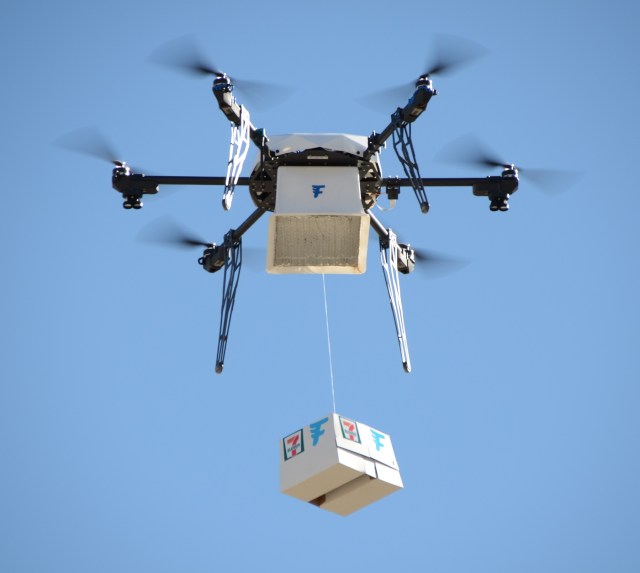
Flirtey’s drone makes a delivery for 7-Eleven. (Flirtey Photo)

In the race to make routine commercial deliveries via drone, Flirtey is going where Amazon hasn’t yet ventured: the United States.

Today, the three-year-old Nevada-based startup reported that its autonomous drones made regular weekend deliveries of food and other convenience-store products for a 7-Eleven store during November.

The pilot project involved a dozen customers in Reno – which happens to be the headquarters for Flirty and for the Nevada Institute for Autonomous Systems’ drone test range at Reno-Stead Airport.

Seventy-seven deliveries in all were made, using a smartphone-style app, Flirtey said in a news release.

Get the full story on GeekWire.

Categories
GeekWire

Delivery drones take small steps toward big deal

Amazon drone
Amazon’s delivery drone comes in for a landing over an English field. (Amazon via YouTube)

Amazon’s multimillion-dollar effort to deliver goods via drone currently has just two customers in the English countryside, but this could well be the way a multibillion-dollar industry gets started.

The current state of Amazon’s Prime Air project came to light today in an online announcement and video from the Seattle-based company, plus a tweet from CEO Jeff Bezos. The first delivery to an actual customer, identified only as Richard B. of Cambridgeshire, occurred on Dec. 7.

In the coming months, Amazon expects to expand the customer base from the current two to dozens of folks living within several miles of a specially designed drone fulfillment center near Cambridge. Hundreds more will be added as time goes on.

Get the full story on GeekWire.