DroneSeed’s aerial vehicles drop water and seeds for reforestation. (DroneSeed via YouTube)
Seattle-based DroneSeed has raised more than $5 million in funding for a venture that uses drones to plant trees and sustain them from the air, according to documents filed this month with the Securities and Exchange Commission.
The Nov. 16 filing says 19 investors contributed to the funding round, with $260,000 of a $5.3 million offering remaining to be sold.
DroneSeed declined to identify the investors or provide further details about the investment.
In an email to GeekWire, DroneSeed CEO Grant Canary said the level of investment reported in the filing may change. More details are expected early next year.
A monarch butterfly feasts of swamp milkweed in Michigan. The loss of milkweed due to the spread of herbicide-resistant crops is seen as one of the reasons for the Monarchs’ decline. (USFWS Photo / Jim Hudgins)
Premier Residential CEO Eli Moreno has helped several startups take flight in Western Washington, but his latest venture focuses on flights of a different kind: the continent-spanning treks of Monarch butterflies.
Moreno is priming the pump for a $50,000 prize that’s aimed at encouraging the development of a high-tech system to track the butterflies as they migrate between Canada and his native Mexico.
“A thousand years from now, we want to be able to preserve these butterflies,” Moreno told GeekWire today.
Members of the research team stand on the deck of the R/V Robertson with two Seaglider drones on the left, plus a drone and a float on the right. The team includes UW’s Jason Gobat, Craig Lee, Knut Christianson and James Girton, plus Spencer Reeder of Paul G. Allen Philanthropies. (GeekWire Photo / Alan Boyle)
Researchers from the University of Washington and Columbia University are getting ready for an unprecedented months-long campaign to study Antarctica’s ice shelves from the ocean below, with backing from billionaire philanthropist Paul Allen.
The results are expected to lead to a better understanding of how ice retreats, and how climate change could affect the loss of polar ice sheets and the resulting rise in sea levels.
It’s a high-risk mission — but in this case, robots, not humans, are taking the risk.
“All of these instruments could be lost underneath the ice shelf,” said Spencer Reeder, director of climate and energy for Paul G. Allen Philanthropies.
Reeder said that’s a big reason why Allen, one of Microsoft’s co-founders, is funding the expedition to the tune of just under $2 million. The risks are too high for the traditional funders of polar research, but Allen’s backing could help UW’s Applied Physics Laboratory prove that its devices can do the job.
This map shows the elevation change of Mount Rainier glaciers between 1970 and 2016. The earlier observations are from USGS maps, while the recent data use the satellite stereo imaging technique. Glacier surface elevations have dropped more than 40 meters (130 feet) in some places. (University of Washington Photo / David Shean)
Elevation readings captured by satellites confirm that glaciers in the western United States are fading away at a worrisome rate.
The fade-out isn’t a surprise, considering the rise in global mean temperatures that’s ascribed to climate change. The new twist has to do with how the measurements were made.
University of Washington researcher David Shean looked back at satellite readings that have been amassed in databases, plus fresh readings that are being taken by DigitalGlobe’s constellation of GeoEye and WorldView satellites.
An analysis of the data, facilitated with NASA’s Ames Stereo Pipeline software, produces a 3-D elevation model of mountainous terrain. The method supplements other techniques to estimate glacier size, including area measurements based on aerial imagery and depth measurements made using stakes in the snow.
The result is a year-by-year record tracing the ups and downs of a glacier.
An artist’s conception shows the OCO-2 satellite. (NASA Illustration)
Readings from NASA’s Orbiting Carbon Observatory-2 have confirmed that the El Niño weather pattern of 2015-2016 was behind the biggest annual increase in atmospheric carbon dioxide levels in millennia.
The OCO-2 satellite, launched in 2014, is designed to provide a detailed picture of how carbon is exchanged between air, land and sea.
OCO-2 data showed that 2015’s El Niño weather, created by warmer waters in the central and eastern Pacific Ocean, led to hotter conditions in tropical regions of South America, Africa and Indonesia.
In Africa, hotter-than-normal temperatures led to faster decomposition of dead trees and plants, releasing more carbon into the atmosphere. And in Indonesia, dry conditions led to increased fires, which also released more carbon.
Washington state Gov. Jay Inslee speaks at a New York news conference organized by the U.S. Climate Alliance. (New York Governor’s Office via YouTube)
Washington state Gov. Jay Inslee joined with other governors today in New York to declare they’re “squarely on track” to meet the goals of the Paris climate agreement that the Trump administration says it rejects.
Inslee and the governors of 13 other states and the U.S. territory of Puerto Rico have banded together to form the U.S. Climate Alliance, a bipartisan coalition that aims to reduce greenhouse-gas emissions through state and regional initiatives.
Imagery from the NASA-NOAA Suomi National Polar-Orbiting Partnership satellite shows Earth’s lights at night. In a newly published study, researchers argue that planets could be classified based on the effects of energy on the environment. (NASA Photo / Joshua Stevens / Miguel Roman)
A trio of scientists has just laid out a new classification scheme for planets that would put Earth into a hybrid category, making the transition from a diverse, photosynthetic-based biosphere to a world dominated by an energy-intensive civilization.
The researchers’ analysis meshes with the view that humanity’s influence has spawned a new geological epoch known as the Anthropocene Age.
“Our premise is that Earth’s entry into the Anthropocene represents what might, from an astrobiological perspective, be a predictable planetary transition. … In our perspective, the beginning of the Anthropocene can be seen as the onset of the hybridization of the planet,” they say in a study published by the journal Anthropocene.
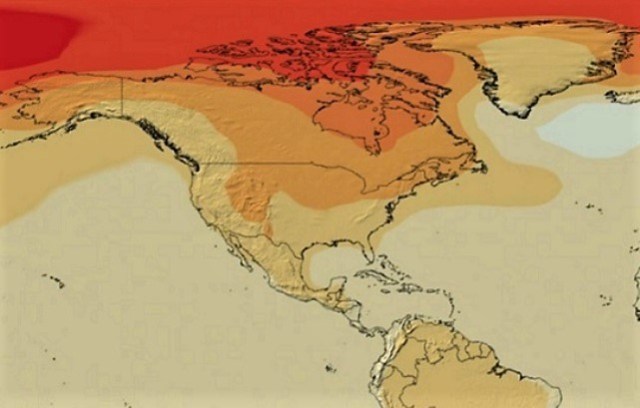
This projection shows how a rise of more than 2 degrees Celsius is expected to affect North America, Greenland and the Arctic. (NASA Graphic)
A statistical analysis led by researchers at the University of Washington sees almost no chance that the world’s nations will be able to keep the rise in global temperatures below 2 degrees Celsius (3.6 degrees Fahrenheit) over the course of the 21st century, as promised in last year’s Paris climate accord.
“Our analysis shows that the goal of 2 degrees is very much a best-case scenario,” lead author Adrian Raftery, a UW professor of statistics and sociology, said today in a news release. “It is achievable, but only with major, sustained effort on all fronts over the next 80 years.”
In discussions about the future effects of climate change, the 2-degree mark has been called a “speed limit” that, if broken, would significantly heighten humanity’s peril. But even as the goal was being set, experts voiced worries that it would be very hard to stay below the speed limit by 2100.
A southern resident killer whale calf accompanies its mother in 2004. (NOAA Photo)
What’s killing the killer whales? After following the whales and analyzing their poop for years, scientists say the Pacific Northwest’s population is dwindling primarily due to a chronic lack of Chinook salmon.
The killer whales, also known as orcas, aren’t dying of starvation. Rather, the scientists say the stress of not getting enough to eat is causing orca pregnancies to fail.
Other factors, such as marine pollutants and disruptive ship traffic, contribute to the whales’ woes as well. But in a paper being published in the June 29 issue of the journal PLOS ONE, the researchers say the data point most directly to nutritional stress.
Workhorse Group’s HorseFly delivery system makes use of drones and trucks. (Workhorse via YouTube)
Delivering items with drones instead of trucks is likely to reduce carbon dioxide emissions for short-range trips, or on routes with few customers, according to a study conducted by transportation engineers at the University of Washington. The study, set for publication in Transportation Research Part D, suggests that trucks have the environmental advantage for longer-range trips and routes with lots of stops. Also, size matters.