Air Force Secretary Heather Wilson chats with Stratolaunch CEO Jean Floyd (left) at the company’s hangar in Mojave, Calif. The twin-tailed airplane is behind them. (Heather Wilson via Twitter)
Stratolaunch, the six-year-old space venture backed by Microsoft co-founder Paul Allen, says it’ll use the world’s biggest airplane to launch small satellites into orbit – but what kind of satellites?
Marine Corps Commandant Robert Neller uses a HoloLens augmented-reality system to manipulate virtual objects during a demonstration at Camp Foster on Okinawa in April. (U.S. Marine Photo / Tayler P. Schwamb)
Microsoft’s HoloLens augmented-reality system is scoring victories with the U.S. military, which means the goggle-eyed headsets are more likely to pop up at a wargame near you.
The experiment, conducted during training exercises at Camp Lejeune, N.C., worked so well that the Marines are now distributing HoloLens kits to 24 infantry battalions around the country.
An artist’s conception shows Boeing’s Phantom Express XS-1 space plane in flight. (Boeing Illustration)
The Pentagon’s Defense Advanced Research Projects Agency says it has selected the Boeing Co. to develop and test its XS-1 hypersonic space plane, using a design now known as the Phantom Express.
Boeing won out over Northrop Grumman and Masten Space Systems to take the long-running XS-1 project beyond Phase 1 into Phase 2/3, culminating with test flights in 2020.
The reusable space plane would be designed to carry and deploy a small, expendable upper stage, then return to Earth for a runway landing. The upper stage would be capable of putting satellites weighing up to 3,000 pounds in low Earth orbit.
Maj. Ric Turner, an F-15 fighter pilot with the 40th Flight Test Squadron, flies a test mission with the Talon HATE Pod slung beneath the F-15’s fuselage. (U.S. Air Force Photo / Brandi Hansen)
The Boeing Co. and the U.S. Air Force say they’ve shown that a new type of communication pod for F-15 fighter jets, known as Talon HATE, can link together different types of aircraft and ground stations for secure communications.
The Boeing-developed system is designed to knit together the communication systems aboard F-15 jets and other traditional weapons systems, plus the F-22 stealth fighters built for the Air Force by Lockheed Martin. The F-22 uses a special type of networking system that’s optimized for stealthiness but poses a challenge for communication with non-stealth airplanes, as explained in this report from Foxtrot Alpha.
During a flight demonstration conducted out of Nellis Air Force Base in Nevada, Talon HATE pods on two F-15C aircraft enabled test pilots to share information through a variety of channels, including the Wideband Global Satcom system, Boeing said in today’s news release.
Workers in protective suits check out the Air Force’s X-37B Orbital Test Vehcile after its touchdown at NASA’s Kennedy Space Center Shuttle Landing Facility. (U.S. Air Force Photo)
After nearly two years in orbit, the U.S. Air Force’s X-37B robotic space plane landed at NASA’s Kennedy Space Center in Florida today with a loud sonic boom, but nary a word about what exactly it was doing up there all this time.
This was the fourth and longest classified mission for the Boeing-built craft, which was launched from Florida 718 days earlier in 2015 atop a United Launch Alliance Atlas 5 rocket. The three earlier missions were flown in 2010, 2011-2012 and 2012-2014, with landings at Vandenberg Air Force Base in California.
The Air Force’s fleet of X-37B Orbital Test Vehicles has now spent a total of 2,085 days to gauge the reusable winged plane’s ability to conduct on-orbit operations and return for airplane-style horizontal landings.
An artist’s conception shows the expansion of the Flying Heritage & Combat Armor Museum. (Flying Heritage Illustration)
Cross Seattle billionaire Paul Allen’s Flying Heritage Collection off your list of local attractions, and put a new name in its place: the Flying Heritage & Combat Armor Museum.
The rebranding, announced on March 24, will be followed by an expansion in the museum’s offerings and the construction of a third hangar to house its growing collection of aircraft and military vehicles.
The additional hangar at Everett’s Paine Field will boost the museum’s current 57,000 square feet of exhibit space by another 30,816 square feet, the museum said.
Boeing executive Pat Shanahan speaks at the opening of the company’s Seattle Delivery Center in 2015. (GeekWire Photo / Jacob Demmitt)
President Donald Trump today announced his intent to nominate longtime Boeing executive Patrick Shanahan as deputy secretary of defense, the Pentagon’s No. 2 civilian spot.
Shanahan, 54, currently oversees Boeing’s manufacturing operations and supplier management functions as senior vice president for supply chain and operations. He’s the chair of the University of Washington’s Board of Regents, a UW engineering grad and a member of the Washington Roundtable.
His background also includes management roles for the 737, 747, 767, 777 and 787 commercial airline programs, as well as work with Boeing Missile Defense Systems.
Replicas of the first atomic bombs, Little Boy and Fat Man, are on display in the “Why War” exhibit at the Flying Heritage Collection in Everett, Wash. (GeekWire Photo / Kevin Lisota)
EVERETT, Wash. – The idea behind the Flying Heritage Collection’s groundbreaking new exhibit about the causes and effects of conflict, “Why War,” was born five years ago – and the man behind the idea is none other than Microsoft co-founder Paul Allen, who owns the collection.
“He’s the ‘Idea Man,’ as you know,” said Adrian Hunt, the collection’s executive director, referring to Allen’s memoir.
The Flying Heritage Collection shows off scores of historic aircraft and other military artifacts in a 57,000-square-foot hangar complex next to Everett’s Paine Field, including a German V-2 rocket, a Soviet Scud missile system and a couple of tanks.
Hunt recalled that Allen raised a big-picture question during a conversation about the collection and its future: “At some level, don’t we just have a lot of weapons on display? … We should do something to provide some context.”
That set off years of thinking and designing, aimed at putting together an interactive exhibit to explain why conflicts arise, how warfare has changed, and how war affects societies. Hunt says the resulting 2,500-square-foot exhibit, which opens to the public on March 4, is the only one of its kind in the U.S.
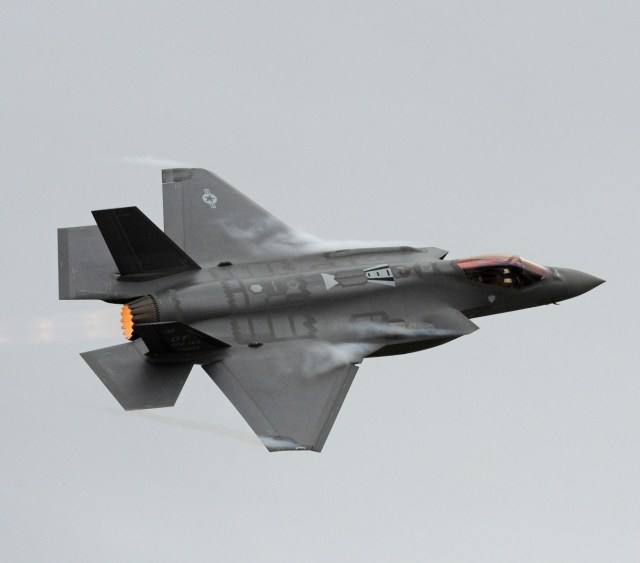
An F-35 Lightning II fighter jet prepares to land. (U.S. Air Force Photo / Alex R. Lloyd)
The Pentagon has struck a deal with Lockheed Martin for the purchase of 90 F-35 stealth fighter jets at a cost that adds up to nearly $9 billion, finishing up negotiations highlighted by President Donald Trump’s threats to walk away.
It’s the latest order in what’s expected to amount to nearly $400 billion in sales for Lockheed Martin, involving thousands of the jets.
This round, known as Lot 10, marks the first time that the per-jet purchase price for an F-35A has been below $100 mlilion. Lockheed Martin said Lot 10 reflects a $728 million reduction in the total price, compared with the previous lot.
The current Air Force One planes were built more than a quarter-century ago. (White House Photo)
President Donald Trump’s defense secretary, James Mattis, has ordered reviews of the multibillion-dollar programs to acquire new Air Force One jets and more F-35 fighter jets – two programs that sparked his boss’ ire in the run-up to his inauguration.
“Yesterday Secretary Mattis directed separate reviews of the F-35 Joint Strike Fighter program and the Presidential Aircraft Recapitalization program,” Navy Capt. Jeff Davis, a Pentagon spokesman, said today in a statement quoted by The Hill. “The purpose of these reviews is to inform programmatic and budgetary decisions, recognizing the critical importance of each of these acquisition programs.”
Lockheed Martin is the main contractor for the F-35 program, which has experienced cost overruns and production delays. The Boeing Co. is working with the Air Force on the specifications for two replacement Air Force One jets to be used for presidential flights.