An artist’s conception shows Team SpaceIL’s lunar lander. (Credit: SpaceIL)
The organizers of the Google Lunar X Prize competition confirmed that five teams have been cleared to go after the $20 million grand prize, and doled out a total of $1 million to all 16 teams that entered.
These five teams previously reported that they had launch contracts for missions to the moon, and that those deals had received the XPRIZE seal of approval.
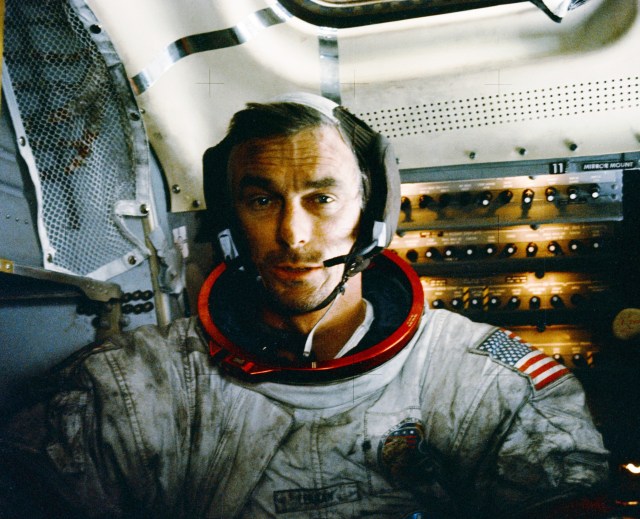
Apollo 17 commander Gene Cernan wears a spacesuit smeared with lunar dirt in 1972. (NASA Photo)
Apollo 17 commander Gene Cernan, the last human to leave footprints on the moon, passed away today – but his family says his dying wish remains to be fulfilled.
“Even at the age of 82, Gene was passionate about sharing his desire to see the continued human exploration of space, and encouraged our nation’s leaders and young people to not let him remain the last man to walk on the moon,” the family said in a statement released by NASA.
The family statement said Cernan had been suffering from ongoing health issues. He died at a Houston hospital, surrounded by relatives.
An artist’s conception shows Moon Express’ lander extending its robotic arm to take a “selfie” of the spacecraft on the lunar surface with Earth in the background. (Credit: Moon Express)
An executive at Moon Express has been widely quoted as saying his company has reached its funding goal for this year’s planned commercial mission to the lunar surface, thanks to $20 million in new investment.
“We now have all the resources in place to shoot for the moon,” the Florida-based company’s CEO, Bob Richards, said in a statement. “Our goal is to expand Earth’s social and economic sphere to the moon, our largely unexplored eighth continent, and enable a new era of low-cost lunar exploration and development for students, scientists, space agencies and commercial interests.”
Space News quoted Richards as saying that the latest round of investment includes contributions from new and existing investors, including the company’s chairman and co-founder, Seattle-area tech entrepreneur Naveen Jain.
An artist’s conception shows the Chang’e 4 spacecraft landing on the moon. (CCTV via YouTube)
China’s latest white paper on space exploration confirms the country’s plans to send a rover to the moon’s far side in 2018 and put a rover on Mars in 2020.
Today’s white paper, released by the State Council Information Office, says the Chang’e 4 mission will “conduct in-situ and roving detection and relay communications at Earth-moon L2 point” in 2018, the official China Daily newspaper reported.
In 2012, NASA’s Grail probes crash-landed on the moon’s far side – the so-called “dark side” that never faces Earth. However, no spacecraft has made a soft landing on the moon’s normally hidden half.
Communicating with such a spacecraft would require using a relay satellite, such as the one that China plans to send to the L2 gravitational balance point beyond the moon for Chang’e 4.
Japan’s Team Hakuto is testing two small rovers known as Tetris (left foreground) and Moonraker (right background). The rovers would ride along with Team Indus’ spacecraft. (Team Hakuto Photo)
The rocketeers on Japan’s Team Hakuto say they’ve gotten the Google Lunar XPRIZE’s seal of approval on its plans for a mission to the moon.
The XPRIZE verification of Team Hakuto’s launch agreement with India’s Team Indus boosts the number of approved competitors to five. That includes Team Indus as well as Moon Express, Synergy Moon and SpaceIL.
“The Google Lunar XPRIZE has always pushed us beyond our limits” Takeshi Hakamada, Team Hakuto’s leader, said in today’s news release. “We will continue to challenge ourselves next year and choose an optimal path to reach the moon.”
Team Hakuto is run by a Tokyo-based startup called ispace, and draws upon expertise from faculty and students at Tohoku University.
PTScientists’ ALINA lander is designed to carry two Audi Lunar Quattro rovers to the moon’s surface. (PTScientists Photo)
A German team that’s going after the Google Lunar XPRIZE has secured a contract with Seattle-based Spaceflight to get its rover-carrying lander to the moon.
PTScientists, based in Berlin, announced the deal today, and Spaceflight confirmed the partnership. If the contract is verified by the $30 million contest’s organizers at XPRIZE, the group will join three other contestants in the home stretch for the top prize for commercial lunar exploration.
There are 16 teams in the GLXP hunt, but they have to have verified launch contracts by the end of this year in order to stay in the competition.
The top prize of $20 million will go to the first team to send a spacecraft to the moon and have it travel more than 500 meters (1,640 feet) while sending back images and video. Other prizes are being offered as extra incentives. If no team gets to the moon by the end of 2017, all those prizes go poof.
This week’s supermoon has been pretty much clouded out in Seattle, but it appears to have had an effect on Apollo 11 moonwalker Buzz Aldrin.
In a Twitter update, the 86-year-old space icon mugged for the camera, werewolf-style, and said it took all his willpower to stop from howling.
Aldrin doesn’t shy away from media moments, whether it’s cutting a rug on “Dancing With the Stars” or putting in a cameo on the NBC sitcom “30 Rock.”
On a 2010 episode, Aldrin invited series star Tina Fey to join him in yelling at the moon over Manhattan. Fey obliged, but it was Aldrin who showed the moon who’s boss. “I own you! I walked on your face!” he shouted.
Seattle photographer Tim Durkan captured this view of the full moon behind the Space Needle. (Credit: TimDurkan.com)
The full moon is looking bigger and brighter this week than it’s looked since 1948 – and although you may not notice just how much more super this “supermoon” is, it’s definitely worth looking up. If the skies are ever clear, that is.
The moon is due to be at its closest at 3:22 a.m. PT Nov. 14, and it’ll reach the peak of its full phase a few hours later at 5:52 a.m. The bottom line is that the lunar disk will look about 14 percent wider than it does at its farthest distance from Earth, and shine about 30 percent brighter.
This doesn’t mean you’d have to get up in the wee hours to catch a super view.
“I’ve been telling people to go out at night on either Sunday or Monday night to see the supermoon,” Noah Petro, deputy project scientist for NASA’s Lunar Reconnaissance Orbiter mission, said in a NASA feature about the phenomenon. “The difference in distance from one night to the next will be very subtle, so if it’s cloudy on Sunday, go out on Monday.”
An artist’s conception shows a Moon Express lander in lunar orbit. (Credit: Moon Express)
NASA wants suggestions for experiments that can be sent to the moon on commercial spacecraft – and Moon Express, one of the companies building those spacecraft, wants to kick in up to $500,000 per experiment.
The experiments would be aimed at filling the “strategic knowledge gaps” for lunar exploration, NASA said in today’s request for information, which was timed to coincide with this week’s meeting of the Lunar Exploration Analysis Group in Columbia, Md.
The time frame for the proposed experiments – in the range of 2017 to 2020 – seems tailor-made for Moon Express, which is one of several teams going after the top award in the $30 million Google Lunar X Prize.
An artist’s conception shows a permanent lunar base that’s part of the European Space Agency’s “Moon Village” vision. (Credit: ESA)
GUADALAJARA, Mexico – If the world wants to create a village on the moon, the Federal Aviation Administration is willing to start up an online trading post for lunar services.
George Nield, the FAA’s associate administrator for commercial space transportation, says he doesn’t even need to wait for the village to be built.
Nield offered to set up what he called LMASS – the Lunar Marketplace and Swap Shop – during one of today’s sessions at the International Astronautical Congress in Guadalajara.
“Think of it as a corkboard,” Nield said. The potential traders could include businesses that are working on ways to move cargo from low Earth orbit to lunar orbit, or on moon landers, or on habitats, or surface transportation, or communication services, or other technologies that will eventually be needed for lunar operations.