Categories
GeekWire

Blue Origin proposes moon delivery in 2020

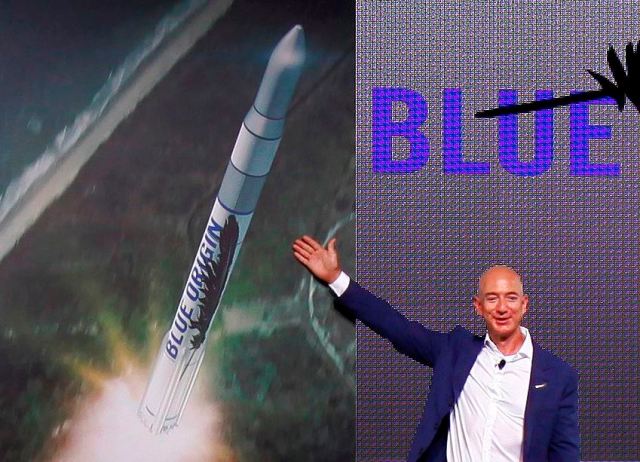
Image: Jeff Bezos and Blue Origin
Jeff Bezos shows off the concept for Blue Origin’s launch system during a 2015 news conference in Florida. The rocket could reportedly be adapted for moon missions. (Blue Origin photo)

Amazon billionaire Jeff Bezos’ Blue Origin space venture has reportedly proposed sending a robotic lander to the moon’s south polar region by 2020, as an initial step toward an “Amazon-like” lunar delivery system and eventually a permanently inhabited moon base.

Blue Origin’s white paper is described in a report from The Washington Post, which is owned by Bezos.

The Post says the company’s seven-page proposal, dated Jan. 4, has been circulating among NASA’s leadership and President Donald Trump’s transition team. It’s only one of several proposals aimed at turning the focus of exploration beyond Earth orbit to the moon and its environs during Trump’s term.

Get the full story on GeekWire.

Categories
GeekWire

Jeff Bezos previews his Florida rocket factory

Blue Origin site
The steel structure for Blue Origin’s factory rises from a Florida site. (Blue Origin Photo via Jeff Bezos)

Amazon billionaire Jeff Bezos is showing off the “extraordinary progress” being made on the Florida factory where Blue Origin’s New Glenn orbital launch vehicle will be built.

“As you can see here, the first steel is now going up,” he wrote today in an email update, accompanied by a picture showing a lattice of girders rising from the construction site near NASA’s Kennedy Space Center.

The 750,000-square-foot facility is due to open by the end of 2017 and produce New Glenn rockets for Blue Origin’s orbital missions. Test flights are expected to begin by the end of the decade, lifting off from Launch Complex 36 under the terms of a lease from Space Florida.

Meanwhile, Bezos’ Blue Origin venture is also proceeding with its New Shepard suborbital space program. The first full-fledged New Shepard rocket ship was retired after making five successful test flights to the edge of outer space and back.

Get the full story on GeekWire.

Categories
GeekWire

New Glenn rocket aces wind tunnel tests

New Glenn model
This model of Blue Origin’s New Glenn rocket was put through wind tunnel testing. (Credit: Jeff Bezos via Twitter)

GUADALAJARA, Mexico – Blue Origin’s New Glenn rocket isn’t due to go into orbit until later this decade, but its design has already been validated by computer simulations and three weeks of wind tunnel testing.

That’s the word from Amazon billionaire Jeff Bezos, who founded Blue Origin 16 years ago this month. In a pair of tweets, Bezos showed off a scaled-down version of the New Glenn, which will tower 313 feet high in its three-stage version.

The pictures follow up on Bezos’ unveiling of the design earlier this month. Bezos said the model has been tested at transonic and supersonic speeds, with “exciting results.”

Get the full story on GeekWire.

Categories
GeekWire

Blue Origin unveils ‘New Glenn’ orbital rocket

Image: Rocket lineup
Blue Origin’s chart shows a lineup of past, present and future rockets, ranging from Orbital ATK’s Antares to the New Glenn configurations and the Saturn 5 moon rocket. (Credit: Blue Origin)

Amazon billionaire Jeff Bezos is providing a sneak preview of the “New Glenn” rocket for orbital launches, which his Blue Origin space venture has been working on for four years already.

Bezos shared the design and basic specifications in an update sent to thousands of email subscribers.

“Named in honor of John Glenn, the first American to orbit Earth, New Glenn is 23 feet in diameter and lifts off with 3.85 million pounds of thrust from seven BE-4 engines,” Bezos wrote. “Burning liquefied natural gas and liquid oxygen, these are the same BE-4 engines that will power United Launch Alliance’s new Vulcan rocket.”

The two-stage version of New Glenn would be capable of flying commercial satellites and astronauts into low Earth orbit. Bezos said a three-stage New Glenn could send payloads on “demanding beyond-LEO missions.”

Get the full story on GeekWire.