Categories
GeekWire

White House lays out its COVID-19 testing plan

Coronavirus press conference
Deborah Birx, the White House’s coronavirus response coordinator, shows a flowchart for a website that would screen online visitors for COVID-19 testing, with President Donald Trump at her side. (White House via YouTube)

The Trump administration says it will set up a nationwide screening and testing system for coronavirus that relies upon online self-screening and drive-through sampling stations in store parking lots.

Lots of details about the system have yet to be fleshed out.

For example, the website that will take Americans through the screening process hasn’t yet been finished. Hundreds of parking-lot stations will have to be set up. And it could be challenging to ramp up operations, not only for test-kit production but also for other supplies and personnel.

Meanwhile, the COVID-19 outbreak continues to widen. More than 2,100 confirmed cases have been identified in the U.S., including 568 in Washington state. Thirty-two of the nearly 50 U.S. deaths recorded so far have occurred in King County.

Epidemiologists say it’s likely that tens of thousands of Americans, if not hundreds of thousands, have the virus but have not been tested. They expect the death toll to rise as well.

Get the full story on GeekWire.

Categories
GeekWire

White House seeks tech support on virus info

White House Matrix
The White House is seeking help from tech industry leaders to combat the spread of the coronavirus, as well as the spread of disinformation about it. (White House / Pho.to / GeekWire Graphic)

The White House’s Office of Science and Technology Policy and other federal agencies today met with Amazon, Microsoft and other tech industry leaders to kick off a campaign aimed at getting the best information about coronavirus out to researchers and the general public.

Get the news brief on GeekWire.

Categories
GeekWire

White House’s top techie touts AI trends

Michael Kratsios
White House chief technology officer Michael Kratsios speaks at last year’s Web Summit in Portugal. (Web Summit via YouTube)

One year after the White House kicked off the American AI Initiative, its effects on research and development in the burgeoning field of artificial intelligence are just beginning to sink in.

And Michael Kratsios, the White House’s chief technology officer, says those effects are sure to be felt in Seattle — where industry leaders including Amazon and Microsoft, and leading research institutions including the University of Washington and the Allen Institute for Artificial Intelligence, are expanding the AI frontier.

This month, funding for AI emerged as one of the bright spots in a budget proposal that would reduce R&D spending on other fronts. Kratsios said the White House conducted a “cross-cut” analysis of non-defense spending on AI research, and found that it amounted to nearly $1 billion.

“We made the big step of announcing, a couple of weeks ago, a doubling of AI R&D over two years,” he told me this week in an interview marking the anniversary of the American AI Initiative.

Get the full story on GeekWire.

Categories
GeekWire

Moon shines in White House budget proposal

Blue Moon crewed lander
A stretch version of the Blue Moon lander can accommodate astronauts and an ascent vehicle. (Blue Origin Illustration)

While most discretionary spending is getting the axe in the White House’s newly released budget request, NASA and its Artemis program to put astronauts on the moon by as early as 2024 would receive a big boost.

For fiscal year 2021, which starts in October, NASA would be in for a 12% increase over current-year levels, with a budget of $25.2 billion.

Nearly half of that money, $12.3 billion, would go toward programs focusing on Artemis and the follow-up push toward a human landing on Mars in the 2030s.

Get the full story on GeekWire.

Categories
GeekWire

Trump signs the Space Force into existence

Trump signs bill into law
President Donald Trump signs the National Defense Authorization Act as VIPs including First Lady Melania Trump, Vice President Mike Pence and Karen Pence look on. (White House via YouTube)

Amid military fanfare, President Donald Trump signed a defense authorization bill into law to create the U.S. Space Force as a sixth branch of the armed forces.

“This is a very big and important moment,” Trump told hundreds of military personnel and VIPs who gathered at Joint Base Andrews in Maryland for today’s signing ceremony.

The Space Force is intended to bring together military resources focusing on the high frontier, including potential threats from GPS jammers, anti-satellite weapons, space-based weapons and hypersonic attack vehicles.

Trump said the creation of the Space Force recognizes that the final frontier has evolved into a distinct warfighting domain.

“American superiority in space is absolutely vital,” he said. “We’re leading, but we’re not leading by enough. But very shortly, we’ll be leading by a lot.”

Get the full story on GeekWire.

Categories
GeekWire

Bill aims to keep space station going until 2030

Starliner and space station
An artist’s conception shows a Boeing Starliner space taxi approaching the International Space Station. (Boeing Illustration)

Sen. Maria Cantwell, D-Wash., has joined with three other U.S. senators in introducing a NASA authorization bill that aims to extend federal support for International Space Station to 2030.

The bill voices support for NASA’s Artemis campaign to explore the moon in preparation for missions to Mars. But it doesn’t mention NASA’s 2024 deadline for the astronauts’ first landing. Instead, the legislation urges NASA to “collaborate with commercial and international partners to establish lunar exploration by 2028” — which had been NASA’s plan until April.

It also backs NASA’s plans for a space-based infrared survey telescope designed to scan the skies for potentially hazardous near-Earth objects, and sets a 2025 launch deadline for that project.

Cantwell is a co-sponsor of the bipartisan bill in part because she’s the ranking Democratic member of the Senate Commerce, Science and Transportation Committee, which plays a lead role in NASA-related matters.

The other co-sponsors are Roger Wicker, R-Miss., the Commerce Committee’s chair; Ted Cruz, R-Texas, who chairs the Senate aviation and space subcommittee; and Kyrsten Sinema, D-Ariz., that subcommittee’s ranking Democratic member.

The upshot of the bill is that the senators are in favor of what NASA is aiming to do, but not necessarily on the same timetable.

Get the full story on GeekWire.

Categories
GeekWire

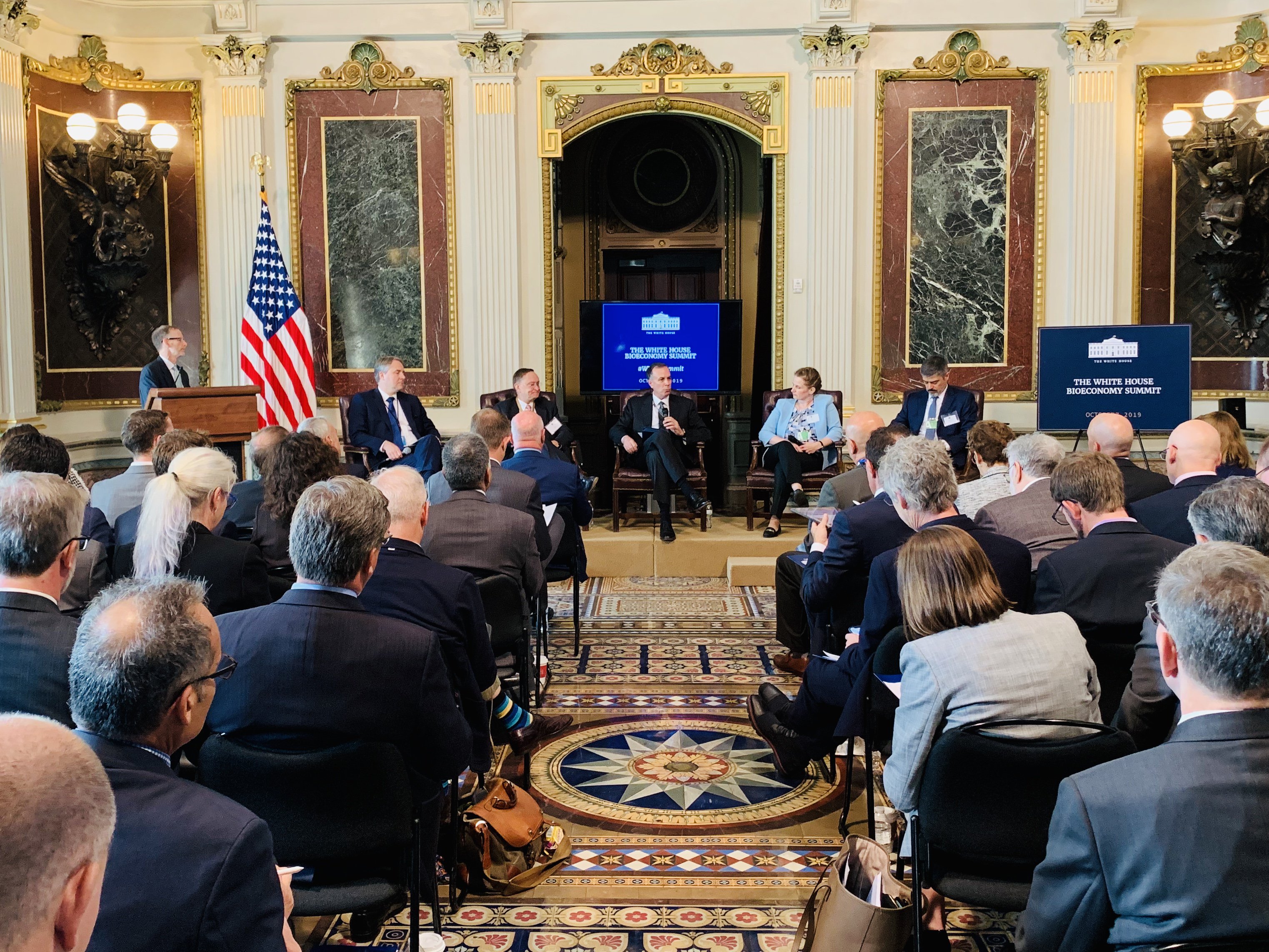
Biotech experts gather for White House summit

White House summit
Federal officials discuss America’s bioeconomy during a White House summit. (OSTP Photo via Twitter)

More than 100 biotech researchers, industry executives and government officials met at the White House today for a summit focusing on America’s bioeconomy — the range of products, services and data derived from biological processes and bioscience research.

“The bioeconomy is already an integral part of the general economy,” White House chief technology officer Michael Kratsios told the attendees. “In 2017, revenues from engineered biological systems reached nearly $400 billion.”

He cited figures from SynBioBeta suggesting that the private sector alone invested more than $3.7 billion in early-stage biological engineering and manufacturing tech companies during 2018.

“But we are not only here because of what biotechnology has done — we are invested in what biotechnology is going to do,” Kratsios said.

Get the full story on GeekWire.

Categories
GeekWire

U.S. officials seek advice on quantum computing

Quantum computer component
Components for IBM’s quantum computer are on display at a science conference in Lausanne, Switzerland. (GeekWire Photo / Alan Boyle)

The U.S. Department of Energy is looking for experts to guide the White House and federal agencies through the weird world of quantum information science.

Today’s solicitation seeks nominations to the National Quantum Initiative Advisory Committee, a panel that gets its mandate from legislation that President Donald Trump signed into law last December.

In addition to calling for the establishment of the advisory committee, the National Quantum Initiative Act sets aside $1.2 billion over five years to support research, development and workforce training relating to quantum information science.

Get the full story on GeekWire.

Categories
GeekWire

White House lists space among R&D priorities

Peregrine lander
By 2021, Astrobotic’s Peregrine lander should be ready to go to the lunar surface. Space exploration and commercialization are listed as priorities for federally backed R&D. (Astrobotic Illustration)

Congress hasn’t yet approved a federal budget for the fiscal year that starts next month, but the White House is already setting an agenda for research and development in 2021.

Hypersonic weapons, artificial intelligence, quantum computing, nuclear energy research and missions to the moon are among the priorities listed in a memo sent out to federal agencies last week by White House science adviser Kelvin Droegemeier and acting budget director Russell Vought.

Get the full story on GeekWire.

Categories
GeekWire

How Jay Inslee moved the ball on the climate issue

Washington Gov. Jay Inslee talks with Marsha Maus, a resident of Agoura Hills, Calif., during a visit to the site of the Woolsey Fire, which Inslee said “was made worse by climate change.” (Jay Inslee Photo via Twitter)

Jay Inslee may be out of the presidential race, but he’s not out of the minds of climate policy campaigners.

The two-term Washington state governor won high praise from his Democratic rivals as well as experts on global climate change after he acknowledged on Aug. 21 that he would not be “carrying the ball” in the presidential campaign, largely due to his failure to attract sufficient support in political polls.

One of Inslee’s problems on the campaign trail was that he didn’t have a “unique selling proposition” for his climate policy initiatives, said Aseem Prakash, founding director of the University of Washington’s Center for Environmental Politics.

He said Inslee’s clarion call on climate was “pioneering” – but easily co-opted by other candidates. “So, in some sense, Jay Inslee is a victim of his own success,” Prakash said.

Get the full story on GeekWire.