Retired astronaut Al Worden, who was once called the “loneliest human being” because of his role as Apollo 15’s command module pilot in 1971, died in his sleep in Houston on March 17 at the age of 88, his family announced.
 Cosmic Log
Retired astronaut Al Worden, who was once called the “loneliest human being” because of his role as Apollo 15’s command module pilot in 1971, died in his sleep in Houston on March 17 at the age of 88, his family announced.

King County now has three landmarks that are out of this world. Literally.
Tonight, the King County Landmarks Commission unanimously approved historic landmark designation for the Boeing-built rovers that were left behind on the moon by the Apollo 15, 16 and 17 missions nearly a half-century ago.
The landmark decision, delivered during a meeting in Kent, Wash., came in response to a request from Kent city officials and the Kent Downtown Partnership. Why Kent? That’s where the Boeing assembled and tested the lunar rovers.
“Above all, the designation for the City of Kent acts as a reminder of the dedicated engineers who changed history through the creation of the Lunar Roving Vehicles 50 years ago,” Kent Mayor Dana Ralph said in a statement. “The momentous recognition for Kent Valley allows for continued education and remembrance of the tangible impact these vehicles have had on space exploration indefinitely.”
The next step will be to win landmark recognition from Washington state and get the rovers added to the Washington Heritage Register.

Fifty years after Apollo 11’s moonwalkers took one giant leap for humanity, luminaries including President Donald Trump and Amazon CEO Jeff Bezos — the world’s richest individual — paid tribute to the achievement and looked forward to the future of spaceflight.
Today’s observances were about more than memories: There were also fresh questions about where that future might lead — plus a Russian rocket launch that resonated with references to the U.S.-Soviet space race of the 1960s.
The marquee observance on today’s anniversary of the landing on July 20, 1969, came at NASA’s Kennedy Space Center, where Vice President Mike Pence invoked the legacy of the Apollo program and hailed NASA’s initiative to send astronauts to the moon once again by 2024.

This episode of the GeekWire Podcast is part of the Destination Moon podcrawl, organized by Seattle’s Museum of Flight.
Fifty years ago, it took a special kind of person to work in NASA’s Apollo Mission Control: Take Gerry Griffin and Milt Windler, for example.
Both men got their degrees in aeronautical engineering and became jet fighter pilots — but when NASA needed flight controllers for the space race against the Soviets, they answered the call and traded their cockpits for control panels. Both were elevated to flight director roles in the wake of the Apollo 1 fire, which killed three astronauts in 1967. There was one key requirement for the job: winning the approval of Chris Kraft, director of flight operations at Mission Control in Houston.
“Chris Kraft decided he needed more flight directors to make it to Apollo, and in those days, if Chris wanted you to be a flight director, you were a flight director,” Griffin said during a recent stopover at Seattle’s Museum of Flight. “Nowadays you have to go through a certification process. …”
“We probably wouldn’t have made the cut,” Windler joked.

Even after 50 years, it’s still possible to find new angles on one of history’s most widely witnessed events — as this year’s retellings of the Apollo 11 moon saga demonstrate.
The golden anniversary of the historic mission to the lunar surface in July 1969 provides the hook for a new wave of documentaries showing up in movie theaters and on video screens. Perhaps the best-known example is “Apollo 11,” which capitalized on recently rediscovered 70mm film footage from NASA’s vaults as well as 19,000 hours’ worth of audio recordings of Mission Control conversations.
But “Chasing the Moon,” a six-hour documentary series that premieres July 8 on PBS, freshens the Apollo story in different ways. Oscar-nominated filmmaker Robert Stone goes back to the roots of the U.S.-Soviet moon race and brings in perspectives that rarely get a share of the spotlight.

The Apollo 11 Lunar Module Timeline Book that sat between Neil Armstrong and Buzz Aldrin for the moon landing 50 years ago is going up for auction, at a price that’s expected to amount to as much as $9 million — but first, it’s going on display.
Today, for one day only, the ring-bound flight manual is on exhibit inside a glass case at Seattle’s Living Computers Museum + Labs. From Seattle, the book travels on to Palo Alto, Calif., for another one-day preview Thursday at the Pace Gallery. Then it’s off to Christie’s auction house in New York for a showing from July 11 to 17.
Christie’s is featuring the book as the marquee item in a 195-lot auction of space artifacts and memorabilia scheduled for July 18, to coincide with the 50th anniversary of the Apollo 11 moon mission.

Back in 1962, President John F. Kennedy said he chose to have Americans go to the moon not because it was easy, but because it was hard. Today, billionaire Jeff Bezos said it’s still hard — and in some ways, it’s even harder than it was in the ’60s.
Bezos, the world’s richest person by virtue of his status as the founder of Amazon and the Blue Origin space venture, laid out his argument during a discussion with the late president’s daughter, Caroline Kennedy, at the John F. Kennedy Presidential Library and Museum in Boston.
Today’s “JFK Library Space Summit” was a daylong affair that drew luminaries ranging from Apollo 11 astronaut Mike Collins to Boeing CEO Dennis Muilenburg.

Want a little space history in your beer? Or soda pop? Or chocolate? Seattle brands are banding together to mark the 50th anniversary of the Apollo 11 moon landing, with the Museum of Flight leading the charge.
You’ll find a roundup of space-themed products on the museum’s “Summer of Space” website.
For instance, take Elysium Brewing Co.’s Space Dust IPA, one of the Seattle brewery’s standards: This summer, Space Dust bottles will be sporting a series of three Apollo 11 labels celebrating the mission’s liftoff, moonwalk and splashdown in July 1969.
If your tastes run more toward the softer side, check out the collectible Apollo 11 labels that’ll be part of Jones Soda’s 50th-anniversary lineup.
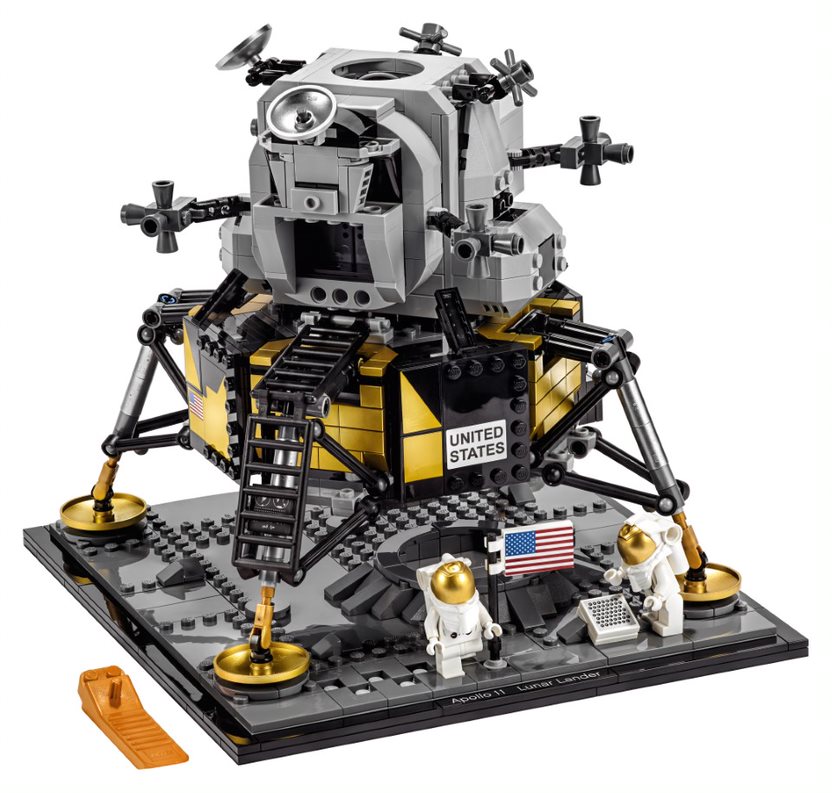
That’s one giant heap of Lego bricks: To celebrate the 50th anniversary of the Apollo 11 moon landing, the Lego Group is unveiling a 1,087-piece building set that recreates the mission’s Eagle lunar module.
The Lego Creator Expert NASA Apollo 11 Lunar Lander model, developed in cooperation with NASA, consists of an ascent stage with a detailed interior, plus a descent stage with a ladder and hatches that open.
Two astronaut minifigures are included in the kit, along with a depiction of the lunar surface complete with a crater, moon footprints and a U.S. flag.
In a news release, the company said the $99.99 set will be exclusively available at Lego stores and via the Lego Shop website beginning June 1.

In the 50 years since Apollo 11 astronaut Neil Armstrong left humanity’s first bootprint on the moon, that “one small step” has launched one giant load of books.
Basketfuls of books about space are now hitting store shelves — not only to mark the golden anniversary of that first moon landing, but also to provide the context for a renewed focus on lunar exploration.
Whether you’re looking for an Apollo book you can read to your kids, an award-winning sci-fi novel about alternate space history, or up-to-date management tips gleaned from the early space effort, we’ve got you covered. Here are 18 recently published (or updated) books that are well-suited for this year’s summer of space, plus a couple of bonus picks.