Mark Armstrong, one of the sons of Apollo 11 commander Neil Armstrong, checks out the spaceship that his father rode to the moon at the Museum of Flight’s “Destination Moon” exhibit. (GeekWire Photo / Alan Boyle)
“Destination Moon,” the traveling exhibit making its debut at Seattle’s Museum of Flight this month, puts some of the greatest treasures of the Space Race on display. But if you know where to look, you’ll also spot little treasures that shed light on the life of Apollo 11 commander Neil Armstrong.
Lisa Young, conservator at the Smithsonian Institution’s National Air and Space Museum, adjusts the gloves that Apollo astronaut Buzz Aldrin wore on the moon, on display as part of the “Destination Moon” exhibit at Seattle’s Museum of Flight. Aldrin’s helmet and visor can be seen on display, and in the famous moon picture seen in the background at left. (Museum of Flight Photo)
The countdown is on for the 50th anniversary of the Apollo 11 moon landing, and that means the appointment books for space luminaries and their fans are filling up like the propellant tanks on a Saturn V rocket.
Seattle’s Museum of Flight is one of the epicenters for the festivities, thanks to its status as the next stopover for the Smithsonian Institution’s traveling “Destination Moon” exhibit. Due to a remodeling project at the National Air and Space Museum, some of the choicest Apollo artifacts are going on the road. The Museum of Flight will be hosting the exhibit starting next month and running all the way through the July 20 anniversary into the Labor Day weekend.
Just this week, curators worked in a sealed-off section of the museum to get the helmet and the gloves worn by Apollo 11 astronaut Buzz Aldrin ready for the exhibit. A magnifying glass was positioned near the cuff of a glove to give museumgoers a close look at the checklist of tasks Aldrin was given for his moonwalk. The checklist reminded him about an important chore: taking a picture of a bootprint.
“Destination Moon” officially opens on April 13, but VIPs will get sneak peeks starting a couple of weeks before that date. There’s a luncheon for museum members on March 30, featuring talks by Apollo flight directors Glynn Lunney, Gerry Griffin and Milt Windler. A members-only preview of the exhibit is planned for April 6.
Vice President Mike Pence and NASA Administrator Jim Bridenstine set a memorial wreath among the gravestones for the astronauts who died in the Apollo 1 fire of 1967, with former NASA administrators, family members and other VIPs surrounding them at Arlington National Cemetery. (NASA / White House Photo)
NASA highlighted the legacy of astronauts lost in tragic missions including 1967’s Apollo 1, the shuttle Challenger’s launch in 1986 and the shuttle Columbia’s breakup in 2003 today — a week later than originally planned due to the partial government shutdown.
The observance was postponed because NASA had to forgo non-essential activities during the 35-day hiatus in funding. A deal was struck to end the shutdown on Jan. 25, but by then NASA had already decided to reschedule. Now another shutdown deadline is looming on Feb. 15.
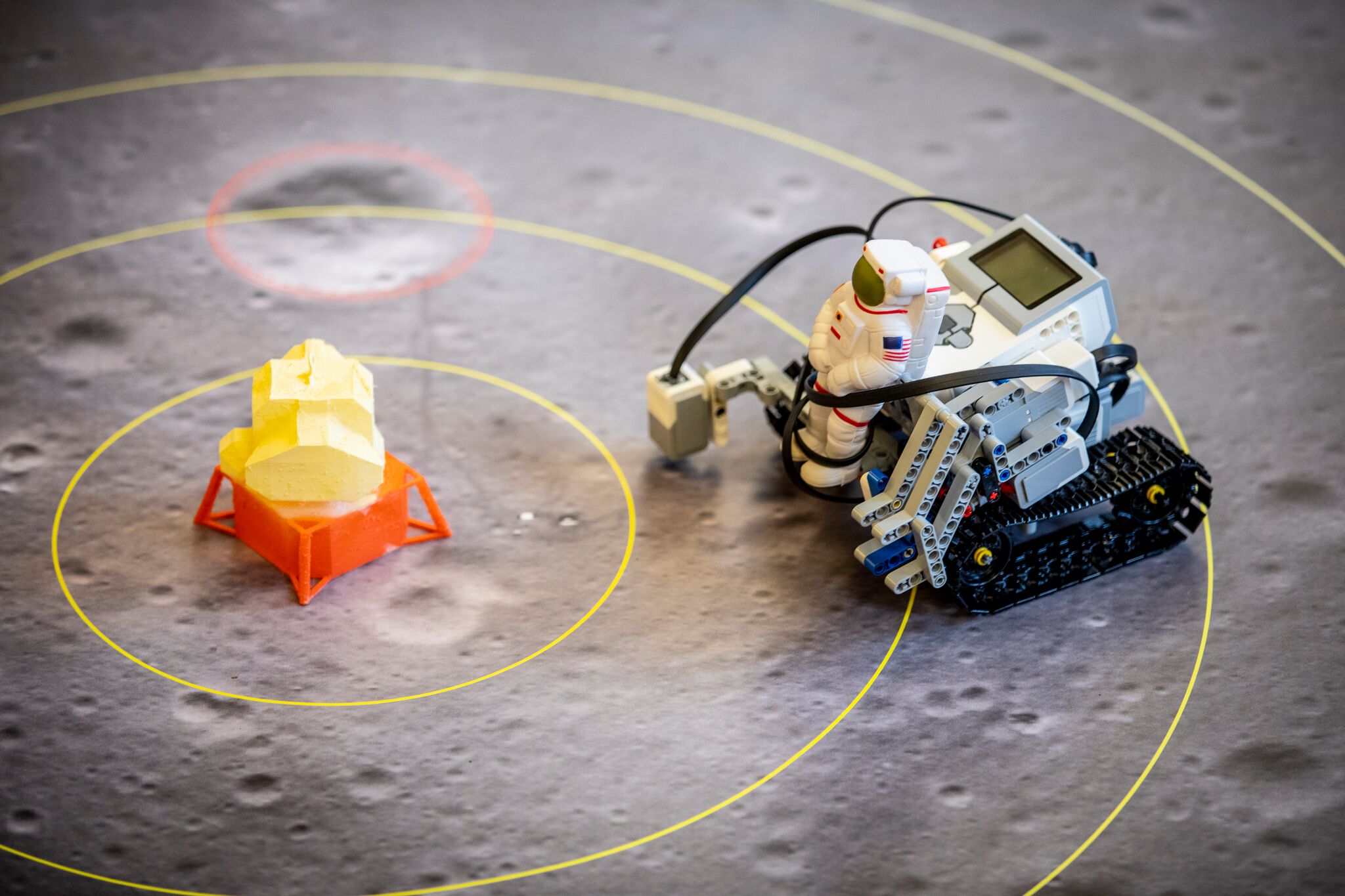
A Lego Mindstorms robot, with a plastic astronaut strapped to the front, approaches a toy lunar lander during an Apollo moon mission re-enactment. (University of Washington Photo / Dennis Wise)
Fifty years after the first Apollo moon landing, students from across the country will get a chance to re-enact the feat with drones and robots, thanks to an educational challenge orchestrated by NASA and the University of Washington’s Northwest Earth and Space Sciences Pipeline.
The event — known as the Apollo 50 Next Giant Leap Student Challenge, or ANGLeS Challenge for short — got its official kickoff today at Kent-Meridian High School in Kent, Wash.
“This is a truly interdisciplinary challenge, involving computer programming, robotics, remote sensing and design,” Robert Winglee, who’s the director of the Northwest Earth and Space Sciences Pipeline as well as a UW professor of Earth and space sciences, said in a news release.
Apollo 8’s astronauts were the first to witness Earthrise from lunar orbit, on Christmas Eve in 1968. (NASA Photo / Bill Anders)
It’s been 50 years to the day since Apollo 8 astronaut Bill Anders’ “Earthrise” photo changed our world forever, but that mission to the moon and back wouldn’t have happened the way it did if it weren’t for a giant leap in technology.
That comes through loud and clear in “Apollo’s Daring Mission,” a NOVA documentary making its debut on public television on Wednesday.
“NASA usually went step-by-step. In this case, they jumped three or four steps,” the 85-year-old Anders, who now lives in Anacortes, Wash., says during the show.
The Apollo 8 story usually spotlights the impact of Anders’ photos, which show our planet hanging over the moon’s surface, and the magic of the crew’s Christmas Eve reading from Genesis. Those moments get their due in “Apollo’s Daring Mission.” But the show focuses primarily on the engineering magic that opened the way for history to be made in 1968.
NASA astronaut Harrison Schmitt stands next to the U.S. flag on the moon with Earth hanging in the black sky above during the Apollo 17 mission in 1972. (NASA Photo)
WASHINGTON, D.C. — An American rivalry with China could stoke a new space race in the years ahead, prominent members of the space community said at a session marking the 50th anniversary of NASA’s Apollo missions.
But it may not play out the way the U.S.-Soviet space race did, said Scott Pace, executive secretary for the White House’s National Space Council. Billionaire-backed space efforts such as Elon Musk’s SpaceX and Amazon founder Jeff Bezos’ Blue Origin could play a leading role, he said.
“China has billionaires, too,” Pace said today at the ScienceWriters 2018 conference, held at George Washington University. “China has a growing commercial space sector that is not simply People’s Liberation Army guys in new suits, but a commercial industry also emerging out there. And so they are not merely national security competitors, but they’re also potential commercial competitors — as China is in many other areas.”
Ryan Gosling plays the role of NASA astronaut Neil Armstrong in “First Man.” (Universal Pictures Photo)
Two big-name dramatic productions — “First Man” in theaters, and “The First” on Hulu — are putting the glorious past and potentially glorious future of space exploration on big and small screens.
But if you’re expecting the Ryan Gosling movie about Neil Armstrong, or the Sean Penn streaming-video series about the first mission to Mars, to tell a geeky off-world tale like “The Martian” … expect to be surprised.
Astronaut Buzz Aldrin salutes the U.S. flag during 1969’s Apollo 11 moon mission. (NASA Photo)
Forty-nine years ago today, humans first set foot on a world beyond Earth — and by the time the 50th anniversary of the Apollo 11 lunar landing rolls around, a year from now, there’s likely to be more moon milestones to celebrate.
Today NASA’s myriad Twitter accounts are buzzing with #NationalMoonDay shout-outs, and the space agency’s website is filled with links to Apollo 11 lore.
You can bet next year’s #Apollo50 observances will take on a far higher profile. Even Seattle’s Museum of Flight is getting in on the action: Apollo 11 artifacts on loan from the Smithsonian, including the Columbia command module, will be on display starting next April and running through the 50th anniversary.
But the year ahead isn’t just about past glories: We’re due to see a ramping-up of missions to the moon, in part because of the Trump administration’s initiative aimed at lunar exploration and settlement.
“Women of NASA” Lego toys are arrayed in front of Blue Origin’s New Shepard crew capsule. (Blue Origin)
The first American woman in space, Sally Ride, is the subject of serious and playful memorials today, 35 years after her historic flight and nearly six years after her death.
Blue Origin, the space venture founded by Amazon millionaire Jeff Bezos, marked today’s anniversary by showing off a Lego set that flew to space and back on the company’s New Shepard suborbital spaceship.
Astronaut Alan Bean poses for a portrait in front of a mockup of NASA’s lunar module in advance of his Apollo 12 moon mission in 1969. (NASA Photo)
Artist-astronaut Alan Bean, the moonwalker who saw himself as different from the rest, died today at the age of 86 at Houston Medical Hospital.
Bean’s death followed a sudden illness that befell him two weeks earlier during a trip to Fort Wayne, Ind., for a school fundraising event.
He became the fourth human to walk on the moon during the Apollo 12 mission in November 1969, exploring Oceanus Procellarum alongside the late astronaut Pete Conrad. Bean also commanded the second crewed flight to Skylab, America’s first space station, in 1973.
“Alan was the strongest and kindest man I ever knew. He was the love of my life, and I miss him dearly,” Leslie Bean, his wife of 40 years, said in a statement released by NASA and the Astronaut Scholarship Foundation. “A native Texan, Alan died peacefully in Houston surrounded by those who loved him.”