Mark this down for later: Tech billionaire Elon Musk says the Boring Company could begin work on the express tunnel linking downtown Chicago and O’Hare International Airport in three to four months, and have it finished in three years. Musk, who’s famous for overly optimistic timelines, laid out that plan today as he stood alongside Chicago Mayor Rahm Emanuel to announce the deal at a news conference in the unfinished Block 37 transit superstation.
Kittyhawk’s Web-based dashboard gives drone users an overview on operations. (Kittyhawk Graphic)
Boeing says its HorizonX venture capital arm is investing in Kittyhawk, a San Francisco startup that provides end-to-end software solutions for autonomous drone operations.
The investment is part of a $5 million seed round that was led by Bonfire Ventures with participation by Boeing HorizonX Ventures as well as Freestyle Capital and Kluz Ventures’ The Flying Object. Boeing didn’t disclose precisely how much it contributed to the round.
Boeing says Kittyhawk’s software will support the development of a traffic management system that allows piloted and autonomous vehicles to coexist safely.
Washington Gov. Jay Inslee is surrounded by aerospace industry and labor representatives as he talks about a new report on the state’s competitiveness at South Seattle College. (GeekWire Photo / Alan Boyle)
Boeing hasn’t yet declared whether it will build a new breed of midsize passenger jet — variously known as the New Mid-Market Airplane, NMA or 797 — but Washington state officials are already arguing they have the best place to build it.
Those groups have an obvious interest in keeping Boeing airplane production in the Evergreen State, but today Washington Gov. Jay Inslee insisted the report is legit.
“If you dig down and look at this research, this is not a puff piece,” Inslee told journalists and VIPs who gathered at South Seattle College’s aviation maintenance technology hangar. “It is a scientifically rigorous evaluation that shows what we know: Washington is the place to build this airplane.”
Tesla CEO Elon Musk speaks to shareholders. (Tesla via YouTube)
Tesla shareholders at today’s annual meeting swatted down challenges to billionaire CEO Elon Musk, who laid out an admittedly optimistic plan for the crucial months ahead.
“This is going to sound maybe a little cheesy, but at Tesla, we build our cars with love,” an emotional Musk told the crowd at the Computer History Museum in Mountain View, Calif. “We really care.”
He contrasted the dedication of the Tesla team with what he said was the typical mindset in the auto industry. “At a lot of other companies, they’re built by the marketing department and the finance department. There’s no soul, you know?” Musk said.
Musk acknowledged that the team has faced a lot of “incredible headwinds” in the course of manufacturing electric cars, battery storage systems and solar panels.
The tail section of a FedEx 777 Freighter ecoDemonstrator flight-test airplane has been opened to reveal its auxiliary power unit, which contains a 3-D-printed titanium part. (Boeing Photo / Paul McElroy)
Boeing and Safran have set up a joint venture to design, build and service auxiliary power units for airplanes, marking another big step in Boeing’s drive to build a more integrated supply chain.
“This strategic partnership will leverage Boeing’s deep customer and airplane knowledge along with Safran’s experience in designing and producing complex propulsion assemblies to deliver expanded, innovative services solutions to our customers,” Stan Deal, president and CEO of Boeing Global Services, said today in a news release.
News about the 50-50 joint venture comes a little more than a month after Boeing announced a $4.25 billion deal to acquire KLX Inc., a Florida-based aerospace parts distributor.
Both moves are in line with Boeing’s strategy to grow aviation services into a business that contributes $50 billion annually to the company’s bottom line. They also show that Boeing is willing to move away from traditional supply-chain models.
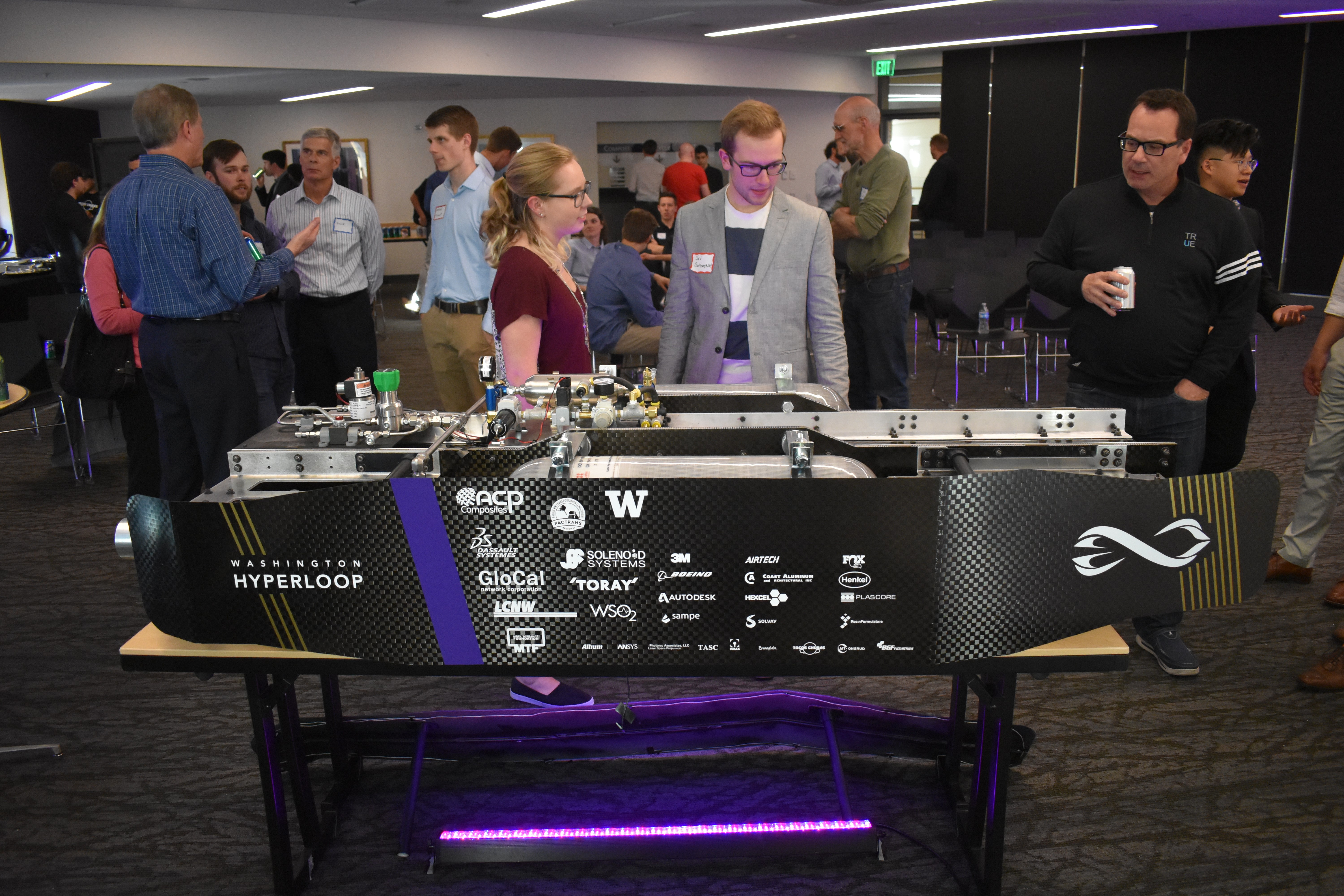
Courtney Klein, Washington Hyperloop team member Sev Sandomirsky and Marc Lemire take a look at the pod racer during its unveiling at the University of Washington. (GeekWire Photo / Alan Boyle)
The Washington Hyperloop team is counting on the third time being the charm.
But it’s not just a question of superstitious sayings: For SpaceX’s third university Hyperloop competition, the three dozen student engineers and entrepreneurs on the University of Washington’s pod-racing team have reworked the design for their vehicle from the ground up.
“Everything on this pod has been redesigned, manufactured,” said team co-leader Nicole Lambert, a junior who’s majoring in mechanical engineering. “It’s a completely new pod from the last two years.”
The pod racer had its formal unveiling at UW on June 1. It’ll be put to the ultimate test next month, when SpaceX hosts a series of practice runs and races inside a mile-long enclosed test track next to the company’s headquarters in Hawthorne, Calif.
Zunum Aero says its first hybrid-to-electric airplanes will wear the colors of JetSuite, a private aviation company that’s a partner of JetBlue Airways.
Kirkland, Wash.-based Zunum Aero, which has financial backing from JetBlue Technology Ventures as well as Boeing HorizonX and the State of Washington Clean Energy Fund, aims to start flight tests in 2019 and deliver its first regional-class plane in 2022.
Eventually, California-based JetSuite plans to add 100 of Zunum’s planes to its fleet, the two companies said today in a news release.
Elon Musk and Boring Company project leader Steve Davis talk about tunnels at Leo Baeck Temple in Los Angeles. (Boring Company Photo / Kevin Mills)
If billionaire Elon Musk’s tunnel vision comes to pass, travelers will be able to zip beneath Los Angeles through an underground Loop system at 150 mph for about $1 a ride.
That’s the promise of the Boring Company in a nutshell. During a Thursday night session that lasted nearly an hour, Musk and the Boring Company’s project leader, Steve Davis, laid out their case for building a network of tunnels 30 feet or more beneath Los Angeles, starting with a 2.7-mile “proof of concept” dig.
Musk’s aim is to get around the “soul-destroying traffic” that afflicts L.A. and other big cities, by building as many tunnels as needed to accommodate underground transit on fast-moving pods. Priority would be given to passengers and bicyclists, but cars could be lowered from the streets into subterranean superhighways as well.
An artist’s conception shows a pod heading for Los Angeles International Airport through a Boring Company transit tunnel. (Boring Company Illustration)
Billionaire Elon Musk is talking up his tunnel-boring vision at a public forum in Los Angeles tonight, and hinting that the Boring Company’s Hyperloop system could eventually whisk travelers to sea-based spaceports.
But first, the Boring Company has to clear away logistical, legal and regulatory roadblocks — which is part of Musk’s agenda for his 7 p.m. PT presentation at Leo Baeck Temple in L.A. The Boring Company says the forum will be live-streamed via its website.
APiJET CEO John Schramm shows how parameters from an airplane’s data stream, including the startup of the jet’s engines, can be displayed on a Smart Aircraft dashboard. (GeekWire Photo / Alan Boyle)
Seattle’s Aviation Partners and iJet Technologies have joined forces in a software-as-a-service venture called APiJET, which is aimed at making airplanes smarter — and producing significant savings for airlines in the process.
How significant? Joe Clark, founder and CEO of Aviation Partners Inc., said the Smart Aircraft system could cut the cost of operating an airplane by 10 percent or more.
“The airlines know that we don’t get involved in something unless we think it’s really good. … I see the traction happening very quickly,” he told reporters at Aviation Partners’ Boeing Field headquarters.
The first customer is low-cost carrier Icelandair, which has been been using APiJET’s data service since the end of 2017. It’s installed on all of the airline’s 757s and 767s.