Categories
GeekWire

New Horizons does a far-out parallax experiment

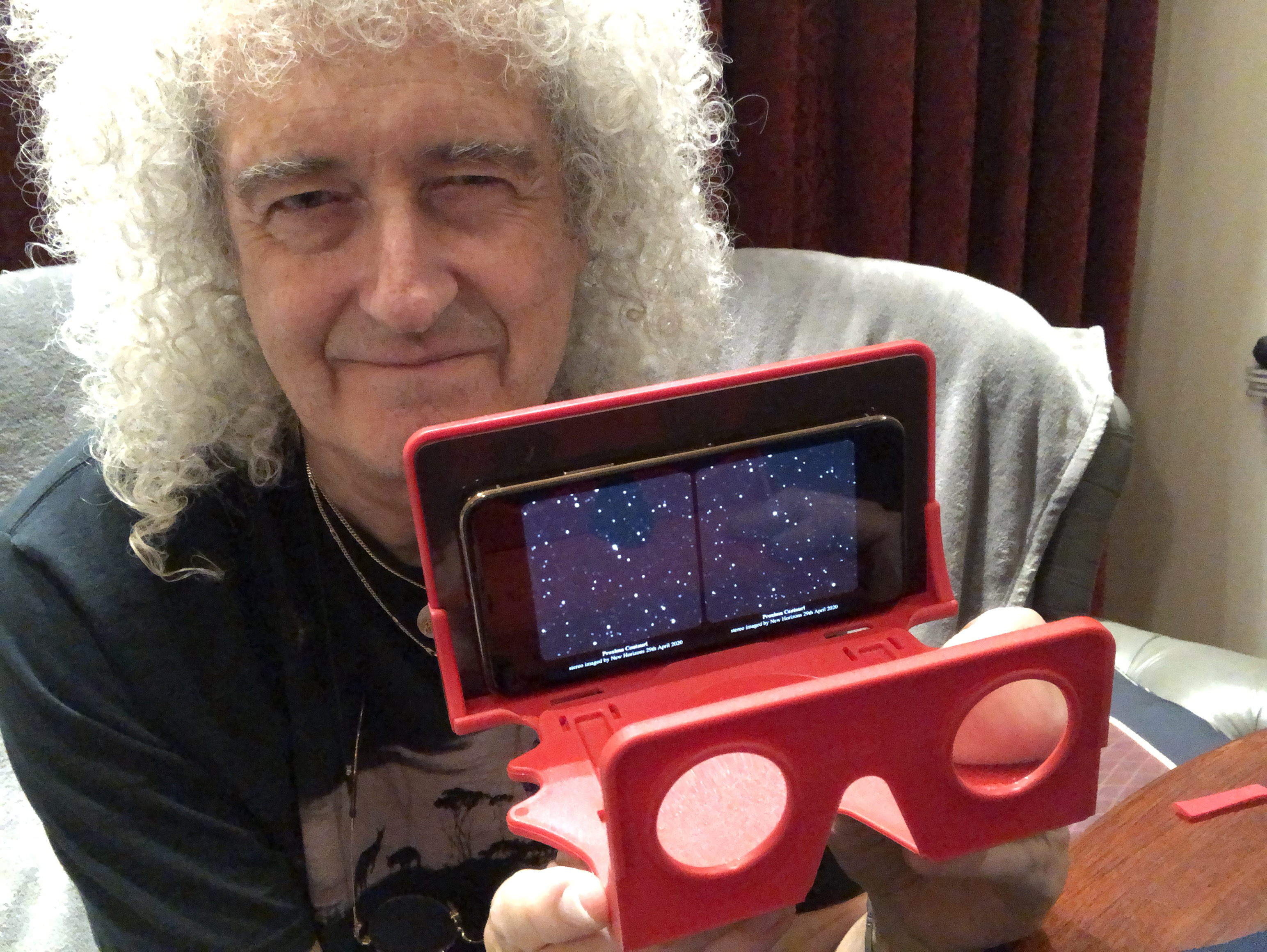
Brian May with OWL viewer
Queen guitarist (and astrophysicist) Brian May, a member of the New Horizons science team, uses his patented OWL viewer to check out the stereo images of Proxima Centauri that he created by combining pictures from Earth-based telescopes and the New Horizons spacecraft. (Photo courtesy of Brian May, via New Horizons / JHUAPL / SwRI / NASA)

NASA’s New Horizons probe has measured the distance to nearby stars using a technique that’s as old as the ancient mariners, but from a vantage point those mariners could only dream of.

The experiment, conducted on April 22-23 as the spacecraft zoomed 4.3 billion miles out from Earth, produced the farthest-out parallax observations ever made.

“It’s fair to say that New Horizons is looking at an alien sky, unlike what we see from Earth,” principal investigator Alan Stern, a planetary scientist at the Southwest Research Institute, said today in a news release. “And that has allowed us to do something that had never been accomplished before — to see the nearest stars visibly displaced on the sky from the positions we see them on Earth.”

Get the full story on GeekWire.

Categories
GeekWire

How genomics can revolutionize public health

Coronavirus evolutionary tree
A phylogenetic tree tracks the evolution of SARS-CoV-2, the virus that causes COVID-19, as it spread throughout the United States. An orange dot at lower left indicates WA-1, the first confirmed case in the U.S., which was detected in Washington state. (Nextstrain / GISAID Graphic)

From the early days of the coronavirus pandemic, genetic sleuths have been at the forefront in the global effort to monitor SARS-CoV-2, the virus that causes COVID-19. By comparing the molecular fingerprints of different virus samples collected in Washington state, they were able to track down the first signs of community spread in the U.S.

In a paper published today by Nature Medicine, some of the pioneers of genomic epidemiology have laid out a 10-point plan for creating a well-supported scientific ecosystem — not only to fight COVID-19, but to head off future pandemics as well.

Get the full story on GeekWire.

Categories
GeekWire

Adaptive joins Microsoft to track virus-fighting cells

Seattle-based Adaptive Biotechnologies and Microsoft have launched an open-access database called ImmuneCODE to catalog the many ways in which our immune systems fight off a coronavirus infection.

Get the news brief on GeekWire.

Categories
GeekWire

WiBotic raises $5.7M for wireless charging systems

Robot and WiBotic charger
WiBotic’s system is designed to charge up robots wirelessly. (WiBotic Photo)

Seattle-based Wibotic says it’s secured $5.7 million in fresh investment to ramp up development of its wireless charging and power optimization systems, five years after being spun out from the University of Washington.

“We’re heading into our toddler phase here,” WiBotic CEO Ben Waters joked during an interview with GeekWire.

Investors in the Series A funding round include Junson Capital, SV Tech Ventures, Rolling Bay Ventures, Aves Capital, The W Fund and WRF. The latest round brings WiBotic’s total investment to nearly $9 million.

Get the full story on GeekWire.

Categories
GeekWire

Astrobotic will deliver VIPER rover to the moon

NASA has awarded a $199.5 million contract to Pittsburgh-based Astrobotic to deliver its VIPER rover to the moon’s south pole in 2023, marking one more not-so-small step for the commercialization of lunar exploration.

Get the news brief on GeekWire.

Categories
GeekWire

Boeing teams up with Varjo on Starliner VR

Boeing's Connie Miller with VR headset
Boeing software engineer Connie Miller tries out the Varjo virtual-reality system to control a computer-generated Starliner space taxi. (Varjo / Boeing Photo)

Boeing isn’t due to start flying NASA crews to the International Space Station until next year, but in the meantime, astronauts can steer a computer-generated Starliner space taxi with the aid of Varjo’s virtual-reality headsets.

Get the news brief on GeekWire.

Categories
GeekWire

SCAN resumes COVID-19 tests after resolving snag

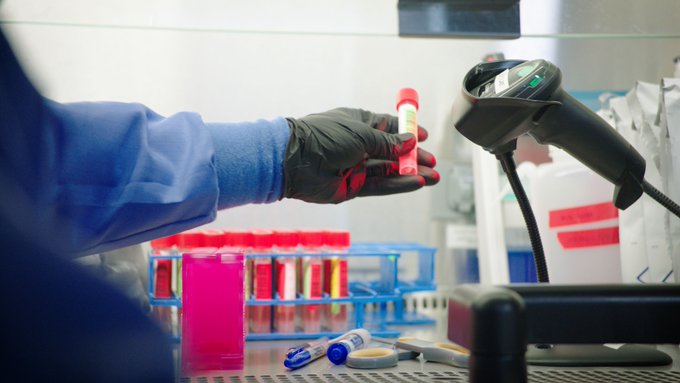
Test in lab
The Seattle Coronavirus Assessment Network says that it’s resuming sample collection after resolving a regulatory snag. (Public Health – Seattle & King County via Twitter)

The Seattle Coronavirus Assessment Network today resumed its at-home COVID-19 testing campaign, nearly a month after the program was suspended due to regulatory snags.

Public Health – Seattle & King County announced that the research study could go forward with the approval of an institutional review board and oversight by the University of Washington, Seattle Children’s and the Fred Hutchinson Cancer Center.

“SCAN continues to provide an important and unique window into the COVID-19 outbreak across King County, and in its next phase will also help us expand access to testing for at-risk groups,” Jeff Duchin, health officer for Public Health – Seattle & King County, said in a blog posting. “This data can inform public health decisions in the weeks and months to come as King County takes steps to increase activities and get back to work.”

Winning the review board’s approval cleared up an issue that led SCAN’s organizers to put the project on pause on May 12.

Get the full story on GeekWire.

Categories
GeekWire

Boeing CEO will ‘turn up the volume’ to fight racism

David Calhoun
Boeing CEO David Calhoun gives a talk at Virginia Tech, his alma mater, in 2018. (Virginia Tech Photo)

In a letter sent to employees today, Boeing CEO Dave Calhoun pledged to “turn up the volume on dialogue” about diversity and inclusion — and said the company would boost its support for marginalized communities.

Get the news brief on GeekWire.

Categories
GeekWire

Virus forecasts converge, but will there be a surge?

COVID-19 deaths
This chart shows the daily COVID-19 death count in the U.S. as a dark red line, with the rolling average as a dotted line, up to the present. Looking ahead, the projection from the Institute for Health Metrics and Evaluation calls for a steady decline (light red dotted line), while the projection from data scientist Youyang Gu calls for a slight increase in daily deaths (dark red dotted line). Both projections see the rate largely stabilizing in August. IHME’s model calls for a plateau at about 550 deaths per day, while Youyang Gu’s model builds to a peak of more than 900 daily deaths. (IHME / COVID19-projections. com)

Dueling projections for the course of the COVID-19 pandemic are converging on a narrower range of estimates for this summer, as expected, but the longer-term outlook doesn’t call for coronavirus infections to fade away quickly.

Get the news brief on GeekWire.

Categories
GeekWire

Tethers Unlimited to support sun-watching mission

PUNCH mission
Four microsatellites will study how the sun’s outer atmosphere, or corona, imparts energy and mass to the solar wind during NASA’s PUNCH mission. (SwRI Illustration)

Bothell, Wash.-based Tethers Unlimited says it will provide key communications and propulsion capabilities to Southwest Research Institute in support of a NASA mission to study how the sun’s corona whips up the solar wind.

Tethers Unlimited’s SWIFT-XTS software-defined radio will be used for telemetry and control of the four suitcase-sized microsatellites that will conduct a mission known as PUNCH (Polarimeter to Unify the Corona and Heliosphere). And the company’s HYDROS-C water-electrolysis thruster will serve as the satellites’ propulsion system.

Last year NASA selected Southwest Research Institute, which has centers in Colorado and Texas, to lead the mission.

“Procuring these complete spacecraft subsystems ‘off-the-rack’ is critical to the PUNCH science,” Craig DeForest, a solar scientist at SwRI who serves as the mission’s principal investigator, said today in a news release. “The growing commercial ecosystem for space enables a constellation of four separate high-capability spacecraft, within the cost of a single traditionally-built satellite.”

The satellites will orbit Earth in formation to study how the corona, which serves as the sun’s outer atmosphere, infuses the solar wind with mass and energy. PUNCH’s satellites are due for launch as early as 2022.

Get the full story on GeekWire.