Categories
GeekWire

Allen Institute gives a boost to cell researchers

Samantha Morris in lab
Biomedical researcher Samantha Morris, shown here in her lab at Washington University School of Medicine in St. Louis, is one of the newly named Allen Distinguished Investigators. ““This award is enabling us to take a big risk in our arena by generating a completely new technology, one which will be useful to the scientific community. That’s really exciting for us,” she said. (Washington University in St. Louis Photo)

The Paul G. Allen Frontiers Group, a division of Seattle’s Allen Institute, is making a total of $7.5 million in awards to its latest class of five biomedical researchers.

The themes for this year’s Allen Distinguished Investigators focus on stem cell therapies and single-cell interactions in their native environments.

“The field of stem cell biology has the potential to change how we treat diseases by helping precision medicine, and there’s so much we still don’t understand about the interplay between cells in living tissues or organs,” Kathy Richmond, director of the Frontiers Group, said today in a news release.

“Our 2019 Allen Distinguished Investigators are pushing their fields in these two areas, through new technology development, probing pivotal interactions in the body that cause health to fail, and generating creative new stem cell models that will improve our understanding of different human diseases,” she said.
Get the full story on GeekWire.

Categories
GeekWire

Allen Institute maps out ‘org chart’ for brain

Allen Institute researchers
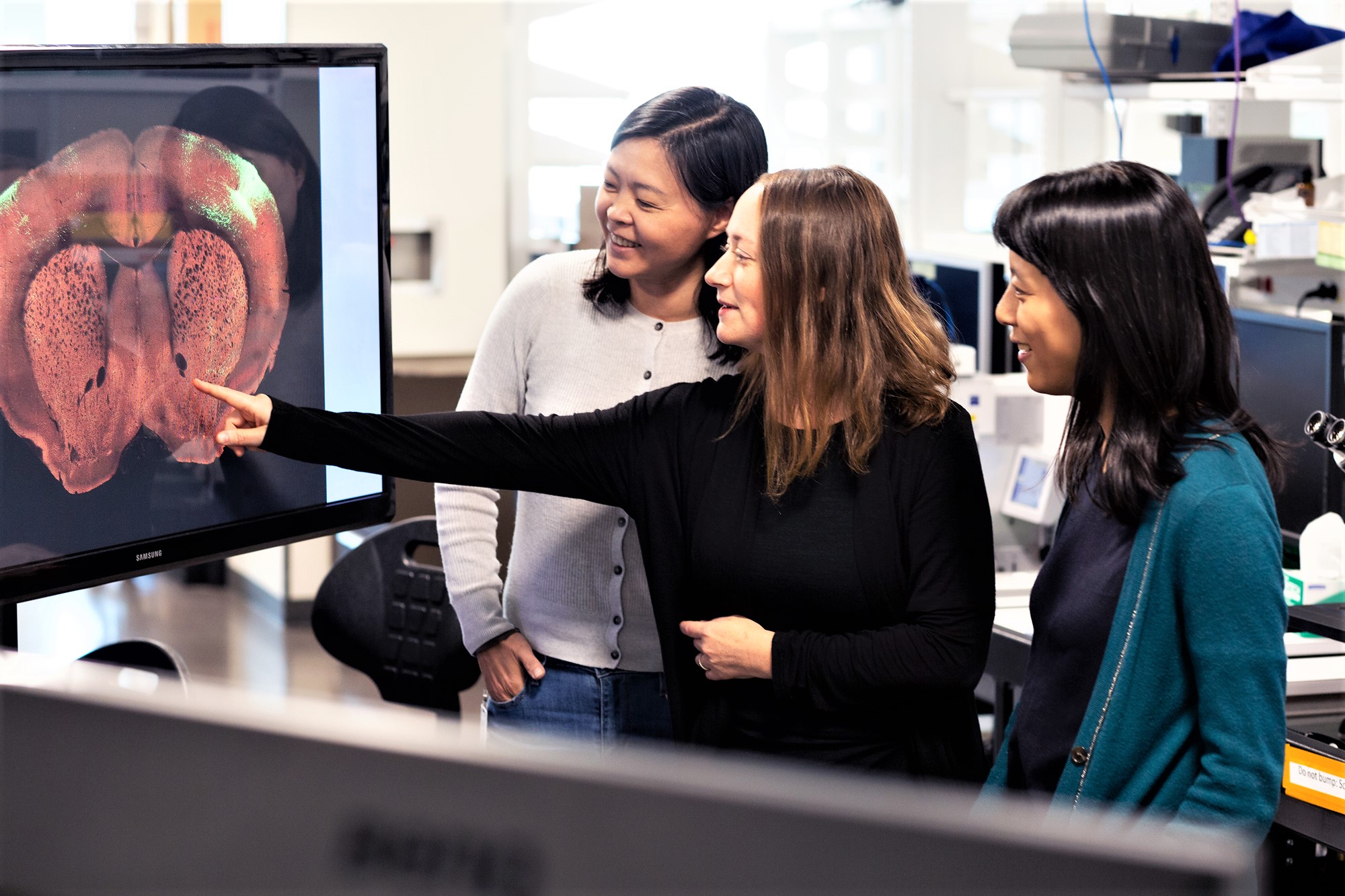
Researchers Hongkui Zeng, Julie Harris and Hannah Choi check out a brain connectivity image at the Allen Institute for Brain Science. (Allen Institute Photo)

Researchers at Seattle’s Allen Institute say a new and improved map of the mouse brain reveals not only how different regions are connected, but how those connections are ordered in a hierarchical way.

They add that the mapping techniques behind their study, which was published today by the journal Nature, could shed light on how diseases like Alzheimer’s, Parkinson’s or schizophrenia tangle up connections in the human brain.

The map produced by the study is technically known as a medium-scale “connectome.” It’s been variously compared to a wiring diagram, organizational chart or subway map for the brain. An initial version of the map was published five years ago — and at the time, it was hailed as a landmark for brain science.

Like that earlier version of the Allen Mouse Brain Connectivity Atlas, the newly published map was created by injecting glow-in-the-dark viruses into the brains of mice, and then tracking how brain impulses lit up different types of brain cells.

Get the full story on GeekWire.

Categories
GeekWire

Semantic Scholar takes in the full sweep of science

Semantic Scholar screengrab
The Allen Institute for Artificial Intelligence’s academic search engine, Semantic Scholar, keeps track of more than 175 million research papers from all fields of science. (Semantic Scholar Graphic)

Seattle’s Allen Institute for Artificial Intelligence says its academic search engine, Semantic Scholar, is now in high gear — thanks to a power boost from Microsoft that helped expand its reach to every field of science.

Over the course of just a few months, Semantic Scholar’s database has gone from indexing 40 million research papers in computer science and biomedicine to taking in more than 175 million papers. The database not only covers the time-honored physical sciences, but also political science and sociology, art and philosophy.

“That’s enabled us to take the research that we’ve done in making AI a tool for overcoming information overload in science [and turn it into] a tool that is now usable by, essentially all scholars around the world,” Doug Raymond, general manager of Semantic Scholar, told GeekWire.

Get the full story on GeekWire.

Categories
GeekWire

Brain wave recording goes into overdrive

Neuropixels researchers
Severine Durand and Tamina Ramirez, researchers at the Allen Institute for Brain Science, review data collected from mice using the Neuropixels brain-probing system. (Allen Institute Photo)

Seattle’s Allen Institute for Brain Science is sharing 70 trillion bytes’ worth of data documenting electrical activity in mouse brains, collected by a new type of silicon probe that can monitor hundreds of neurons simultaneously.

The Neuropixels system, developed by an international collaboration that includes the Allen Institute, could be adapted to record brain activity in human patients as well, said Josh Siegle, a senior scientist at the institute who works with the probes.

“The application I’m most interested in is decoding the communication patterns of the brain, and really understanding how information is transmitted between regions,” Siegle told GeekWire. “What are the transmission protocols?”

Neuropixels has already produced insights into the brain’s inner workings, Siegle said. This week, the institute is due to publish findings on the BioRxiv preprint server that confirm hierarchical patterns of connectivity in the brain.

Get the full story on GeekWire.

Categories
GeekWire

Supp.AI tracks how drugs and supplements interact

Dietary supplements
The Allen Institute for Artificial Intelligence’s Supp.AI search engine combs through research focusing on interactions involving nutritional supplements as well as drugs. (GeekWire Photo / Alan Boyle

Physicians and regulators keep close tabs on how different drugs interact. But what about interactions involving dietary supplements?

“There’s just no way for anybody to keep up with the combinations of supplements and drugs,” said Deborah Rappaport, vice president of product at InHealth Medical Services. “It’s a huge number.”

Seattle’s Allen Institute for Artificial Intelligence, or AI2, is harnessing the power of its Semantic Scholar academic search engine to make the job easier. Today it unveiled Supp.AI, a searchable database that indexes 4,650 supplements and drugs from Abbokinase to Zytiga, and serves up research findings on more than 56,000 interactions involving those products.

Get the full story on GeekWire.

Categories
GeekWire

SonoSite and AI2 add AI to ultrasound imaging

Ultrasound imaging
Air Force Staff Sgt. Christine Blanco performs an ultrasound examination on a patient in Afghanistan. (Air Force Photo / Justyn M. Freeman)

A new collaboration between Fujifilm SonoSite and the Allen Institute for Artificial Intelligence aims to use AI to generate better interpretations of ultrasound images, opening the way for new applications and enhanced accuracy.

The collaboration demonstrates how Pacific Northwest connections can pay off: Fujifilm SonoSite, a subsidiary of Japan’s Fujifilm that’s headquartered in Bothell, Wash., reached out to the startup incubator at the Seattle-based institute, known as AI2, for advice on improving their compact ultrasound imaging systems.

“The AI2 Incubator was a perfect place to look for help in creating breakthrough technology,” Rich Fabian, SonoSite’s president and chief operating officer, said in a news release. “They have the type of talent that is hard to recruit, combined with the hunger of a startup. We look forward to collaborating more.”

Ultrasound imaging is significantly more affordable and portable than X-ray imaging, CT scans or PET scans, with none of the downside associated with radiation exposure. “Ultrasound’s comparative disadvantage is its lower image quality, which we aim to address with the use of deep learning,” Vu Ha, technical director at the AI2 Incubator, told GeekWire in an email.

Get the full story on GeekWire.

Categories
GeekWire

AI system finally passes 8th-grade science test

Aristo AI program
The Aristo AI software has matched an eighth-grader’s ability to pass a science test. (AI2 Illustration)

Five years after the late Seattle billionaire Paul Allen challenged researchers to come up with an artificial intelligence program smart enough to pass an eighth-grade science test, that feat has been declared accomplished — by the hometown team.

The Allen Institute for Artificial Intelligence, or AI2, announced today that its Aristo software scored better than 90% on a multiple-choice test geared for eighth graders, and better than 80% on a test for high school seniors.

There are caveats, of course: The exam, which was based on New York Regents aptitude tests, excluded questions that depended on interpreting pictures or diagrams. Those questions would have required visual interpretation skills that aren’t yet programmed into Aristo. Questions requiring a direct answer (that is, essay questions) were also left out. And for what it’s worth, Aristo would have been useless outside the areas of science in which it was trained.

Nevertheless, the exercise illustrated how far AI has come just since 2016, when all of the programs competing in the $80,000 Allen AI Science Challenge flunked.

Get the full story on GeekWire.

Categories
GeekWire

Scientists publish a ‘parts list’ for the brain

Rebecca Hodge with brain
Rebecca Hodge, a senior scientist at the Allen Institute for Brain Science and one of the principal authors of a research study outlining a “parts list” for mouse brains and human brains, holds a section of postmortem human brain that was used in the study. (Allen Institute Photo)

A study led by researchers at Seattle’s Allen Institute for Brain Science lays out a “parts list” for the brain, including a detailed look at the differences between the parts for human brains and mouse brains.

They say the genetic results, published today in the journal Nature, suggest that relying on mice to study how the brains of men and women work could lead neuroscientists down blind alleys.

“The answer may be that you have to go to species that are more similar to humans,” Ed Lein, an investigator at the Allen Institute who’s also affiliated with the University of Washington, told GeekWire.

It’s not that the basic parts list is all that different: The researchers found that most of the 75 different cell types identified in the human brain, based on genetic makeup, are found in the mouse brain as well.

That commonality applies even to cells that the scientists had previously thought might be uniquely human, such as the “rosehip neurons” discovered last year.

But there are significant differences in the way those genes are expressed — differences that have developed over 75 million years of evolution. “The genes themselves haven’t really changed, but their regulation can change a lot,” Lein said.

Get the full story on GeekWire.

Categories
GeekWire

Scientists fine-tune brain-to-speech translator

David Moses and Edward Chang
Eddie Chang (right), a neuroscientist at the University of California at San Francisco, discusses findings with postdoctoral researcher David Moses. (UCSF Photo / Noah Berger)

Neuroscientists have demonstrated a computerized system that can determine in real time what’s being said, based on brain activity rather than actual speech.

The technology is being supported in part by Facebook Reality Labs, which is aiming to create a non-invasive, wearable brain-to-text translator. But in the nearer term, the research is more likely to help locked-in patients communicate through thought.

“They can imagine speaking, and then these electrodes could maybe pick this up,” said Christof Koch, chief scientist and president of the Seattle-based Allen Institute for Brain Science, who was not involved in the study.

The latest experiments, reported today in the open-access journal Nature Communications, were conducted by a team at the University of California at San Francisco on three epilepsy patients who volunteered to take part. The work built on earlier experiments that decoded brain patterns into speech, but not in real time.

“Real-time processing of brain activity has been used to decode simple speech sounds, but this is the first time this approach has been used to identify spoken words and phrases,” UCSF postdoctoral researcher David Moses, the study’s principal investigator, said in a news release.

Get the full story on GeekWire.

Categories
GeekWire

AI researchers want to make it easier to be green

High-performance computing
High-performance computing is becoming the lifeblood of artificial intelligence research. (Intel Photo)

The development of ever more powerful models for artificial intelligence is revolutionizing the world, but it doesn’t come cheap. In a newly distributed position paper, researchers at Seattle’s Allen Institute for Artificial Intelligence argue that more weight should be given to energy efficiency when evaluating research.

The AI2 researchers call on their colleagues to report the “price tag” associated with developing, training and running their models, alongside other metrics such as speed and accuracy. Research leaderboards, including AI2’s, regularly rate AI software in terms of accuracy over time, but they don’t address what it took to get those results.

Of course, cutting-edge research can be expensive in all sorts of fields, ranging from particle physics done at multibillion-dollar colliders to genetic analysis that requires hundreds of DNA sequencers. Financial cost or energy usage isn’t usually mentioned in the resulting studies. But AI2’s CEO, Oren Etzioni, says that times are changing – especially as the carbon footprint of energy-gobbling scientific experiments becomes more of a concern.

“It is an ongoing topic for many scientific communities, the issue of reporting costs,” Etzioni, one of the position paper’s authors, told GeekWire. “I think what makes a difference here is the stunning escalation that we’ve seen” in the resources devoted to AI model development.

One study from OpenAI estimates that the computational resources required for top-level research in deep learning have increased 300,000 times between 2012 and 2018, due to the rapid development of more and more complex models. “This is much faster than Moore’s Law, doubling every three or four months,” Etzioni said.

Get the full story on GeekWire.