Categories
GeekWire

Amazon provides a peek at delivery drone design

Image: Amazon drone design
A figure from Amazon’s patent application shows how a delivery drone’s rotors would be encased in a protective shroud. (Credit: Amazon via USPTO)

A newly published patent application almost literally delves into the nuts and bolts of the package-delivering drones that Amazon is developing – but it also makes clear that the look of the drones could vary, depending on where and how they’re being used.

The proposed designs include quadcopters and octocopters, drones with motors as wide as 18 inches that are mounted vertically to push the craft and its cargo through the air, and drones with fixed wings that extend well beyond the craft’s protective shroud.

That safety shroud is the common thread in all of the described designs.

The application was filed in December 2014 by Gur Kimchi and Rick Welsh, two of the lead engineers for Amazon Prime Air, but published by the U.S. Patent and Trademark Office only last week.

Get the full story on GeekWire.

Categories
GeekWire

Project Wing drones get boost from White House

Image: Project Wing drone
Members of the Project Wing team test automated flight in California. (Credit: Project Wing / X)

The White House says it’s taking steps to speed up the development of civil and commercial applications for drones – including the experimental deployment of Google’s Project Wing, a delivery service that could rival what Amazon has in mind.

Today’s announcement comes a week after Amazon indicated that it would be shifting the focus of its own drone delivery tests from the United States to Britain. Amazon Prime Air may benefit indirectly from the Project Wing experiment as well – but if there is any benefit, Project Wing will get it first.

The Project Wing study is just one of more than a dozen public-private initiatives announced today to coincide with a workshop on drones and the future of aviation, organized by the White House Office of Science and Technology Policy. Another initiative opens the way for Bloodworks Northwest to deliver blood medicine and medical products to remote communities in the San Juan Islands via drones.

The White House said the National Science Foundation would set aside $35 million in funding over the next five years for research into how drones, also known as unmanned aircraft systems, can be used to inspect infrastructure and farm fields, monitor the weather and respond to disasters.

Get the full story on GeekWire.

Categories
GeekWire

Facebook shows off its solar-powered drone

Facebook Aquila drone
Facebook’s Aquila drone soars over Arizona’s Yuma Proving Ground. (Credit: Facebook)

After more than a year of development, Facebook unveiled a video showing the first flight of its full-scale Aquila drone, which is designed to stay aloft for months and potentially connect billions of users to the internet.

A one-fifth-scale version of the pilotless plane has been undergoing flight tests for months, but the full-scale Aquila – with a wingspan wider than that of a Boeing 737 jet – had its first outing over the Yuma Proving Ground in Arizona on June 28. The details came out today in a posting by Jay Parikh, Facebook’s global head of engineering and infrastructure, and in an inside report from The Verge.

“This first functional check was a low-altitude flight, and it was so successful that we ended up flying Aquila for more than 90 minutes — three times longer than originally planned,” Parikh said.

Eventually, the Aquila is meant to fly for as long as three months at a time, powered day and night by solar cells and batteries. Facebook says it weighs only a third as much as an electric car, and is designed to use a mere 5,000 watts of power to stay in the air and relay data.

“When complete, Aquila will be able to circle a region up to 60 miles in diameter, beaming connectivity down from an altitude of more than 60,000 feet using laser communications and millimeter wave systems,” Parikh said.

Get the full story on GeekWire.

Categories
GeekWire

Washington creates drone industry council

Drone
An unmanned aerial vehicle flies through a forest. (Photo via Chase Jarvis)

Officials at the Washington State Department of Commerce are working to create an Unmanned Systems Industry Council to foster commercial drone operations in the state.

Plans for the council are being drawn up by John Thornquist, the director of the state’s Office of Aerospace; and Joseph Williams, state director of economic development for the information and communication technology sector. An organizing symposium will be held in Seattle on Sept. 19, Thornquist told GeekWire today.

“It’s going to be selective, for the businesses that are players in this industry,” he said. “It’s not just about the vehicles. It’s also about the tech companies that are behind it.”

Thornquist said the council would bring together state officials, industry representatives and academic experts on unmanned aircraft systems, also known as drones or UAS’s (or unmanned aerial vehicles, or UAVs, for that matter). “The idea is to create a forum whose goal is to increase commercialization in this subsector of aerospace,” he said in an email.

Get the full story on GeekWire.

Categories
GeekWire

Echodyne unveils radar that’s dandy for drones

Image: Echodyne radar
Echodyne’s MESA-K-DEV radar, shown here in comparison with the size of a smartphone, is designed for use in a wide variety of applications, including drone guidance systems and security systems. (Credit: Echodyne)

BELLEVUE, Wash. – Radar and aircraft go together like hand and glove, but what do you do when the aircraft is a commercial drone that weighs less than a fully loaded suitcase? Bellevue-based Echodyne is taking the wraps off a radar system that’s just a step up from smartphone size but provides advanced capabilities for drones and autonomous vehicles.

Echodyne’s technology is known as Metamaterials Electronically Scanning Array, or MESA. It takes advantage of beam-directing metamaterials to perform radar scanning without moving parts, and without the complicated electronics that phased-array systems require. The system’s small size and big capability hit the sweet spot for small unmanned aerial vehicles, or UAVs, which could soon be used for package deliveries.

“No radar has existed that anyone could think of to put on a small UAV,” Eben Frankenberg, Echodyne’s founder and CEO, told GeekWire. “That’s where we’re super-excited to come into play.”

Get the full story on GeekWire.

Categories
GeekWire

Report calls for drone crash-test dummies

Image: Drone overhead
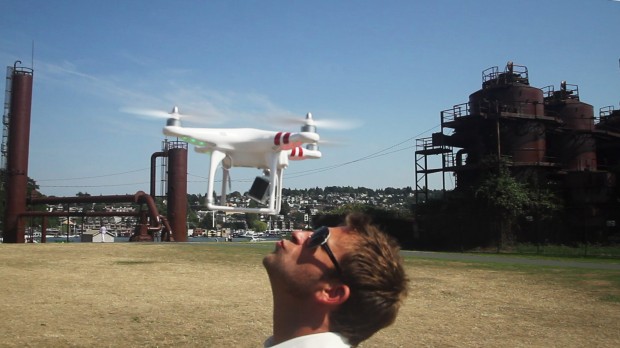
Photographer Chase Jarvis with a drone at Gas Works Park in Seattle.

Drones should face the equivalent of crash-test dummies to gauge how safe they are for flying around people, a panel appointed by the Federal Aviation Administration said in a report released today.

The recommendations from the Micro UAS Aviation Rulemaking Committee laid out a wide range of conditions for letting drones, also known as unmanned aircraft systems, fly close to the uninvolved public. Such flights are not allowed under a different set of regulations that are due for release within the next few months.

The committee, which includes industry representatives and other stakeholders, finished its report in less than a month. “We commend the committee members for their sincere dedication and for producing a comprehensive report in such a short time,” FAA Administrator Michael Huerta said in a statement.

Get the full story on GeekWire.

Categories
GeekWire

Zipline drone venture is on a medical mission

Image: Zip drone plane
Zipline’s fixed-wing Zip drone airplane makes a flyover. (Credit: Zipline)

A drone delivery venture called Zipline International is coming out of stealth mode with backing from big-name investors and a humanitarian mission in mind.

During a Bay Area demo broadcast via Periscope, Zipline CEO Keller Rinaudo and other executives showed how they plan to use mini-planes launched with compressed air to deliver blood and medical supplies in Rwanda starting in July.

Zipline has been working on a fleet of 15 electric-powered, GPS-guided Zip drones for a couple of years, but the startup has been flying under the radar (so to speak) until this month.

Rinaudo says the San Francisco startup has raised $18 million in funding from investors including Microsoft co-founder Paul Allen, Yahoo founder Jerry Yang, Sequoia Capital, Google Ventures and Stanford University. (Much of that investment came during Zipline’s previous incarnation as Romotive.) Zipline’s employees are said to include aerospace engineers from NASA, SpaceX, the Boeing Co. and Lockheed Martin.

Categories
GeekWire

Flirtey makes a milestone urban drone delivery

Image: Flirtey drone
Flirtey’s hexacopter hovers over Nevada during a drone delivery test. (Credit: Flirtey)

A startup named Flirtey says it’s executed the first FAA-approved urban drone delivery in the United States, in a test that could blaze a trail for Amazon and other companies that want to do the same thing.

The GPS-guided drop-off to an unoccupied house took place on March 10 in Hawthorne, Nev. The package of supplies, including bottled water, emergency food supply and a first-aid kit, was lowered by a rope to the house’s front porch from a hovering hexacopter. A drone pilot and several visual observers were on standby in case something went wrong, but they weren’t needed, the company said.

“Conducting the first drone delivery in an urban setting is a major achievement, taking us closer to the day that drones make regular deliveries to your front doorstep,” Flirtey CEO Matt Sweeny said today in a news release about the test.

Flirtey has already used drones to deliver textbooks in Australia and auto parts inNew Zealand, but its grand plan is to crack the market in the United States. That’s why it’s been participating in limited tests sanctioned by the Federal Aviation Administration at specified sites. Last July, Flirtey conducted a similar test for rural drone delivery in Virginia.

Get the full story on GeekWire.

Categories
GeekWire

Navy investigates mystery drone sighting

Image: Drone
Drones are raising issues as they become more widespread. (Credit: DJI)

The Navy has confirmed that it’s investigating the illegal flight of an unidentified drone over Naval Base Kitsap-Bangor, the home base for Trident submarines that carry nuclear weapons.

In an email, Navy spokeswoman Silvia Klatman said the drone was sighted in prohibited airspace by a civilian employee on Feb. 8.

“Any operation over the base without prior permission and coordination with appropriate authorities is both illegal and hazardous,” she said. “It’s our intent to support the investigation and prosecution of this reported act, and any others that may occur, in coordination with civilian law enforcement.”

The Seattle Times and the Kitsap Sun quoted a nearby resident, Al Starcevich, as saying that he and his neighbors were interviewed by investigators last week, and that he was told there were repeated drone flights at night.

Get the full story on GeekWire.

Categories
GeekWire

How much should drones and people mix?

Image: Photographer with drone
Photographer Chase Jarvis with a drone at Gas Works Park in Seattle.

What are the rules for letting a drone get in your face? Right now, there are no rules, but today the Federal Aviation Administration said it’s setting up a committee to come up with a proposal.

The announcement marks the latest step in the FAA’s effort to get a handle on the rapidly rising fleets of small drones, also known as unmanned aircraft systems or UAS.

A year ago, regulators issued draft rules for the operation of commercial drones, like the ones Amazon is working on for package deliveries. Last December, the FAA set up a system for registering recreational drones. Now the FAA and industry representatives will be taking on one of the thornier questions relating to drones: How close can they get to the folks who aren’t operating them?

The newly announced aviation rulemaking committee is due to begin its work in March, and issue its final report to the FAA on April 1.

Get the full story on GeekWire.